

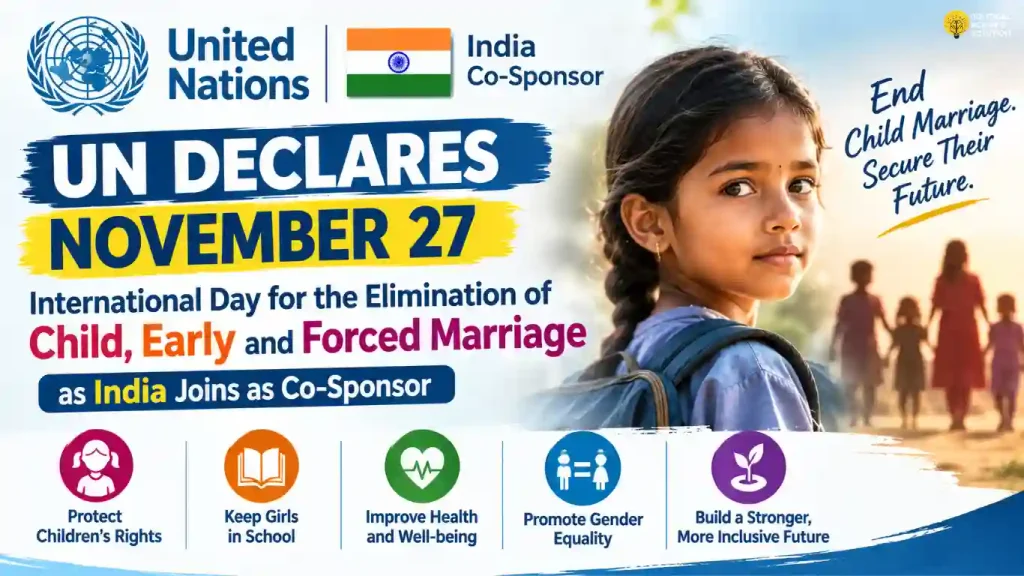
New Delhi: The United Nations General Assembly has declared November 27 the International Day for the Elimination of Child, Early and Forced Marriage, creating a dedicated annual platform for global action against the practice. The resolution was adopted by consensus on September 4, with Sierra Leone leading the initiative and India among the co-sponsoring nations. The move elevates long-standing efforts to end child marriage and links them directly to measurable progress toward Sustainable Development Goal 5.3, which seeks the elimination of harmful practices including child, early and forced marriage by 2030.
The chosen date holds particular resonance for India. It marks the anniversary of the launch of the Bal Vivah Mukt Bharat, or Child Marriage Free India, campaign by the Union government in 2024. What began as a domestic drive has now been formally recognized on the international stage, giving Indian stakeholders an annual milestone against which to track results and strengthen accountability.
Background to the Resolution and Key Voices Behind It
The demand for a specific international day was first raised at the United Nations Commission on the Status of Women in March 2026 by Bhuwan Ribhu, founder of Just Rights for Children. Approximately six months later the proposal reached the General Assembly. Sierra Leone submitted the resolution, backed by Dr Fatima Maada Bio, First Lady of Sierra Leone, and other international leaders. India joined as a co-sponsor. Reports of the number of co-sponsoring countries vary slightly across accounts, with figures of 50, 66 and more than 67 nations cited at different stages of the process.
Ribhu was the only civil society representative present when the resolution was adopted. In a virtual press briefing afterwards he described the outcome as the beginning of the end of child marriage and a tipping point that makes the end of the crime both inevitable and imminent. He stressed that November 27 must not remain a symbolic date. Countries, he said, will need national action plans, measurable indicators and clear accountability mechanisms if the declaration is to produce lasting change. “This is the beginning of the end of child marriage,” he stated, adding that governments globally must now provide decisive leadership to end the practice by 2030.
Ribhu also framed the day as a moment of pride for India. The Child Marriage Free India campaign, which started with children and communities, has become an international observance accepted by the world. He thanked the children, community leaders, faith leaders and NGO partners whose work made the resolution possible, and expressed particular gratitude to the First Lady of Sierra Leone for her leadership. “The world is looking at us, and our work has only just begun,” he said.
The resolution itself calls for stronger laws and more consistent enforcement, greater investment in girls’ education and protection, and deeper community participation. It positions the annual observance as a recurring opportunity to measure progress, identify children at risk of dropping out of school or being married early, and ensure they receive timely support.
India’s Challenge, Progress and Practical Interventions
Despite the international recognition, India continues to face a substantial challenge. National Family Health Survey-6 data for 2023–24 show that 20.1 percent of women aged 20–24 were married before the age of 18. That figure is down from 23.3 percent recorded in NFHS-5 for 2019–21, indicating measurable improvement yet underscoring the scale of remaining work.
Poverty, school dropout, social norms and migration often interact to push children into early marriage. Just Rights for Children has consistently argued that keeping children in school is one of the most effective protective measures. Attendance monitoring systems and mechanisms to identify and re-enrol children who leave school can interrupt the pathway that frequently leads to child marriage.
According to the organisation, its partners have prevented or stopped more than 5.5 lakh child marriages in India and helped identify and enrol more than 12 lakh out-of-school children. These figures, shared during the post-adoption briefing, demonstrate the practical impact of coordinated education and protection efforts already under way. Ribhu emphasised that the new international day should now translate into sustained action by governments, schools, local administrations and communities so that children at risk are identified early and supported effectively.
The declaration therefore sits at the intersection of global commitment and national responsibility. By anchoring the observance to the original launch date of Bal Vivah Mukt Bharat, it gives India a clear annual reference point for assessing domestic results while reinforcing the country’s role as a co-sponsor of the United Nations resolution. Continued focus on education, enforcement of existing laws, community engagement and reliable data will determine whether the new day becomes a genuine catalyst for reducing child, early and forced marriage or remains largely ceremonial. The expectation set on September 4 is that governments, including India’s, will use the platform to accelerate progress toward the 2030 target and beyond.
FAQs
1. When was the UN resolution declaring November 27 as the International Day for the Elimination of Child, Early and Forced Marriage adopted?
The United Nations General Assembly adopted the resolution by consensus on September 4. Sierra Leone led the initiative and India was among the co-sponsors.
2. Why was November 27 selected as the date?
The date marks the launch of India’s Bal Vivah Mukt Bharat (Child Marriage Free India) campaign by the Union government in 2024. The demand for a dedicated international day was first raised by Bhuwan Ribhu, founder of Just Rights for Children, at the UN Commission on the Status of Women in March 2026.
3. How many countries co-sponsored the resolution and who were the key figures involved?
Reports cite between 50 and more than 67 co-sponsoring nations. Sierra Leone submitted the resolution with support from First Lady Dr Fatima Maada Bio. India co-sponsored it. Bhuwan Ribhu was the only civil society representative present at the adoption and described the outcome as the beginning of the end of child marriage.
4. What do recent data show about child marriage prevalence in India?
NFHS-6 (2023–24) data show that 20.1 percent of women aged 20–24 were married before the age of 18, down from 23.3 percent in NFHS-5 (2019–21). Just Rights for Children and its partners report preventing or stopping more than 5.5 lakh child marriages and helping identify and enrol more than 12 lakh out-of-school children.
5. How is the new International Day linked to global goals and what actions does it call for?
It is connected to Sustainable Development Goal 5.3, which aims to eliminate child, early and forced marriage by 2030. The resolution calls for stronger laws and enforcement, investment in girls’ education and protection, and greater community participation. Advocates stress the need for national action plans, measurable indicators, accountability mechanisms, and sustained efforts by governments, schools, local administrations and communities.