

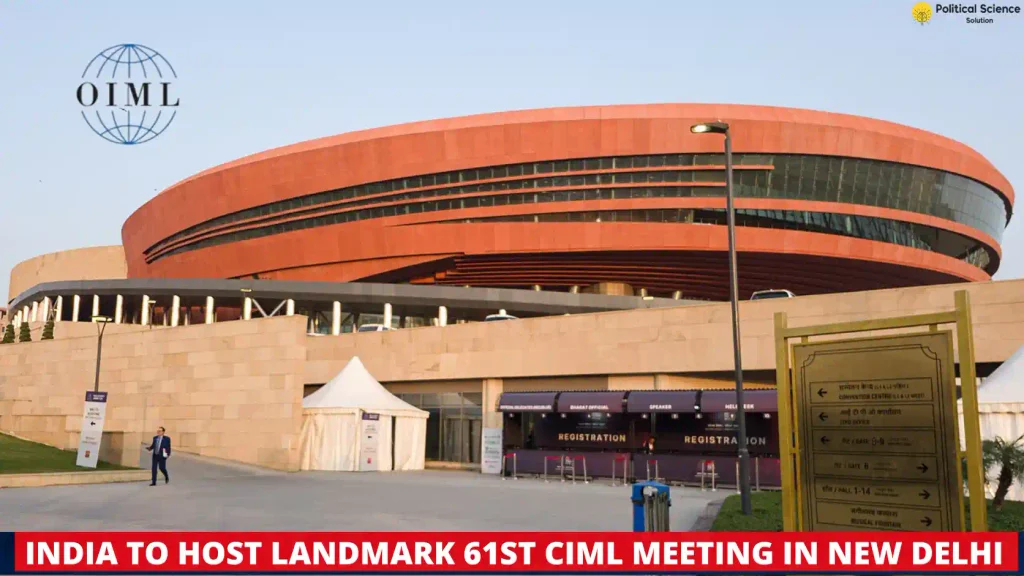
New Delhi: India is preparing to welcome the world of legal metrology to its capital for a historic gathering that underscores the country’s rising influence in international standards-setting. For the first time, New Delhi will host the 61st Meeting of the International Committee of Legal Metrology (CIML) from October 26 to 28, 2026. Organised by the Department of Consumer Affairs in collaboration with the International Organization of Legal Metrology (OIML), the three-day event will draw more than 100 international delegates and legal metrology experts. Discussions will centre on harmonising measurement standards, advancing digital transformation, strengthening fair trade practices, and enhancing consumer protection worldwide.
The meeting represents a significant step in India’s engagement with global measurement systems. Representatives from OIML member states, corresponding member states, and international organisations are expected to attend. Delegates from France, Germany, the United Kingdom, Japan, China, Australia, Switzerland, the United States, South Africa, and Brazil are among those confirmed or anticipated. The gathering will enable participants to share experiences and best practices aimed at modernising legal metrology frameworks across borders.
Opening Focus: International Seminar on Evolutions in Legal Metrology
The programme begins on October 26 with an international seminar titled “Evolutions in Legal Metrology.” This session will examine the modernisation of legal metrology systems in detail. Key topics include the digitalisation of regulatory services, international recognition of measuring instruments, the development and use of e-learning tools, and innovative approaches to regulatory administration. Experts will explore how technology can streamline compliance while maintaining rigorous standards for accuracy and fairness in measurements used in trade, industry, healthcare, safety, and environmental protection.
The seminar sets the stage for deeper technical and policy conversations that follow. By bringing together practitioners from diverse regulatory environments, it aims to identify practical solutions that countries can adapt to their own contexts. India’s own recent reforms in simplifying compliance procedures and promoting trust-based regulation will feature prominently as a case study for participants seeking efficient models.
Strategy Workshop and Core CIML Deliberations
On October 27, an OIML Strategy Workshop will provide a dedicated platform for countries and experts to shape the organisation’s future direction. Participants will address emerging technological challenges, evolving regulatory requirements, and long-term priorities for the OIML. This workshop is designed to ensure the organisation remains responsive to rapid changes in measurement technology and global trade dynamics.
The formal CIML sessions will occupy the core of the three-day agenda. Members will review the development and revision of international recommendations—technical documents that guide the design, testing, and use of measuring instruments. Technical activities of the OIML, the operation and expansion of the OIML Certification System (OIML-CS), capacity-building initiatives, and broader international cooperation will all come under discussion. These conversations are expected to produce concrete outcomes that support stronger, more interoperable measurement systems globally.
Context from the Previous Meeting in Paris
The 60th CIML Meeting took place in Paris, France, on October 13 and 15, 2025. It attracted representatives from 55 member states, 12 corresponding members, and five organisations in liaison. Among the key outcomes were the approval of technical publications covering automated refractometers, weights, and traffic speed meters. Delegates also advanced discussions on the framework for the OIML Certification System, digitalisation efforts, and mechanisms for international cooperation. The New Delhi meeting builds directly on this foundation, carrying forward unfinished work while introducing fresh perspectives from India’s regulatory experience.
India’s Growing Role and Domestic Reforms
Hosting the CIML meeting for the first time allows India to showcase reforms undertaken by the Department of Consumer Affairs. These reforms focus on modernising the legal metrology framework, simplifying compliance procedures, promoting trust-based regulation, and improving the ease of doing business—all while reinforcing consumer protection. Officials note that greater harmonisation of measurement requirements can help Indian manufacturers better understand international standards, conformity assessment procedures, and certification requirements.
A particularly practical benefit stems from India’s status as an OIML Certification Authority. Domestic manufacturers can now obtain internationally accepted OIML certificates within the country rather than relying on foreign authorities. This capability reduces costs and timelines for exporters and supports wider market access. The OIML Certification System itself helps manufacturers by facilitating recognition of measuring instruments and, where applicable, reducing duplication in testing and certification.
For consumers, the stakes are equally clear. Accurate and reliable measurements underpin fair transactions, correct quantity declarations, and confidence in goods and services. Whether at the petrol pump, in retail packaging, or in medical and environmental monitoring, trusted metrology systems protect everyday economic interactions. The New Delhi meeting will reinforce these principles on a global stage while giving India an opportunity to contribute its digitalisation and reform experiences to the collective knowledge base.
Background on the OIML and the Role of the CIML
The International Organization of Legal Metrology was established in 1955 as an intergovernmental body dedicated to the international harmonisation of legal metrology procedures. It develops recommendations, standards, and related documents for measuring instruments used across trade, industry, healthcare, safety, and environmental protection. The organisation’s work helps ensure that measurements performed in one country are accepted and understood in another, reducing technical barriers to trade and supporting economic fairness.
The CIML functions as the OIML’s principal decision-making body. It oversees the organisation’s technical and administrative activities and convenes annually to address policy matters, technical developments, and international cooperation. The annual meeting serves as the primary forum where member states shape the direction of global legal metrology. By hosting the 61st session, India positions itself at the centre of these deliberations and strengthens its voice in the ongoing evolution of measurement standards.
Expected Outcomes and Broader Significance
Participants anticipate that the New Delhi meeting will facilitate meaningful exchange of technical expertise and best practices. Strengthened measurement systems and wider adoption of internationally recognised standards are among the hoped-for results. Discussions on digital transformation are likely to accelerate the shift toward more efficient, transparent, and accessible regulatory services. Capacity-building conversations will help countries at different stages of development improve their institutional frameworks.
The event also aligns with India’s longer-term vision of Viksit Bharat 2047. Reliable measurement infrastructure supports fair trade, technological innovation, and consumer confidence—elements essential to sustained economic growth and global competitiveness. By demonstrating leadership in hosting and contributing to the CIML, India reinforces its commitment to these goals.
Officials from the Department of Consumer Affairs have emphasised that the presence of more than one hundred international delegates creates a unique platform for dialogue. The combination of the seminar, strategy workshop, and formal CIML sessions ensures that both high-level policy issues and practical technical questions receive attention. Outcomes from the meeting are expected to influence the revision of international recommendations and the further development of the OIML Certification System in the years ahead.
Looking Ahead
As the first CIML meeting held on Indian soil approaches, preparations are focused on creating an environment conducive to productive exchange. The Department of Consumer Affairs, working closely with the OIML, aims to deliver a programme that balances formal decision-making with opportunities for informal networking and knowledge sharing. Delegates will leave with deeper insights into India’s reform journey and a clearer picture of how digital tools and trust-based approaches can modernise legal metrology worldwide.
The 61st CIML Meeting in New Delhi from October 26 to 28, 2026, marks more than a logistical achievement. It signals India’s readiness to play an active role in shaping the global rules that govern measurement accuracy, trade fairness, and consumer trust. Through careful attention to technical detail, strategic priorities, and international cooperation, the gathering has the potential to advance legal metrology standards for the benefit of manufacturers, regulators, and consumers across continents.
In an interconnected economy where precise measurement underpins everything from commodity trade to public health monitoring, the work of the CIML remains indispensable. India’s hosting of this landmark session places the country at the heart of that essential global conversation.
FAQs
1. When and where will the 61st Meeting of the International Committee of Legal Metrology (CIML) take place?
The 61st CIML Meeting will be held in New Delhi, India, from October 26 to 28, 2026. This is the first time India is hosting the annual meeting of the International Committee of Legal Metrology.
2. Who is organising the event and who will attend?
The Department of Consumer Affairs is organising the meeting in collaboration with the International Organization of Legal Metrology (OIML). More than 100 international delegates and legal metrology experts are expected, including representatives from OIML member states such as France, Germany, the United Kingdom, Japan, China, Australia, Switzerland, the United States, South Africa, and Brazil, along with corresponding members and international organisations.
3. What are the main topics that will be discussed during the three-day meeting?
Key discussions will cover digitalisation of regulatory services, international recognition of measuring instruments, e-learning tools, innovative regulatory approaches, development and revision of international recommendations, the OIML Certification System (OIML-CS), capacity building, and international cooperation. An international seminar on “Evolutions in Legal Metrology” will be held on October 26, followed by an OIML Strategy Workshop on October 27.
4. How does hosting this meeting benefit India and its stakeholders?
It allows India to showcase reforms in modernising its legal metrology framework, simplifying compliance, and promoting trust-based regulation. Indian manufacturers benefit from easier access to internationally accepted OIML certificates issued within the country, improved awareness of global standards, and reduced duplication in testing. Consumers gain from stronger systems that ensure accurate measurements, fair transactions, and greater confidence in goods and services. The event also supports India’s broader Viksit Bharat 2047 vision.
5. What is the background of the OIML and the previous CIML meeting?
The OIML was established in 1955 as an intergovernmental organisation to promote the international harmonisation of legal metrology procedures and develop standards for measuring instruments used in trade, industry, healthcare, safety, and environmental protection. The CIML is its principal decision-making body. The 60th meeting was held in Paris, France, on October 13 and 15, 2025, with participation from 55 member states, 12 corresponding members, and five organisations in liaison. Key outcomes included approval of technical publications on automated refractometers, weights, and traffic speed meters.