

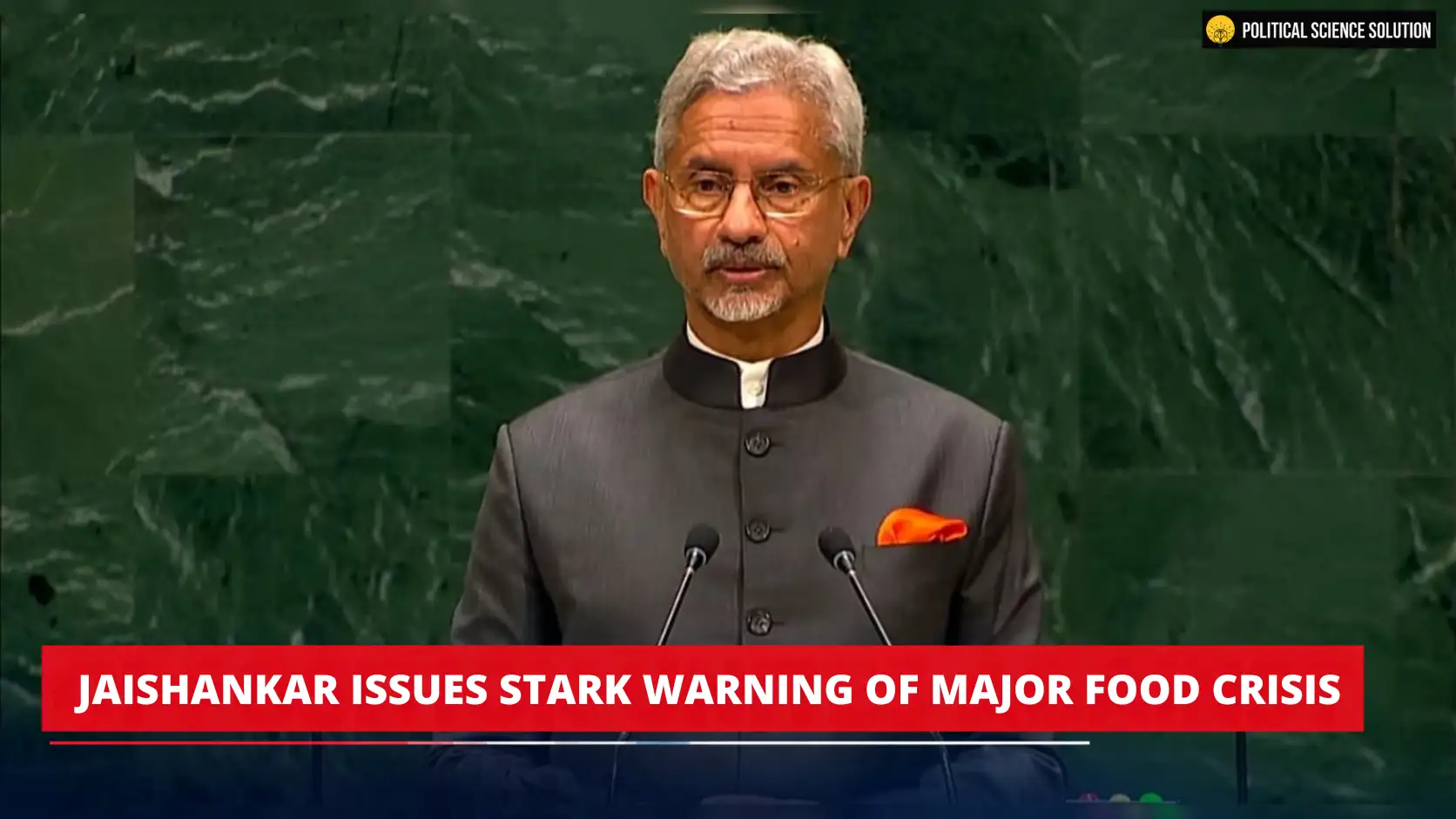
New Delhi: External Affairs Minister S. Jaishankar has delivered a blunt assessment of mounting global pressures, cautioning that the world faces a major food crisis in the coming months driven by disruptions linked to the Ukraine conflict and the Iran-Gulf confrontation. Speaking at an Asia Society event in New York on Monday following the United Nations General Assembly high-level week, the minister described the combined effects of strained energy markets, fertiliser shortages, restricted grain shipments, climate pressures, and shifting financial flows as “very very stressful” for economies across the Global South.
Twin Conflicts Create Devastating Impact on Developing Nations
Jaishankar framed the Ukraine war and the Iran-Gulf conflict as having produced a devastating impact on Global South economies. He emphasised that these two ongoing confrontations have generated cascading effects far beyond the immediate theatres of conflict. Developing nations, many of which rely heavily on imported essentials, find themselves absorbing the secondary shocks of higher prices, constrained supplies, and reduced policy space. The minister positioned this as a central concern for India and other countries seeking to navigate an increasingly fragmented global environment.
Black Sea Grain Shipments Face Major Disruptions
A core element of the warning centres on grain trade. Jaishankar stated that the world is looking at a situation where some of the major grain exporters will not be able to send out their shipments, particularly those moving out through the Black Sea. This logistical bottleneck threatens to reduce the volume of cereals available on international markets at a time when demand remains firm. Import-dependent countries in Asia, Africa, and elsewhere stand to feel the effects most directly through tighter supplies and elevated prices.
Fertilizer Production Shortfalls in West Asia and Russia
Fertiliser availability forms the second critical pillar of the emerging food challenge. The minister noted that the world is witnessing significant fertiliser shortages because key producers are located in West Asia and Russia, and their production has been impacted by the conflicts. Reduced output of essential agricultural inputs raises costs for farmers globally and risks lower yields in subsequent planting seasons. For nations that depend on imported fertilisers to sustain domestic food production, the shortage translates into both immediate price pressure and longer-term productivity concerns.
Energy Markets Remain Tight Amid Political Complications
Jaishankar highlighted particular concern over the energy situation, describing the market as very tight. He warned that political decisions affecting oil supplies could further complicate matters and drive prices higher at a moment when stabilisation is urgently needed. Part of the difficulty, he explained, lies in the security of oil supplies, while another part stems from the politics of oil supplies. These two factors are feeding into each other and creating a double crisis or an aggravated crisis. The resulting volatility affects transport costs, industrial production, and household energy bills across the developing world.
Super El Niño Climate Patterns Amplify Food Risks
The minister linked these conflict-driven pressures to adverse climate patterns, specifically the possibility of a super El Niño. When fertiliser shortages and restricted grain shipments combine with climate-induced reductions in agricultural output, the conditions for a major food crisis in the coming months become significantly more likely. Climate variability has long been recognised as a risk multiplier for food systems; its interaction with geopolitical disruptions narrows the margin for effective response.
Financial Capital Flows Away from the Global South
Beyond physical commodities, Jaishankar pointed to financial dynamics that compound the stress. Every time conflict erupts, money tends to move toward safe harbours and away from the Global South. This redirection of capital reduces the financing available to developing economies precisely when they need resources to cushion food and energy shocks. Higher borrowing costs or restricted access to credit limit the ability of governments to support vulnerable populations or invest in domestic agricultural resilience.
Policymakers Cannot Claim Unintended Consequences
The External Affairs Minister rejected any attempt by decision-makers to distance themselves from the wider fallout of their choices. Countries should not be so self-centred that they operate within their own world, take decisions, and then assert that it was never their intention to make life difficult for others. Sound common sense, he argued, requires that the basic needs of a large number of countries not be neglected to the point of placing them in distress situations. This remains a fundamental concern for India.
Energy Crisis Risks Feeding Political Instability
Jaishankar also warned that the energy crisis is already creating instability. The period following the Ukraine war produced direct results in the form of political instability within India’s neighbourhood. He expressed fear that developments in Iran and the Gulf would feed into and aggravate those same pressures. The linkage between energy scarcity, price spikes, and domestic political strain has been observed before; the current configuration of conflicts raises the probability of similar outcomes in vulnerable regions.
Strategic Autonomy Faces Uneven Pressures
On the question of national independence, the minister offered a measured assessment. Some countries will obviously maintain their independence and autonomy despite the pressures generated by global conflicts. Others will find it harder to do so. Those that remain autonomous would like to see more countries join that category. The situation is not black and white. Outcomes will depend on the specific issue and the stakes involved. In some cases countries will make adjustments; in others they will fight back.
Global Food Price Indicators Already Signal Strain
Independent data released in early September underscore that food markets were under pressure even before the latest conflict-related disruptions fully intensified. The FAO Food Price Index stood at 133.3 in August 2026, its highest level since November 2022. The index rose 1.9 percent from July and 2.5 percent on a year earlier. Cereal prices increased 2.2 percent to their highest since May 2024. Sugar recorded an 11.9 percent monthly jump, reaching levels last seen in June 2025. Vegetable oil prices edged higher as well. World cereal production for 2026 is forecast at 2.98 billion tonnes, approximately 2 percent below the previous year, though still the second-largest on record and well below the March 2022 peak. These figures illustrate an environment of elevated prices and constrained production growth against which new supply disruptions arrive.
Cumulative Burden Hits Import-Dependent Economies Hardest
For Global South countries the combined weight of these factors is particularly severe. Many nations depend on imported grains, fertilisers, and energy. Interruptions in Black Sea shipments directly affect food availability. Reduced fertiliser output from West Asia and Russia raises input costs and threatens future harvests. Tight energy markets inflate the cost of transport, processing, and irrigation. Capital flight toward perceived safe assets shrinks the financing available for essential imports and domestic investment. When these pressures coincide with climate shocks, the risk of widespread food insecurity rises sharply.
India’s Consistent Emphasis on Differential Impacts
Jaishankar’s intervention reflects India’s longstanding emphasis on the uneven distribution of costs arising from major power conflicts. Decisions taken far from the Global South can translate into higher food and fuel prices, reduced agricultural productivity, and political strain in countries that played no role in initiating the confrontations. The call for greater attention to basic needs forms both a diagnosis of current risks and a prescription for more responsible international conduct.
Interconnected Risks Demand Coordinated Attention
The energy dimension receives particular focus because of its dual character. Physical security of supply matters, yet political choices that restrict or redirect oil flows can amplify scarcity and price volatility. In a market already described as very tight, such politics introduce additional uncertainty at a time when stabilisation would benefit the largest number of consumers. Parallel logic applies to fertilisers and grains: production and logistics disruptions do not remain localised; they transmit through global markets and hit hardest those with the least capacity to absorb higher costs.
Climate remains an uncontrollable variable that interacts with human decisions. A super El Niño can suppress yields, reduce water availability, and intensify weather extremes. When layered onto conflict-driven supply constraints, the space for effective policy response contracts. Policymakers, the minister suggested, cannot reasonably claim surprise at resulting distress if they have disregarded these interconnections.
The financial channel operates more quietly but with comparable force. Risk aversion during geopolitical tension channels capital toward assets viewed as secure, often located in developed markets. Developing economies then confront higher borrowing costs or reduced credit access exactly when resources are required to cushion shocks. The net result, as characterised by Jaishankar, is a very stressful environment for Global South countries.
Outlook for the Months Ahead
As the coming months unfold, the interaction of these factors will determine the scale of the projected food crisis. The ability of grain exporters to move cargoes through the Black Sea, the trajectory of fertiliser production in West Asia and Russia, the evolution of oil markets, the intensity of El Niño conditions, and the direction of global capital flows will all shape outcomes. For economies already operating under strain, the cumulative impact remains the central concern articulated by India’s External Affairs Minister.
Jaishankar’s assessment leaves little room for ambiguity. The combination of energy pressures, food and fertiliser shortages, and financial redirection is generating conditions that are very stressful for developing nations. The insistence on sound common sense and attention to basic needs stands as both analysis and appeal. Whether that message influences policy choices in the capitals most directly involved in the conflicts will help determine the severity of the challenges that lie ahead.
FAQs
1. What exactly did External Affairs Minister S. Jaishankar warn about at the Asia Society event in New York?
Jaishankar cautioned that the world is heading toward a major food crisis in the coming months. He linked this risk directly to the ongoing Ukraine conflict and the Iran-Gulf confrontation, which have disrupted grain shipments, reduced fertiliser production, tightened energy markets, and redirected financial flows away from developing nations. He described the overall impact on Global South economies as “very very stressful.”
2. Why are Black Sea grain shipments a central concern in Jaishankar’s assessment?
The minister highlighted that some major grain exporters may be unable to send out their shipments, particularly those moving through the Black Sea. These disruptions threaten to reduce the volume of cereals available on global markets, raising prices and limiting access for import-dependent countries across the Global South at a time when food security is already under pressure.
3. How do fertiliser shortages and climate patterns contribute to the projected food crisis?
Key fertiliser producers located in West Asia and Russia have seen their output affected by the conflicts, creating significant global shortages. When these supply constraints combine with adverse climate patterns such as a super El Niño, agricultural productivity is likely to decline further. Jaishankar warned that this combination could trigger a major food crisis in the months ahead.
4. What did Jaishankar say about the energy market and its broader consequences?
He described the energy market as already “very tight.” Political decisions affecting oil supplies risk driving prices higher when stabilisation is needed. He distinguished between the security of oil supplies and the politics surrounding them, noting that the two factors are feeding into each other and creating a double or aggravated crisis. He also linked the energy crunch to potential political instability, recalling similar effects seen in India’s neighbourhood after the Ukraine war and expressing concern that the Iran-Gulf situation could worsen those pressures.
5. How did Jaishankar address the issue of national autonomy and the responsibility of policymakers?
He observed that some countries will maintain their independence and autonomy despite the pressures, while others will find it harder. Those that remain autonomous would like to see more countries able to do the same; the situation is not black and white and will depend on specific issues and stakes. On responsibility, he stressed that countries should not be so self-centred as to take decisions and then claim that causing hardship elsewhere was never their intention. Sound common sense, he said, requires that the basic needs of many nations not be neglected to the point of placing them in distress.