
New Delhi: The General Debate of the 81st session of the United Nations General Assembly concluded on Monday, September 28, 2026, at United Nations headquarters in New York. Bangladesh’s Foreign Minister and President of the 81st General Assembly, Khalilur Rahman, delivered the closing remarks that captured both the scale of participation and the depth of the challenges facing the world body. A total of 194 delegations took part in the debate. Speakers included 113 heads of state and government, one crown prince, 11 vice presidents, seven deputy prime ministers and 48 ministers. Discussions ranged across peace, development, human rights, UN reform and the selection of the next secretary-general. Artificial intelligence, previously treated as a peripheral issue, moved firmly into the centre of this year’s conversations.
The official theme of the session, “Restoring trust, managing transformation: A United Nations that delivers for all,” resonated throughout the speeches. Rahman urged member states to refuse to abandon the pursuit of peace, to commit resolutely to sustainable development, to defend human rights principles without selectivity, to guide technological transformation in the service of humanity, to pursue reform that is meaningful, representative and fair, and to rebuild an organisation capable of delivering for every nation.
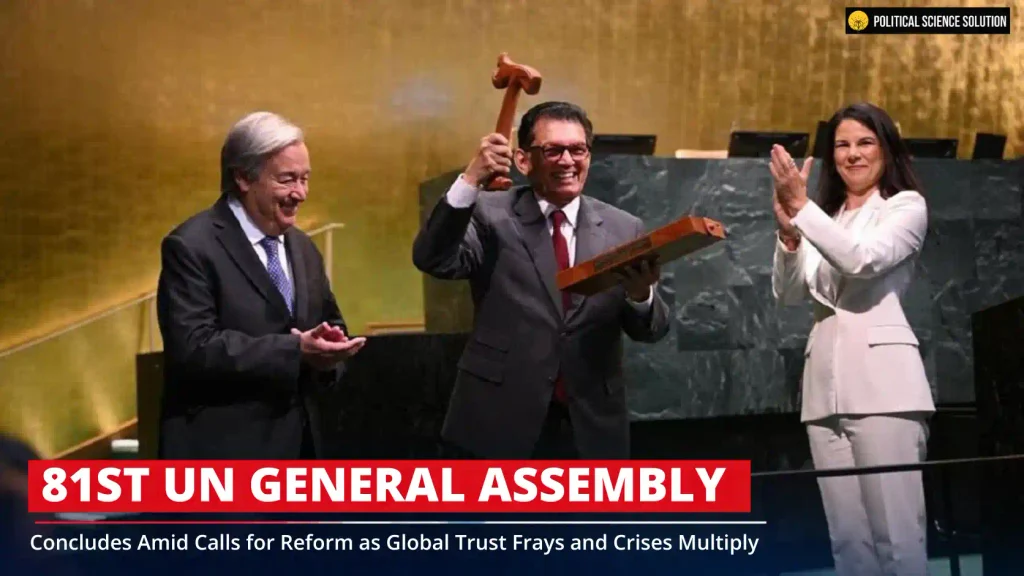
Guterres’ Final Session Highlights Deepening Global Strain
This year’s General Assembly carried unusual significance because it marks the final session for United Nations Secretary-General António Guterres. His tenure has coincided with an extraordinary concentration of crises: multiple armed conflicts, pandemics, climate disasters and the rapid rise of artificial intelligence as a strategic factor in international affairs. Research recorded more than 65 conflicts across 35 countries in 2025, the highest number since 1946. Growing polarisation on nearly every major global issue, wars conducted by major powers in ways that challenge the UN Charter, nuclear threats and the imposition of unilateral sanctions have left the organisation looking overweight, weakened and insufficiently representative of the contemporary world.
The combination of these pressures has made the 81st session a critical moment for member states to unite behind a strengthened and reformed United Nations while beginning the process of selecting the next secretary-general. That individual will guide the organisation through the next decade. South Asia holds particular institutional weight this year because Bangladesh’s Foreign Minister Khalilur Rahman was elected President of the 81st session and will oversee the secretary-general selection process.
Sharp Divisions Dominate High-Level Speeches
The high-level speeches reflected deep divisions rather than consensus solutions. United States President Donald Trump spoke of the possible “annihilation” of Iran and defended American actions in Venezuela. He again claimed credit for negotiating peace in several conflicts, including the four-day India-Pakistan war of 2025, an assertion that has drawn strong objections from New Delhi. Iranian President Masoud Pezeshkian described the United States and Israel as “murderers, terrorists and assassins” and declared that Iran would not yield to what he termed bullying. Russian President Vladimir Putin did not attend the session. The United States denied visas to the Palestinian delegation, preventing its participation.
An initiative known as the Partnership for Multilateralism, or P4M, was advanced by the European Union and several other countries and co-sponsored by India. The partnership seeks to strengthen multilateral cooperation beyond the dominance of any single superpower. Although the effort is widely regarded as constructive, it was largely overshadowed by the confrontational tone that characterised much of the debate.
India’s Dual Priorities at the 81st Session
India approached the session with two clear priorities. The Narendra Modi government formally launched its campaign for a second consecutive two-year non-permanent seat on the United Nations Security Council for the 2028-29 term. External Affairs Minister S. Jaishankar was scheduled to address the high-level segment of the 81st General Assembly on the same day the General Debate concluded. The United Nations has framed the session around revitalising global cooperation, advancing the Sustainable Development Goals and promoting collective action for peace, dignity and equality.
Prime Minister Narendra Modi chose not to deliver a speech at the General Assembly or to attend the multilateral summits held on the sidelines, even though he had just hosted the BRICS Summit in Delhi. The decision surprised some observers. India’s long-standing position as a balancing power that advocates a rules-based international order grounded in the UN Charter, diplomacy and dialogue is viewed by many as especially relevant at a time of heightened global tension and competing narratives about recent conflicts.
Artificial Intelligence and Broader Agenda Items Take Centre Stage
Artificial intelligence received sustained attention throughout the General Debate. Delegates examined both the opportunities and the risks associated with rapid advances in the technology, including questions of governance, accountability and the potential for AI systems to worsen existing inequalities or contribute to new forms of conflict. The prominence of the topic marked a clear shift from earlier sessions in which AI appeared mainly on the margins of discussions.
Human rights, sustainable development and peacekeeping also featured prominently. Speakers repeatedly linked progress on the Sustainable Development Goals to the need for predictable financing, stronger institutions and reduced geopolitical friction. Several interventions highlighted the human cost of prolonged conflicts and the strain placed on humanitarian systems worldwide.
Selection of Next Secretary-General and Path to Reform
The election of the next secretary-general stands as one of the defining tasks of the 81st session under Rahman’s presidency. The process will test the ability of member states to move beyond narrow national interests and identify a candidate capable of navigating an increasingly fragmented international environment. India’s campaign for a non-permanent Security Council seat underscores its continued investment in the United Nations system even as it presses for institutional reform.
As the General Debate concluded, the practical work of the session continues. Committees will examine specific resolutions, the secretary-general selection process will advance, and member states will keep negotiating reform proposals. Rahman’s closing remarks captured both the ambition and the difficulty of the moment: an insistence that the United Nations must still deliver for all, even as trust remains fragile and the global landscape grows more contested.
Why the 81st Session Matters for the Future of Multilateralism
The 81st session has crystallised long-standing questions about the organisation’s capacity, legitimacy and direction. Critics argue that the United Nations has grown cumbersome and that its decision-making structures no longer reflect the distribution of power and population in the twenty-first century. Supporters of reform, including those behind the Partnership for Multilateralism, insist that only a more representative and effective United Nations can restore the trust that member states say has eroded.
Whether the calls for meaningful reform, greater representation and renewed commitment to the UN Charter translate into concrete institutional change will shape the effectiveness of the United Nations in the decade ahead. For now, the record of participation, the intensity of the exchanges and the explicit focus on restoring trust stand as the defining features of a General Assembly that could not be dismissed as routine. The combination of Guterres’ final appearance, record conflict levels, sharp rhetorical clashes and the formal launch of India’s Security Council campaign has ensured that the 81st session will be remembered as a moment of both urgency and opportunity for the world’s premier multilateral institution.
FAQs
1. Why is the 81st session of the UN General Assembly considered especially significant?
The 81st session marks the final General Assembly for Secretary-General António Guterres after a tenure defined by record global crises, conflicts, pandemics, climate disasters and the rise of artificial intelligence. Research recorded more than 65 conflicts across 35 countries in 2025, the highest number since 1946. Growing polarisation, wars challenging the UN Charter, nuclear threats and unilateral sanctions have left the organisation looking overweight, weak and unrepresentative. The session is therefore seen as a critical moment to push for meaningful reform and to begin selecting the next secretary-general who will lead the UN for the coming decade.
2. Who presided over the 81st UN General Assembly and what were the key participation figures?
Bangladesh’s Foreign Minister Khalilur Rahman served as President of the 81st General Assembly and delivered the closing remarks. A total of 194 delegations took part in the General Debate. Speakers included 113 heads of state and government, one crown prince, 11 vice presidents, seven deputy prime ministers and 48 ministers. The official theme was “Restoring trust, managing transformation: A United Nations that delivers for all.” Artificial intelligence moved from the margins of previous debates to the centre of discussions this year.
3. What major statements and controversies emerged during the high-level speeches?
US President Donald Trump spoke of the possible “annihilation” of Iran, defended American actions in Venezuela, and again claimed to have negotiated peace in several conflicts, including the 2025 four-day India-Pakistan war. Iranian President Masoud Pezeshkian described the United States and Israel as “murderers, terrorists and assassins” and said Iran would not bow to bullying. Russian President Vladimir Putin skipped the session, and the United States denied visas to the Palestinian delegation. An EU-led Partnership for Multilateralism (P4M), co-sponsored by India, aimed to strengthen cooperation beyond superpower dominance but was largely overshadowed by the confrontational tone.
4. What was India’s approach and priority at the 81st UNGA?
India formally launched its campaign for a second consecutive two-year non-permanent seat on the UN Security Council for the 2028-29 term. External Affairs Minister S. Jaishankar was scheduled to address the high-level session. Prime Minister Narendra Modi skipped the UNGA speech and the side-line multilateral summits despite having just hosted the Delhi BRICS Summit. India’s traditional role as a balancing power advocating a rules-based order based on the UN Charter, diplomacy and dialogue was highlighted as especially relevant amid global tensions.
5. What did the closing remarks emphasise and what comes next?
In his closing address, General Assembly President Khalilur Rahman called on nations to refuse to give up on peace, commit to sustainable development, uphold human rights without selectivity, govern technological change for humanity’s benefit, pursue fair and representative reform, and restore trust by rebuilding an organisation that delivers for all. The practical work of the session continues with committee discussions, negotiations on reform proposals, and the formal process of selecting the next secretary-general under Rahman’s presidency.