

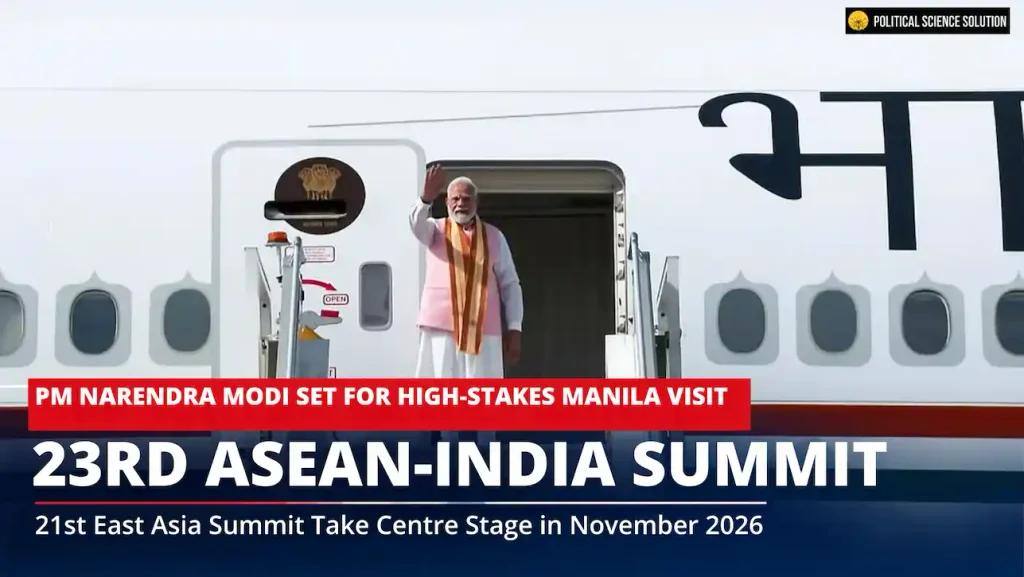
New Delhi: Prime Minister Narendra Modi will travel to Manila in mid-November 2026 for a focused diplomatic engagement that places India firmly at the heart of Southeast Asia’s evolving regional architecture. The two-to-three-day visit, scheduled between 16 and 18 November, centres on the 23rd ASEAN-India Summit and the 21st East Asia Summit. With the Philippines serving as ASEAN Chair for the year, the gatherings offer New Delhi a timely platform to deepen its Comprehensive Strategic Partnership with the 11-member grouping and to advance practical cooperation across maritime security, trade, digital infrastructure and connectivity.
The itinerary begins with a formal dinner hosted by Philippine President Ferdinand R. Marcos Jr for visiting leaders. The following day Modi will participate in both the ASEAN-India Summit and the East Asia Summit, with bilateral meetings expected to be slotted around the main sessions. Officials have also indicated efforts are under way to accommodate a possible interaction with the Indian community in the Philippines, reflecting consistent demand from the diaspora.
Strategic Context of the Visit
India regards its relationship with ASEAN as a cornerstone of the Act East Policy and a central pillar of its broader Indo-Pacific vision. The visit underscores New Delhi’s determination to treat the ASEAN platform not merely as a regional forum but as an essential building block for long-term engagement with Southeast Asia. Secretary (East) in the Ministry of External Affairs, Rudrendra Tandon, underlined this point during a media briefing in New Delhi, noting that India’s active bilateral ties with each of the 11 ASEAN members are complemented by sustained multilateral engagement through the ASEAN architecture itself.
The Philippines’ chairmanship in 2026 has shaped the year’s thematic focus around “Navigating the Future.” Leaders are expected to examine how the region can enhance collective resilience in the face of rapid geopolitical and economic shifts. For India, the summits provide an opportunity to review progress under the ASEAN-India Comprehensive Strategic Partnership and the accompanying Plan of Action covering 2026–2030.
23rd ASEAN-India Summit: Reviewing Partnership and Looking Ahead
The ASEAN-India Summit remains the principal annual mechanism for leaders to assess the state of cooperation and set priorities for the years ahead. In 2026 the discussions will place particular emphasis on implementation of the current Plan of Action. Maritime cooperation has been designated a special focus area for the year, with 2026 observed as the ASEAN-India Year of Maritime Cooperation. Officials anticipate concrete conversations on maritime security, safer sea lanes, and improved connectivity across the Indian Ocean and South China Sea approaches.
Looking further ahead, 2027 will mark two significant milestones: 35 years of India-ASEAN Dialogue Relations and five years of the Comprehensive Strategic Partnership elevated in 2022. These anniversaries are expected to frame longer-term planning even as leaders concentrate on immediate deliverables in Manila.
Key domains of cooperation that will feature prominently include:
- Strengthening maritime security frameworks and operational coordination
- Expanding two-way trade and investment flows
- Promoting regional peace and stability
- Advancing digital technology collaboration and shared digital public infrastructure
- Enhancing physical, economic and people-to-people connectivity
These areas reflect the practical orientation of the partnership and India’s interest in translating strategic statements into measurable outcomes.
21st East Asia Summit: Broader Indo-Pacific Dialogue
Running in parallel, the 21st East Asia Summit brings together ASEAN leaders with partners from outside the grouping in an informal yet strategically significant setting. The forum allows discussion of political, security and economic issues spanning the wider Indo-Pacific. India values the East Asia Summit as a unique ASEAN-led platform where it can engage both Southeast Asian counterparts and other major Indo-Pacific players on questions of regional order, economic resilience and emerging security challenges.
Tandon described the East Asia Summit process as a striking illustration of ASEAN’s diplomatic maturity. The fact that the 2026 edition is being hosted in Manila under Philippine chairmanship further demonstrates the grouping’s capacity to convene and shape regional conversations.
Trade Relationship: Numbers and Frameworks
Economic engagement forms a substantial part of the India-ASEAN relationship. According to figures shared by Secretary (East) Rudrendra Tandon, India’s trade with the ASEAN region stands at approximately USD 122 billion. Separate data from the Ministry of Commerce and Industry place bilateral trade for 2025-26 at USD 128.38 billion, accounting for 10.55 percent of India’s total external trade. These volumes position ASEAN as one of India’s most important trading partners.
The primary instrument governing merchandise trade remains the ASEAN-India Trade in Goods Agreement, which seeks to lower tariffs and expand market access. Officials on both sides continue to explore ways to realise the full potential of the agreement and to address residual barriers that limit further growth.
Historical Trajectory of India-ASEAN Ties
The relationship has followed a clear upward trajectory over more than three decades:
- 1992: India became an ASEAN Sectoral Dialogue Partner
- 1995: Elevation to full Dialogue Partner status
- 2002: Inaugural ASEAN-India Summit held
- 2012: Relationship upgraded to Strategic Partnership
- 2022: Further elevation to Comprehensive Strategic Partnership
Each stage has expanded the scope of cooperation from economic and functional issues into strategic, security, digital and people-to-people domains. The current Comprehensive Strategic Partnership reflects the breadth of shared interests and the institutional maturity of the engagement.
Understanding ASEAN Itself
The Association of Southeast Asian Nations was established on 8 August 1967 through the ASEAN Declaration, commonly known as the Bangkok Declaration. Headquartered in Jakarta, Indonesia, the organisation was founded by five original members—Indonesia, Malaysia, the Philippines, Singapore and Thailand. Its core objectives remain the promotion of economic growth, regional peace, stability and cooperation among Southeast Asian states.
Membership has grown steadily. Timor-Leste became the 11th member on 26 October 2025, completing the current roster:
- Brunei Darussalam
- Cambodia
- Indonesia
- Lao PDR
- Malaysia
- Myanmar
- Philippines
- Singapore
- Thailand
- Timor-Leste
- Vietnam
Over nearly six decades ASEAN has evolved into a mature regional organisation capable of leveraging collective strengths to advance peace, stability and prosperity. India engages the grouping at multiple levels, including the highest political level of heads of government, precisely because of this institutional capacity.
Significance for India’s Regional Strategy
From New Delhi’s perspective, a robust relationship with ASEAN—both as a collective and through individual bilateral channels—enhances resilience against rapid geopolitical change and contributes to overall Asian stability. As an Indian Ocean country whose maritime interests intersect directly with Southeast Asian waters, India sees strategic partnership with ASEAN as mutually beneficial. The Manila meetings therefore serve both immediate diplomatic purposes and longer-term strategic positioning under the Act East Policy.
The combination of the ASEAN-India Summit and the East Asia Summit in a single visit allows the Prime Minister to address both the specialised India-ASEAN agenda and the wider Indo-Pacific conversation in one coherent diplomatic package. Officials have emphasised that the engagement is not transactional but rooted in a shared interest in regional order, economic opportunity and practical cooperation.
Looking Beyond the Summits
While the formal summit sessions will dominate the public schedule, the surrounding bilateral meetings and possible community interaction will give additional texture to the visit. The Philippine host’s emphasis on “Navigating the Future” aligns with India’s own interest in building adaptive, resilient partnerships capable of managing uncertainty.
As 2026 unfolds as the ASEAN-India Year of Maritime Cooperation and preparations begin for the milestone year of 2027, the Manila gatherings are expected to produce both a stock-taking of progress and a forward-looking set of priorities. Trade figures already demonstrate the economic weight of the relationship; the challenge now is to translate political commitment into deeper connectivity, stronger maritime collaboration and expanded digital partnerships.
Prime Minister Modi’s presence in Manila will reaffirm India’s sustained investment in Southeast Asia at a moment when regional architecture continues to evolve. The outcomes of the 23rd ASEAN-India Summit and the 21st East Asia Summit will be watched closely by policymakers, businesses and strategic communities across the Indo-Pacific for signals about the direction and depth of India-ASEAN engagement in the years ahead.
FAQs
1. When is Prime Minister Narendra Modi visiting the Philippines and what is the main purpose of the trip?
Prime Minister Narendra Modi is scheduled to visit Manila from 16 to 18 November 2026 (with core summit engagements on 16–17 November). The primary purpose is to attend the 23rd ASEAN-India Summit and the 21st East Asia Summit. The Philippines is the ASEAN Chair for 2026 and will host both events under President Ferdinand R. Marcos Jr. The visit also includes a formal dinner hosted by the Philippine President and possible bilateral meetings, with efforts being made to accommodate an interaction with the Indian community.
2. What will be discussed at the 23rd ASEAN-India Summit?
Leaders will review progress under the ASEAN-India Comprehensive Strategic Partnership and the implementation of the ASEAN-India Plan of Action for 2026–2030. Special attention will be given to maritime cooperation, as 2026 has been designated the ASEAN-India Year of Maritime Cooperation. Other priority areas include trade and economic ties, regional security and stability, digital technology and digital public infrastructure, and physical, economic and people-to-people connectivity. The summit also looks ahead to 2027, which marks 35 years of India-ASEAN Dialogue Relations and five years of the Comprehensive Strategic Partnership.
3. How significant is India-ASEAN trade and what framework governs it?
India’s trade with the ASEAN region stands at approximately USD 122 billion according to official briefings, while Ministry of Commerce and Industry data place bilateral trade for 2025-26 at USD 128.38 billion — accounting for 10.55% of India’s overall global trade. The main instrument facilitating this commerce is the ASEAN-India Trade in Goods Agreement, which aims to reduce duties and expand market access between India and the ASEAN member states.
4. What is ASEAN and how many countries are currently members?
The Association of Southeast Asian Nations (ASEAN) is an intergovernmental regional organisation established on 8 August 1967 through the Bangkok Declaration. Its headquarters is in Jakarta, Indonesia. Originally founded by five countries (Indonesia, Malaysia, Philippines, Singapore and Thailand), it now has 11 members after Timor-Leste joined on 26 October 2025. The full list is: Brunei Darussalam, Cambodia, Indonesia, Lao PDR, Malaysia, Myanmar, Philippines, Singapore, Thailand, Timor-Leste and Vietnam. ASEAN works to promote economic growth, peace, stability and cooperation across Southeast Asia.
5. Why is this visit important for India’s Act East Policy and Indo-Pacific vision?
India views its partnership with ASEAN as a core pillar of the Act East Policy and a key element of its Indo-Pacific strategy. The relationship has evolved steadily — from Sectoral Dialogue Partner in 1992 and Dialogue Partner in 1995, to the first Summit in 2002, Strategic Partnership in 2012, and Comprehensive Strategic Partnership in 2022. A strong collective and bilateral relationship with ASEAN helps both sides build resilience against rapid geopolitical changes and contributes to peace and stability across Asia. The Manila summits, held under the theme “Navigating the Future,” give India a high-level platform to advance these objectives through practical cooperation in maritime security, trade, digital infrastructure and connectivity.