

New Delhi: The India AI Impact Summit 2026 wrapped up in New Delhi on February 23, 2026, delivering a landmark achievement with the widespread adoption of the New Delhi Declaration on AI Impact. This non-binding yet broadly endorsed framework signals a collective push toward responsible, equitable, and human-centered artificial intelligence advancement on a worldwide scale.
As the fourth installment in the series of major international AI gatherings—preceded by events in Bletchley Park (UK), Seoul (South Korea), and Paris (France)—this summit stood out as the inaugural one hosted in the Global South. Over five intensive days, it brought together heads of government, technology executives from leading firms, researchers, and policymakers to tackle pressing questions about AI governance, access disparities, risk management, and benefit distribution.
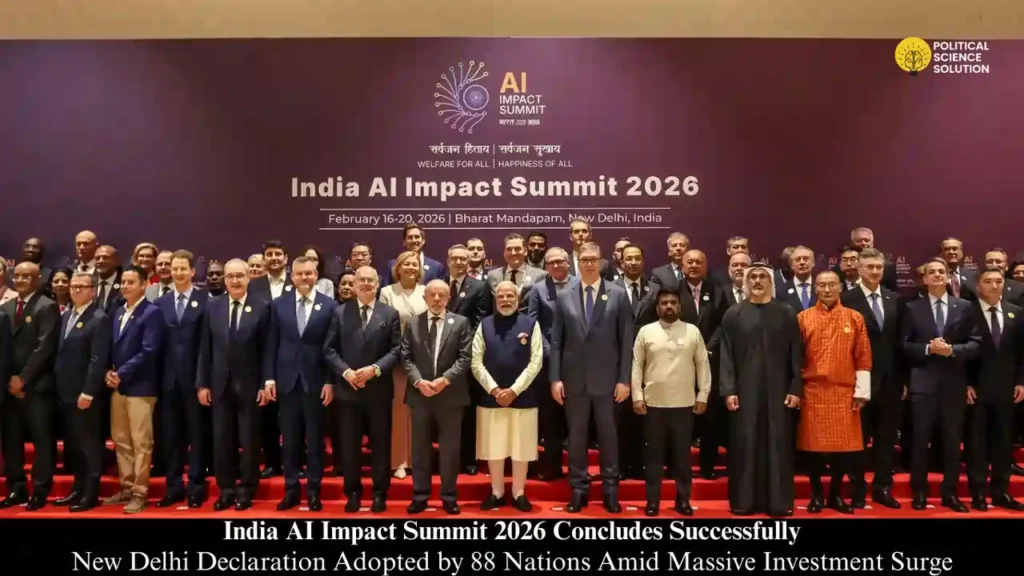
Core Guiding Philosophy: Welfare and Happiness for Everyone
Central to the summit’s ethos was the ancient Indian principle “Sarvajan Hitaya, Sarvajan Sukhaya”, meaning “Welfare for all, Happiness for all.” Delegates repeatedly referenced this idea to stress that artificial intelligence must serve humanity universally, avoiding concentration of advantages among a select few nations or corporations.
The declaration explicitly commits signatories to sustained collaboration aimed at realizing the summit’s three foundational Sutras—People, Planet, and Progress. These guiding themes prioritize serving diverse populations with respect and fairness, ensuring technological progress remains environmentally responsible, and enabling broad-based sharing of AI-driven economic and societal gains.
Seven Pillars (Chakras) Structure the Declaration’s Vision
Organized into seven strategic pillars—often described as Chakras—the declaration outlines priority areas for voluntary joint efforts:
- Building robust human capital through education and skill enhancement for the AI era.
- Expanding access to empower socially disadvantaged groups and promote inclusion.
- Ensuring AI systems remain trustworthy via ethical standards, openness, and dependability.
- Advancing energy-efficient AI technologies to reduce ecological footprints.
- Harnessing AI capabilities to accelerate breakthroughs in scientific domains.
- Democratizing foundational AI resources to lower entry barriers globally.
- Leveraging AI to fuel sustainable economic expansion and widespread social benefits.
Signatories pledged to deepen multilateral and multistakeholder partnerships across these domains.
Key Supporting Frameworks Acknowledged
The declaration takes positive note of the Charter for the Democratic Diffusion of AI, a voluntary mechanism encouraging wider availability of core AI building blocks while fully respecting domestic legal frameworks. It also highlights the launch of a collaborative knowledge-exchange platform to disseminate successful models, practical insights, and replicable approaches that prioritize societal empowerment through AI.
Furthermore, participants welcomed the Voluntary Guiding Principles on Resilient, Innovative, and Efficient Artificial Intelligence, intended to orient future system development toward durability, creativity, and resource optimization.
New Delhi Frontier AI Impact Commitments: Voluntary Industry Pledges
A parallel outcome involved frontier AI developers endorsing the New Delhi Frontier AI Impact Commitments. These focus primarily on two dimensions:
- Greater transparency regarding real-world applications: Companies agreed to produce and share anonymized, high-level analyses of how their technologies affect labor markets, skill requirements, productivity, and macroeconomic patterns—valuable inputs for evidence-based policy formulation.
- Enhanced inclusivity in model refinement: Participants committed to expanded evaluation and fine-tuning efforts targeting underrepresented languages and cultural nuances, especially within developing regions, to boost performance and relevance beyond predominantly English-speaking audiences.
Prominent voices in AI safety welcomed these steps as constructive starting points. Stuart Russell described them as encouraging signs toward eventual mandatory global safeguards. However, some observers, including representatives from safety-focused organizations, lamented the absence of firmer measures addressing urgent concerns like child protection, cybersecurity vulnerabilities, and existential oversight risks.
Addressing Power Imbalances in the AI Landscape
Discussions frequently turned to the stark reality of concentrated control over advanced AI capabilities. A small cluster of primarily American enterprises dominates proprietary frontier models and associated compute capacity, while China holds the second-largest share—together accounting for roughly 90 percent of global high-end AI infrastructure. Although open-source ecosystems continue growing and select nations pursue indigenous development, true frontier competition remains elusive for most players.
Delegates voiced apprehension that unchecked concentration could deepen geopolitical divides or widen socioeconomic gaps. Mozilla’s Mark Surman highlighted strong grassroots demand for open, nationally controlled, and culturally attuned AI solutions. Mistral AI CEO Arthur Mensch underscored the strategic necessity for sovereign entities to retain ultimate authority over critical systems. Yoshua Bengio framed the debate around democratic principles, cautioning against scenarios where dual superpowers exert outsized technological leverage.
Representing the United States, Michael Kratsios emphasized opposition to centralized international regulation, instead promoting “sovereign AI capability” built upon leading-edge tools (often U.S.-originated) combined with localized innovation.
Geopolitical Developments: India Joins Pax Silica Alliance
On the sidelines, India formally entered Pax Silica, an American-initiated coalition dedicated to resilient semiconductor supply networks and cutting-edge fabrication among trusted partners. The alliance—already comprising Japan, South Korea, the United Kingdom, and Israel—marks a notable strengthening of Indo-U.S. strategic alignment following earlier differences over energy sourcing.
Unprecedented Investment Wave Signals India’s Rising Ambition
From a commercial standpoint, the summit generated extraordinary momentum. India’s Electronics and Information Technology Minister Ashwini Vaishnaw announced expectations of surpassing $200 billion in incoming AI and deep-technology capital commitments over the ensuing two years.
Major domestic players drove much of this momentum:
- Reliance Industries and Jio pledged $110 billion across seven years to develop comprehensive AI and data ecosystems, with Mukesh Ambani identifying compute affordability as the foremost obstacle.
- Adani Group announced $100 billion dedicated to solar- and wind-supported AI data facilities by 2035.
- Larsen & Toubro revealed a strategic collaboration with Nvidia to establish India’s most expansive AI computing complex.
Global technology leaders contributed substantially as well:
- Microsoft outlined plans to channel $50 billion into the Global South through 2030, including substantial prior allocations to India totaling $17.5 billion.
- Google introduced dual $30 million initiatives—one focused on governmental AI applications and another on scientific advancement—plus a joint climate innovation hub.
- Blackstone directed $600 million in equity toward Indian AI cloud specialist Neysa.
- AMD deepened cooperation with Tata Consultancy Services to support up to 200 megawatts of dedicated AI capacity.
- OpenAI secured inaugural tenancy in TCS’s ambitious Stargate data center project.
- Anthropic inaugurated a Bengaluru presence, designating India its second-most significant market.
Mixed Reactions: Diplomatic Success Meets Calls for Deeper Structural Change
While the declaration and investment announcements drew praise, some participants felt the gathering leaned heavily toward promotional and transactional elements rather than transformative governance breakthroughs. Critics characterized it as an evolution from prior forums that increasingly prioritized commerce over binding oversight mechanisms.
Nevertheless, by convening an unprecedented breadth of nations—particularly from developing regions—and securing endorsements from both the United States and China, India successfully positioned itself as an influential convener in the evolving AI landscape.
The New Delhi Declaration and associated outcomes from the India AI Impact Summit 2026 collectively advance a hopeful vision: an AI-powered future defined by inclusivity, environmental mindfulness, and shared prosperity. As implementation efforts commence, the true measure of success will lie in translating these aspirations into measurable, widespread benefits across borders and communities.
FAQs
1. What is the India AI Impact Summit 2026, and why was it significant?
The India AI Impact Summit 2026 was a major international gathering on artificial intelligence, held from February 16–20 (or up to 21 in some reports) at Bharat Mandapam in New Delhi. It marked the fourth in a series of global AI summits (following those in Bletchley Park, Seoul, and Paris) and the first hosted in the Global South. The event brought together heads of state, CEOs from leading AI companies (such as OpenAI, Anthropic, Microsoft, Google, and Nvidia), policymakers, and experts to discuss shifting from high-level talks to real-world AI impact. It emphasized inclusive, human-centric AI development, with a strong focus on benefits for developing nations, underrepresented languages, and equitable access. The summit attracted massive participation, generated over $200 billion in announced AI and deep-tech investment commitments for India, and positioned the country as a key convener in global AI discussions.
2. What is the New Delhi Declaration on AI Impact, and how many entities endorsed it?
The New Delhi Declaration on AI Impact is a non-binding, voluntary framework adopted at the summit’s conclusion. It outlines a shared global vision for collaborative, trusted, resilient, and efficient AI that prioritizes equitable benefits for all of humanity. Guided by the Indian principle “Sarvajan Hitaya, Sarvajan Sukhaya” (Welfare for all, Happiness for all), it commits endorsers to ongoing cooperation aligned with three core Sutras: People (inclusive, dignity-focused AI), Planet (environmentally sustainable innovation), and Progress (equitable sharing of AI-driven growth). The declaration is structured around seven pillars (often called Chakras): human capital development, broadening access for social empowerment, trustworthiness of AI systems, energy efficiency, AI use in science, democratizing AI resources, and AI for economic growth and social good. It was endorsed by 88 countries and international organizations (including the EU and IFAD), with the United States and China among the signatories—reflecting unusually broad consensus across geopolitical lines.
3. What were the main outcomes besides the New Delhi Declaration?
Beyond the declaration, the summit produced the New Delhi Frontier AI Impact Commitments, voluntary pledges from frontier AI companies (both global and Indian) focusing on two areas: greater transparency in real-world AI usage (through anonymized, aggregated reporting on impacts like jobs, skills, and productivity) and improved inclusion (enhanced testing and evaluation in underrepresented languages and Global South contexts to make models more reliable and accessible). The event also highlighted massive investment announcements, including Reliance/Jio’s $110 billion pledge over seven years, Adani Group’s $100 billion for renewable-powered AI data centers, partnerships like Larsen & Toubro with Nvidia, and major commitments from Microsoft ($50 billion across the Global South by 2030), Google, Blackstone, AMD, OpenAI, and Anthropic. On the geopolitical side, India joined the U.S.-led Pax Silica alliance for secure semiconductor supply chains. The summit acknowledged supporting frameworks like the Charter for the Democratic Diffusion of AI and a voluntary knowledge-exchange platform for sharing scalable AI practices.
4. What concerns were raised during the summit about AI power concentration and governance?
Despite the positive outcomes, discussions highlighted ongoing worries about AI’s concentration in the hands of a few players—primarily American corporations and China, which together control roughly 90% of global high-end AI computing infrastructure. Attendees expressed fears that this could widen inequalities, create risky dependencies, or allow technological dominance by superpowers. Figures like Mistral CEO Arthur Mensch stressed the need for sovereign “turn-on and turn-off” control over critical AI systems, while Yoshua Bengio warned against a world with two hegemons. U.S. representative Michael Kratsios pushed back against centralized global governance, advocating “sovereign AI capability” built on best-in-class (often U.S.) technology with national layering. Some critics felt the declaration and commitments were too soft—lacking binding rules on safety issues like child protection, national security, or loss of control—and that the event leaned more toward investment promotion than deep structural reform.
5. How does the summit and declaration aim to benefit the Global South and everyday people?
The event strongly prioritized the Global South by focusing on democratizing AI resources, broadening access for social empowerment, and tailoring AI to diverse languages and cultures (especially underrepresented ones). It promoted practical applications in areas like healthcare, education, agriculture, and climate solutions while stressing energy-efficient and environmentally responsible AI to align innovation with planetary limits. By securing broad endorsement (including from major powers) for voluntary principles that respect national sovereignty and encourage multistakeholder collaboration, the declaration seeks to ensure AI drives inclusive economic growth and social good rather than deepening divides. India’s hosting helped amplify voices from developing nations, catalyze partnerships for compute and data infrastructure, and signal that AI’s future should be shaped collaboratively—with benefits equitably shared to advance welfare and happiness for all.