

New Delhi: Hundreds to several thousand people filled Lalbagh botanical garden on Sunday morning for a determined public campaign titled “Walk in Lalbagh. Walk for Lalbagh.” Families with children, Resident Welfare Association members, environmental campaigners, pro-Kannada groups and city BJP parliamentarians walked together from the West Gate starting at 7 am. Their shared message was clear: Bengaluru’s remaining protected parks must not lose even a fraction of their land under a new state law that permits diversion of up to five percent of government park area for public infrastructure.
The gathering followed the Karnataka Assembly’s recent passage of the Karnataka Government Parks (Preservation) (Amendment) Bill, 2026. Organisers and participants framed the event as a defence of the city’s scarce open spaces against both the amendment itself and a linked tunnel-road proposal that would pass near or under Lalbagh.
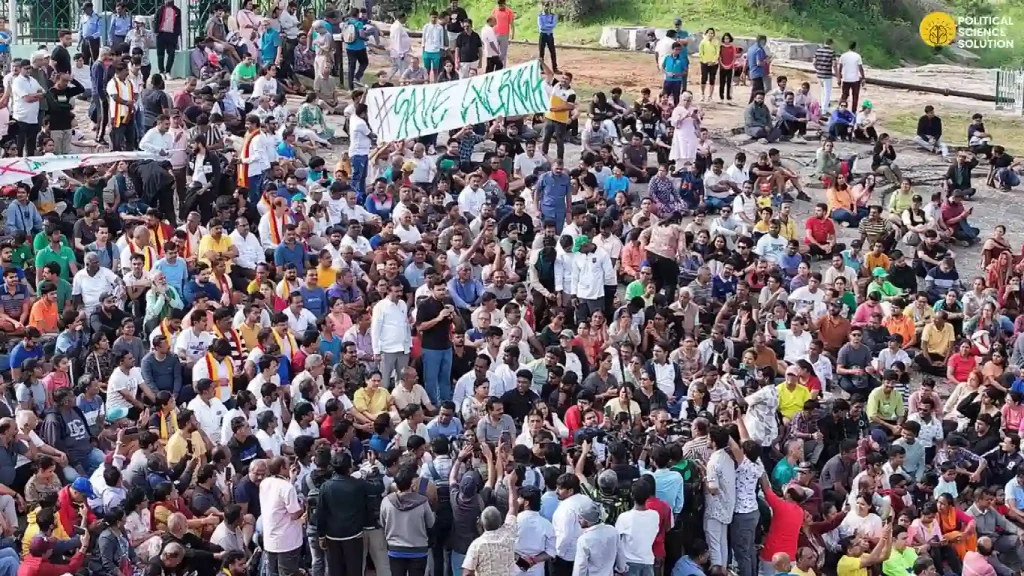
Citizen Turnout and Symbolic Actions Inside the Garden
Participants described the turnout as largely organic. BJP MP Tejasvi Surya told the media that more than five thousand people had assembled. Other accounts spoke of thousands that included children, senior citizens and local association representatives. Ninety-one-year-old environmentalist A.N. Yellappa Reddy, chief adviser to the Lalbagh and Cubbon Park Expert Committee, walked at the front of the procession.
As the group moved through the 240-acre garden, slogans rang out repeatedly: “Not 5 percent, not 1 percent, not one inch of Lalbagh.” Some protesters sat or lay on the Peninsular Gneiss rock formation, an ancient geological feature estimated to be nearly three billion years old. Among those who joined this symbolic act were Union Minister of State Shobha Karandlaje and BJP MP P.C. Mohan. Speakers stressed that the rock and the mature tree cover around it form part of Lalbagh’s irreplaceable ecological and geological heritage, not vacant real estate.
Several participants reported a noticeable police presence and the distribution of notices related to the demonstration. Organisers responded that peaceful efforts to protect public parks would continue even if treated as offences. They insisted their stand was not against development in general but against any plan that permanently reduces the city’s green lung spaces.
Details of the Parks Amendment and Its Immediate Implications
The amendment revises the Karnataka Government Parks (Preservation) Act, 1975, the law that has governed protected government parks and gardens including Lalbagh and Cubbon Park. It authorises the state to alienate—by sale, lease, gift, exchange, mortgage or other transfer—up to five percent of a park’s total area for specified public utility projects carried out by government departments, statutory bodies, government companies or local authorities.
Applied to Lalbagh’s roughly 240 acres, the five-percent ceiling equals about twelve acres. For Cubbon Park the corresponding figure is approximately fifteen acres. The limit is cumulative: any land already diverted in earlier years counts toward the five percent. Routine administrative and allied works by the Horticulture Department remain outside the ceiling. A separate provision allows limited use of Horticulture Department farms for core horticulture activities such as post-processing facilities, cold storage, production of improved plant varieties and agro-based industries that serve local farmers, provided public interest and necessity are formally recorded.
An evaluation mechanism headed by the Additional Chief Secretary, supported by designated officials and relevant experts, must examine every proposal before it reaches the state government. Despite these procedural safeguards, citizens argued that the five-percent principle itself weakens the statutory protection that parks have long enjoyed.
Connection to the Proposed Tunnel Road and Broader Environmental Fears
Protesters repeatedly tied the amendment to the proposed 17-kilometre Hebbal–Central Silk Board tunnel corridor, a project whose estimated cost has been placed at around ₹40,000 crore. Campaign materials and speakers cited survey estimates indicating that roughly five kilometres of the alignment could affect Lalbagh, requiring five to six acres on a temporary basis and about one acre permanently. Earlier short-tunnel works, they claimed, had already taken approximately three acres.
Yellappa Reddy and members of the Lalbagh Walkers Association warned that tunnelling or surface works could damage tree cover, underground water systems, biodiversity and the park’s geological features. They recalled an earlier assurance given by Chief Minister Siddaramaiah during a visit to Lalbagh that not even an inch of the garden would be taken, and asked whether that commitment still held.
The campaign’s core demand went beyond any single project. Participants insisted the five-percent clause must be withdrawn entirely because it could later enable commercial or other forms of development inside the city’s remaining green spaces. One widely repeated line captured the mood: “Lalbagh is not a pizza to cut into slices.” Speakers also challenged the government to publish a clear cost-benefit analysis of the tunnel. Several offered to raise the equivalent financial benefit through voluntary citizen contributions if the administration could demonstrate quantifiable economic gains, rather than surrender park land.
Political Reactions and the Road Ahead
BJP leaders present framed the issue as both local and statewide. Tejasvi Surya described the gathering as a non-political, citizen-led movement and accused the state government of treating precious green space as available for real-estate or commercial projects. Shobha Karandlaje went further, calling the legislation a “draconian bill” passed without adequate discussion and labelling the current administration a “real estate government” that sees money whenever it sees open land. She confirmed that she and other opposition figures had already written to Governor Thawar Chand Gehlot asking him to withhold assent. She stated that the Governor had returned the bill and that the government was reconsidering reintroduction; otherwise, she said, the matter would be taken to the President if necessary.
The BJP and JD(S) had protested inside the legislature during the bill’s passage, partly over related political demands, and later formally approached the Governor. While supporting other government initiatives such as cleanliness drives, clearance of footpath encroachments and the Business Corridor project, the protesters drew a firm line against any conversion of park land. They argued that expanding public transport, improving last-mile connectivity and strengthening non-motorised infrastructure offer more sustainable answers to Bengaluru’s traffic problems than tunnels that cut through green zones.
As of Monday the amendment remains with the Governor. Citizen groups, walkers’ associations and opposition leaders have made clear they will continue the campaign—through further walks, human chains, signature drives and legal avenues if required—until the five-percent provision is dropped and the tunnel alignment under Lalbagh is abandoned. For the thousands who walked the garden paths on Sunday, the principle is absolute: the city’s iconic parks are finite, irreplaceable and not available for incremental diversion under any legislative formula.
FAQs
1. What does the Karnataka Government Parks (Preservation) (Amendment) Bill, 2026 allow?
It permits the state government to divert up to 5% of protected park land (such as Lalbagh and Cubbon Park) for public utility projects through sale, lease or transfer, subject to evaluation by a high-level committee.
2. How much land in Lalbagh could be affected under the 5% rule?
Lalbagh covers about 240 acres, so the 5% ceiling equals roughly 12 acres. For Cubbon Park the corresponding figure is around 15 acres. Previous diversions count toward this limit.
3. Why are citizens linking the amendment to the tunnel road project?
The proposed 17-km Hebbal–Central Silk Board tunnel (estimated cost ₹40,000 crore) is expected to pass near or under Lalbagh, potentially requiring 5–6 acres temporarily and about 1 acre permanently.
4. Who took part in the “Walk in Lalbagh. Walk for Lalbagh” protest and what did they demand?
Thousands of residents, children, RWAs, environmentalists led by 91-year-old A.N. Yellappa Reddy, and BJP MPs including Tejasvi Surya and Shobha Karandlaje joined on 30 August 2026. Their slogan was “Not 5%, not 1%, not one inch” and they called for full withdrawal of the 5% clause and the tunnel plan.
5. What is the current status of the bill and the protest?
The bill has been passed by both Houses and is before Governor Thawar Chand Gehlot for assent. Opposition leaders have urged him to withhold approval, while citizens have vowed to continue campaigns until the provision and tunnel alignment under Lalbagh are dropped.