

New Delhi: In a significant administrative shift that has ignited sharp criticism from civil society and opposition groups, the Delhi Police on Monday, October 12, 2026, formally de-notified Jantar Mantar as a designated site for public protests and demonstrations. The decision, announced through a standing order issued by Delhi Police Commissioner Anurag Kumar, replaces the iconic central location with three alternative venues located farther from Parliament House, key government offices, and major media hubs. The new sites are Ramlila Ground in Central Delhi, Burari Ground in northwest Delhi, and CBD Ground in Shahdara, East Delhi.
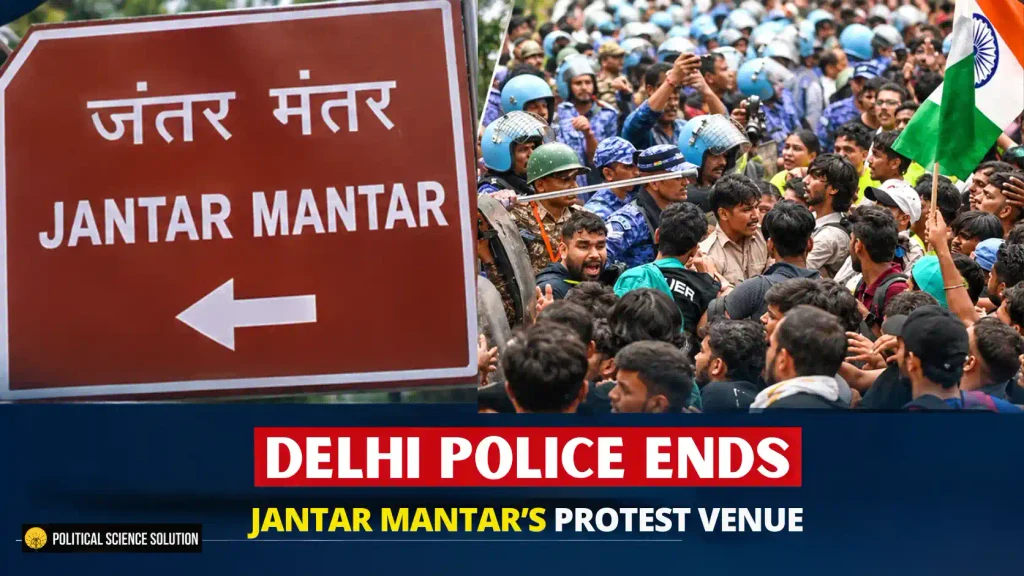
Standing Order Modified After Ministry Committee Review
The move partially modifies Standing Order No. L&O/48/22, dated April 28, 2022, which had earlier established guidelines for organising protests, sit-ins, and public demonstrations across the national capital. That earlier framework had specifically identified Jantar Mantar as the primary designated site. Its stated objectives included providing adequate space for assemblies while limiting disruption to local residents and traffic flow. Under those rules, protests were restricted to the hours between 10 a.m. and 5 p.m., and no programme was permitted to continue beyond a single day.
According to the fresh order, the change follows recommendations made by a committee constituted by the Union Ministry of Home Affairs. The committee had been tasked with examining alternative venues that could better accommodate citizens’ right to organise protests and demonstrations. Delhi Police officials indicated that detailed and revised standard operating procedures for demonstrations at the three newly designated grounds would be issued separately in due course. As of the announcement, those updated SOPs had not yet been released, leaving procedural clarity on permissions, timings, and operational rules pending.
New Protest Venues and Their Distances from the Centre of Power
Distances between the former site and the new venues underscore the geographical shift. Ramlila Ground lies approximately 3 to 4 kilometres from Jantar Mantar and remains the closest of the three alternatives to the central administrative zone around Parliament. Burari Ground is situated around 15 to 21 kilometres away in the northwest, while CBD Ground in East Delhi’s Shahdara area is positioned roughly 12 to 26 kilometres from the old protest hub, depending on the route measured. These distances have become a focal point of concern among activists who argue that physical separation from the corridors of power dilutes the visibility and pressure that protests traditionally exerted.
Why Jantar Mantar Mattered to Long-Time Activists
For many long-time participants in public demonstrations, Jantar Mantar’s value extended far beyond open space. Its central location near Parliament, government offices, and media establishments had long enabled direct engagement. Bhim Kumar, an activist with more than 15 years of experience in street mobilisations, emphasised this point. He noted that the site’s proximity allowed demonstrators to place their demands before elected representatives and decision-makers in real time. “Jantar Mantar is close to Parliament and the offices of those who are in a position to act on people’s demands. There was a possibility of getting a response and seeing the issue move forward. How do you exert that kind of pressure and make yourself heard from a venue so far away,” he asked.
Social activist Shabnam Hashmi, whose involvement in protests dates back to 1975, placed the decision in a longer historical continuum. She recalled that the Boat Club lawns near India Gate once served as a major venue for large public gatherings. After restrictions closed that space and other central locations, Jantar Mantar emerged as the principal site for public mobilisation, partly because of its accessibility from different parts of the city and its closeness to Parliament and media offices. “Jantar Mantar was important because it was centrally located and accessible to people coming from different parts of the city. Its proximity to the Parliament and media offices was crucial too. During a protest, we could get MPs to come out, speak to demonstrators and receive representations,” Hashmi said.
She further observed that the usable space at Jantar Mantar had already been progressively reduced through successive restrictions on area and permitted hours. In her assessment, the latest de-notification represents another incremental step in limiting avenues for public expression. “What was once an important place for people to gather and raise their concerns has been gradually diminished,” she remarked. At the same time, Hashmi expressed confidence that the administrative change would not extinguish the impulse to mobilise. “They may notify and de-notify places, but given the mood in the country, people will now reclaim public spaces. Every place in Delhi could become Jantar Mantar,” she stated.
Weekend Crackdown and the Immediate Political Backdrop
The timing of the order coincided with a period of heightened tension in the capital. Over the preceding weekend, extensive security measures were deployed to prevent student organisations and other groups from reaching Jantar Mantar. Thousands of people were detained across the city as part of efforts to maintain order. The protests centred on demands related to the Special Intensive Revision of electoral rolls and calls for the resignation of Chief Election Commissioner Gyanesh Kumar. Groups including the Congress-led INDIA opposition bloc, the Cockroach Janta Party founded by Abhijeet Dipke, and the All India Students’ Association led by Neha Bora had sought to assemble at the traditional site.
Delhi Police’s weekend response included widespread barricading of roads, temporary suspension of mobile internet services and Metro station access in certain areas, and the deployment of large numbers of police and paramilitary personnel. Reports indicated that more than 7,500 individuals were detained, with some accounts alleging excessive force, including incidents involving women protesters. Shortly before the formal announcement of the new venues, leaders of the Cockroach Janta Party met police officials to press for permission to protest at Jantar Mantar. In a letter released to the media, the group stated that the police refusal to allocate the site had caused significant distress and discontent among people across the country.
Strong Reaction from Cockroach Janta Party Leaders
The Cockroach Janta Party responded to the de-notification with strong language. Co-convenor Saurav Das described the decision as unacceptable and questioned whether the Ministry of Home Affairs had consulted the public or relevant stakeholders. “Unacceptable. Why is Narendra Modi scared of Jantar Mantar? It belongs to the people of India. Did the Ministry of Home Affairs consult the people of India when taking this decision? Were stakeholders, organisations consulted?” he asked. Das further warned that the move could signal a broader erosion of democratic space. “Like they are denotifying the people’s Jantar Mantar, the Prime Minister will soon denotify democracy in India. This move is a step towards that. We do not accept this arbitrary decision. It is an assault on people’s fundamental right to protest and peaceful assembly. The whole country will become Jantar Mantar now,” he declared.
Abhijeet Dipke, founder of the Cockroach Janta Party, echoed the sentiment on social media, stating that the entire country would now function as Jantar Mantar. The group had earlier given Delhi Police a 24-hour window to respond to its request for a protest date and time at the old site, indicating that further action would follow if no clarity emerged. With the site now formally removed from the list of designated venues, that option stands closed under current regulations.
Ramlila Ground’s Historical Role and Pending Guidelines
Ramlila Ground, the nearest of the three new locations, carries its own history of large-scale political assemblies. It previously hosted significant events, including the 1975 rally associated with independence activist and political leader Jayaprakash Narayan and the 2011 anti-corruption movement led by Anna Hazare. Despite this legacy, activists contend that its distance from Parliament still reduces the immediate political impact that Jantar Mantar once provided.
Delhi Police has maintained that the reconfiguration aims to balance the right to peaceful assembly with practical considerations of public order and traffic management. The order explicitly notes that the Ministry of Home Affairs committee examined alternative venues precisely to uphold citizens’ rights while identifying more suitable locations. Revised protocols governing the process for seeking permission at each of the three grounds are expected to be published separately.
Broader Implications and Continuing Debate
The decision has already prompted legal and political scrutiny. The Delhi High Court has agreed to hear a plea challenging the closure of Jantar Mantar as a protest site. Meanwhile, the broader atmosphere of dissent continues, with opposition figures and student organisations framing the de-notification as an attempt to distance public grievances from the centres of decision-making. Activists insist that while specific locations may change, the underlying demand for accountability and the constitutional right to assemble will persist across the capital and beyond.
As revised standard operating procedures remain pending, the practical implementation of the new arrangement is still unfolding. For now, Jantar Mantar—long synonymous with public dissent in the national capital—no longer holds official status as a designated protest venue. The three alternative grounds stand ready, yet the debate over accessibility, visibility, and the genuine exercise of democratic rights continues with undiminished intensity.
Frequently Asked Questions
1. Why did Delhi Police de-notify Jantar Mantar as a protest site?
Delhi Police de-notified Jantar Mantar following recommendations from a committee set up by the Union Ministry of Home Affairs. The committee examined alternative venues to better manage public demonstrations while addressing concerns related to space, traffic, and disruption to residents. The decision modifies the earlier 2022 standing order that had designated Jantar Mantar as the primary site.
2. What are the three new designated protest venues in Delhi and how far are they?
The three new venues are Ramlila Ground (about 3–4 km from Jantar Mantar in Central Delhi), Burari Ground (around 15–21 km away in northwest Delhi), and CBD Ground in Shahdara (roughly 12–26 km away in East Delhi). Ramlila Ground is the closest to the central administrative area.
3. Have the new rules and procedures for protesting at these sites been released?
No. Delhi Police has stated that detailed and revised standard operating procedures (SOPs) for organising protests at Ramlila Ground, Burari Ground, and CBD Ground will be issued separately. As of the announcement on October 12, 2026, these updated guidelines on permissions, timings, and other operational details remain pending.
4. How have activists and political groups reacted to the decision?
Activists such as Bhim Kumar and Shabnam Hashmi have criticised the move, arguing that Jantar Mantar’s proximity to Parliament and media offices was crucial for making demands heard. The Cockroach Janta Party called it an assault on the fundamental right to peaceful assembly, with leaders stating that the entire country would now become Jantar Mantar. Opposition groups and student organisations have also voiced strong objections.
5. What was the immediate context of this decision?
The de-notification came amid a week of protests demanding the resignation of Chief Election Commissioner Gyanesh Kumar over alleged irregularities in the Special Intensive Revision of electoral rolls. Over the preceding weekend, Delhi Police detained more than 7,500 people, imposed barricades, and restricted internet and Metro access to prevent demonstrators from reaching Jantar Mantar.