

New Delhi: In a significant administrative move announced late on Saturday night, President Droupadi Murmu has appointed Dr Dinesh Sharma as the Lieutenant Governor of the Andaman and Nicobar Islands. The Rashtrapati Bhavan issued an official communique confirming that the appointment of the Bharatiya Janata Party Rajya Sabha Member of Parliament will take effect from the date he assumes charge of the office. This decision marks a change in the leadership of the strategically important Union Territory after nearly nine years under the previous incumbent.
The official statement from Rashtrapati Bhavan stated: “The President of India is pleased to appoint Dr. Dinesh Sharma as Lt. Governor of Andaman and Nicobar Islands with effect from the date he assumes charge of his office.” The communique was released late Saturday night, corresponding to the evening of September 5, 2026. Multiple reports from national news agencies, including Press Trust of India, confirmed the development around 23:22 IST on that date, with subsequent updates appearing shortly thereafter.
Dr Dinesh Sharma, aged 62, currently serves as a Rajya Sabha MP representing Uttar Pradesh. His term in the Upper House was scheduled to conclude on November 25. He also holds the position of Vice Chairperson of the Rajya Sabha. The appointment comes at a time when his parliamentary tenure was approaching its natural end, positioning the move as a transition from legislative responsibilities to the executive role of administering a Union Territory.
He will succeed Admiral (Retd) Devendra Kumar Joshi, who has held the office of Lieutenant Governor of the Andaman and Nicobar Islands since October 8, 2017. Admiral Joshi’s long tenure, spanning nearly nine years, has provided continuity in the administration of the islands, which hold considerable strategic, ecological and developmental importance for India. The change in leadership is expected to take effect as soon as Dr Sharma formally assumes charge
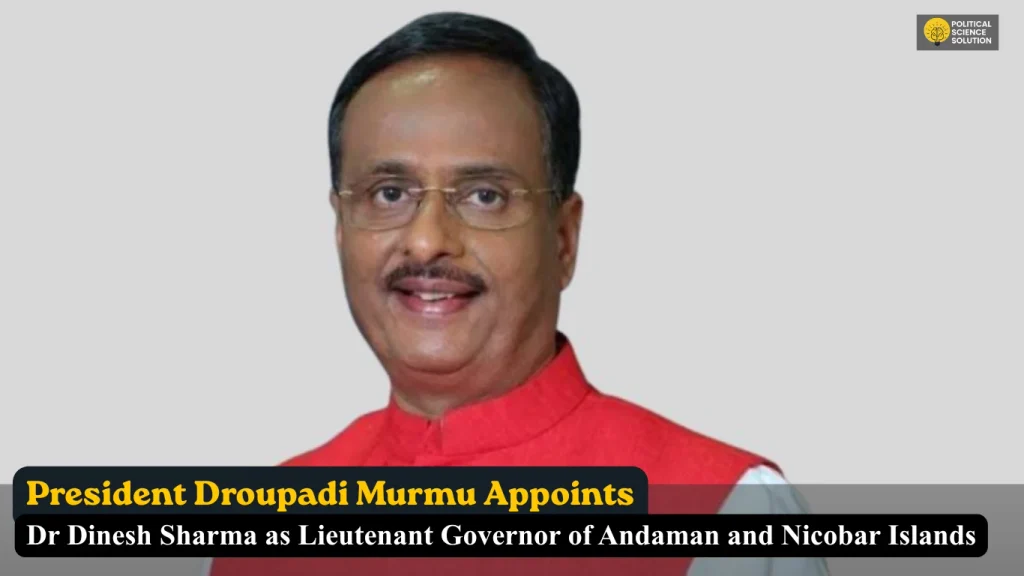
Political and Administrative Background of Dr Dinesh Sharma
Dr Dinesh Sharma brings extensive experience in both state-level governance and national politics. He earlier served as Deputy Chief Minister of Uttar Pradesh from 2017 to 2022 in the government led by Chief Minister Yogi Adityanath. During this period, he handled key portfolios including higher education, technical education, science and technology, and information technology. His tenure as Deputy Chief Minister concluded in 2022, after which Brajesh Pathak succeeded him in that role.
Before entering the state cabinet, Dr Sharma served as the Mayor of Lucknow, gaining direct experience in urban administration and civic governance. Within the Bharatiya Janata Party organisational structure, he has held several important positions. These include National Vice President of the party and the role of Gujarat party in-charge. His rise through the ranks began in student organisations and continued through the BJP’s youth wing, reflecting a long association with the party’s grassroots and organisational apparatus.
Dr Sharma entered the Rajya Sabha on September 9, 2023, after winning a by-election unopposed. This relatively recent entry into the Upper House of Parliament added a national legislative dimension to his already substantial state-level experience. As Vice Chairperson of the Rajya Sabha, he has participated in the functioning of the House, further expanding his understanding of parliamentary procedures and national policy frameworks.
Academic Foundations and Early Public Life
Born on January 12, 1964, in Lucknow, Dr Dinesh Sharma has maintained a strong connection to academia alongside his political career. He has served as a professor of commerce at the University of Lucknow since the 1990s. In this capacity, he has guided numerous research scholars and continued to remain associated with academic work even while holding high political office. This dual identity as an academician and politician has been a consistent feature of his public profile.
His entry into public life occurred through involvement in student organisations. From there, he progressed through the youth wing of the Bharatiya Janata Party, eventually assuming organisational responsibilities at the state and national levels. This trajectory—from campus activism to municipal leadership, state cabinet roles, parliamentary membership and now the Lieutenant Governorship—illustrates a steady expansion of responsibilities over several decades.
Details of the Appointment Process and Timing
The appointment was formalised through a Rashtrapati Bhavan communique issued late on the night of September 5, 2026. Reports from national media outlets, including those dated September 5, 2026 at 23:22 IST and subsequent updates around 11:40 PM IST and 11:54 PM IST, carried the announcement. The wording of the official statement carefully specifies that the appointment becomes effective only from the date Dr Sharma assumes charge of the office, leaving the precise timing of the handover to administrative coordination between the outgoing and incoming officeholders.
At the time of the announcement, Dr Sharma’s Rajya Sabha term was set to end on November 25. The appointment therefore provides a clear pathway for the conclusion of his parliamentary responsibilities and the commencement of his new role. As Vice Chairperson of the Rajya Sabha, he has held a position of parliamentary leadership that will now transition into the executive domain of Union Territory administration.
Context of Leadership Transition in Andaman and Nicobar Islands
Admiral (Retd) Devendra Kumar Joshi has served as Lieutenant Governor since October 8, 2017. His nearly nine-year tenure represents one of the longer continuous periods of leadership in the territory in recent decades. The appointment of Dr Dinesh Sharma introduces a civilian political leader with prior experience in state governance, education policy and organisational management into the role.
The Andaman and Nicobar Islands occupy a critical position in India’s strategic geography, ecological conservation efforts and developmental priorities. The Lieutenant Governor serves as the constitutional head of the Union Territory administration, overseeing the implementation of central government policies while addressing local developmental needs. The transition from a retired naval officer to a politician with academic and administrative experience in education and technology sectors may influence the emphasis placed on different aspects of governance in the islands.
Comprehensive Profile Summary
Dr Dinesh Sharma’s career encompasses multiple domains: academia as a commerce professor at the University of Lucknow since the 1990s; municipal leadership as Mayor of Lucknow; state-level executive authority as Deputy Chief Minister of Uttar Pradesh from 2017 to 2022 with portfolios covering higher education, technical education, science and technology and information technology; organisational roles within the Bharatiya Janata Party including National Vice President and Gujarat party in-charge; and parliamentary service as a Rajya Sabha MP from Uttar Pradesh since September 9, 2023, including the position of Vice Chairperson of the House. His term in the Rajya Sabha was due to conclude on November 25.
Born on January 12, 1964, in Lucknow, he began his public engagement through student organisations and advanced through the BJP youth wing. This layered background—academic, municipal, state cabinet, party organisational and parliamentary—forms the foundation for his new assignment as Lieutenant Governor of the Andaman and Nicobar Islands.
The official announcement by President Droupadi Murmu through the Rashtrapati Bhavan communique late on September 5, 2026, formalises this transition. Dr Sharma will take charge from the date he assumes office, succeeding Admiral (Retd) Devendra Kumar Joshi, who has held the position since October 8, 2017. The development closes one chapter of long-term leadership in the islands while opening another under an administrator whose career has spanned education, technology, urban governance and national politics.
This appointment reflects the constitutional process through which the President of India designates Lieutenant Governors for Union Territories. The detailed record of Dr Sharma’s prior responsibilities, the precise timing of the announcement, the remaining duration of his Rajya Sabha term, and the extended service of the outgoing Lieutenant Governor together provide a complete account of the leadership change. As the transition proceeds, attention will focus on the assumption of charge and the subsequent priorities set for the administration of the Andaman and Nicobar Islands.
FAQs
1. Who has been appointed as the new Lieutenant Governor of the Andaman and Nicobar Islands?
President Droupadi Murmu has appointed Dr Dinesh Sharma, a BJP Rajya Sabha MP from Uttar Pradesh, as the Lieutenant Governor of the Andaman and Nicobar Islands. The appointment was announced via a Rashtrapati Bhavan communique issued late on September 5, 2026.
2. Who is Dr Dinesh Sharma and what are his key previous roles?
Dr Dinesh Sharma, 62, is a BJP leader and former Deputy Chief Minister of Uttar Pradesh (2017–2022). He earlier served as Mayor of Lucknow, is a professor of commerce at the University of Lucknow, and currently holds the position of Vice Chairperson of the Rajya Sabha. His Rajya Sabha term was due to end on November 25.
3. Whom does Dr Dinesh Sharma succeed as Lieutenant Governor?
He succeeds Admiral (Retd) Devendra Kumar Joshi, who has been serving as the Lieutenant Governor of the Andaman and Nicobar Islands since October 8, 2017.
4. When does Dr Dinesh Sharma’s appointment take effect?
The appointment comes into effect from the date he formally assumes charge of the office, as stated in the official Rashtrapati Bhavan communique.
5. What is Dr Dinesh Sharma’s educational and early political background?
Born on January 12, 1964, in Lucknow, he has been a professor at the University of Lucknow since the 1990s and guided many research scholars. He began his public life through student organisations and rose through the BJP’s youth wing before holding key party positions such as National Vice President.