

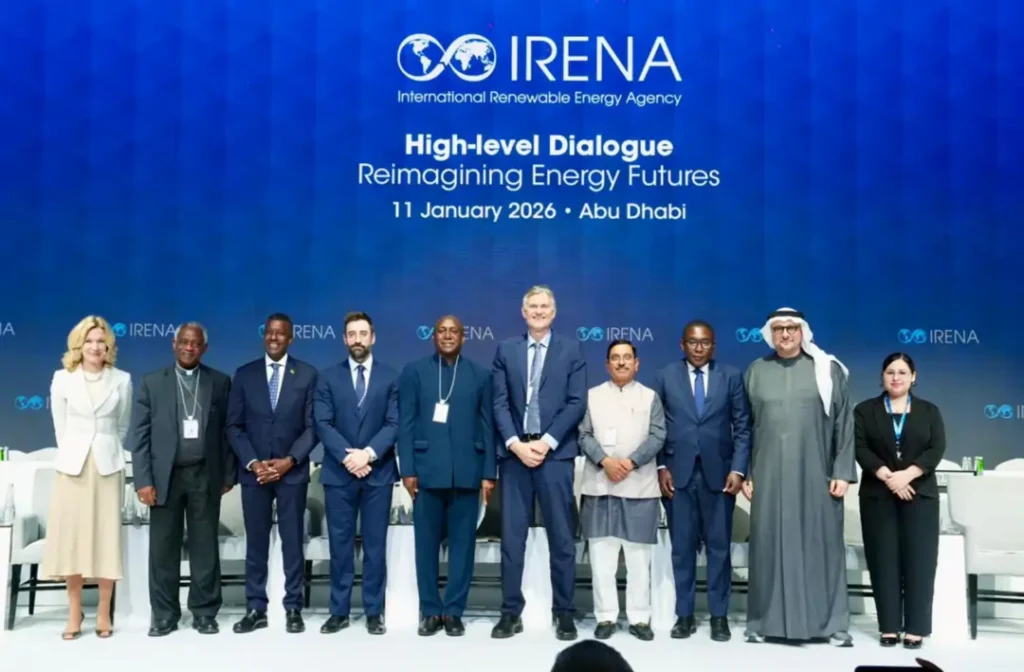
New Delhi: The 16th session of the International Renewable Energy Agency (IRENA) Assembly concluded in Abu Dhabi, United Arab Emirates, on January 12, 2026, delivering a clear and unified message: the global transition to renewable energy must happen faster to ensure long-term economic prosperity, energy security, and climate stability.
Record Participation Underscores IRENA’s Growing Global Influence
Held from January 10 to 12, 2026, under the theme “Powering Humanity: Renewable Energy for Shared Prosperity”, the three-day event attracted more than 1,500 participants — a record number that included heads of government delegations, energy ministers, senior policymakers, business leaders, investors, and development partners from around the world. The exceptional turnout demonstrated IRENA’s position as the leading intergovernmental organization exclusively focused on accelerating renewable energy deployment worldwide.
Director-General Calls for Irreversible Momentum in Clean Energy Shift
In his opening address, IRENA Director-General Francesco La Camera emphasized that the global move toward clean energy is now irreversible. He stressed that future economic strength will depend on countries’ ability to deliver clean, safe, affordable, and reliable energy at the lowest possible cost. Nations that invest early and decisively in renewable infrastructure, he noted, will secure lasting competitive advantages in a rapidly changing global economy.
Key Decisions Adopted at the Assembly
During the session, member states formally adopted the evaluation of IRENA’s Medium-term Strategy 2023–2027 and approved the agency’s Work Programme and Budget for 2026–2027. With 171 members (170 countries plus the European Union), the Assembly reaffirmed strong support for IRENA’s mandate, particularly its role as the official custodian tracking implementation of the “UAE Consensus” goals agreed at COP28.
Renewable Energy Employment Reaches Historic High
Immediately prior to the Assembly, IRENA and the International Labour Organization (ILO) jointly released the Renewable Energy and Jobs – Annual Review 2025. The report revealed that global renewable energy employment reached 16.6 million jobs in 2024 — the highest figure ever recorded.
The solar photovoltaic sector led the way with 7.2 million jobs, followed by liquid biofuels (2.6 million), hydropower (2.3 million), and wind energy (1.9 million). China accounted for the largest share of employment, contributing 44% of the global total.
India Emerges as a Leading Voice in the Global Transition
India, a founding member of IRENA since its establishment in 2009 (with the statute entering into force in 2010), played a highly visible and influential role throughout the Assembly.
Union Minister for New and Renewable Energy Pralhad Joshi delivered India’s national statement, anchoring the country’s energy vision in the timeless Indian principle of Vasudhaiva Kutumbakam — “One Earth, One Family, One Future”. He reiterated India’s commitment to achieving 500 GW of non-fossil fuel installed power capacity by 2030 and Net Zero emissions by 2070.
Major Milestone: 50% Non-Fossil Fuel Capacity Achieved Ahead of Schedule
Minister Joshi announced that India had reached 50% of its total installed electricity capacity from non-fossil fuel sources in 2025 — five years ahead of its Nationally Determined Contribution (NDC) target under the Paris Agreement. The country’s non-fossil fuel capacity now exceeds 266 GW, following the addition of nearly 50 GW of renewable energy in 2025 alone.
Comprehensive Strategy for Scale, Resilience, and Inclusion
The Minister outlined India’s multi-pronged approach, which includes:
- Rapid deployment of energy storage solutions
- Modernization of transmission and distribution networks
- Development of Green Energy Corridors
- Innovative bidding mechanisms such as hybrid and round-the-clock renewable energy projects
- Expansion of domestic manufacturing across solar modules, wind components, batteries, and electrolysers
These efforts aim to strengthen national energy self-reliance while contributing to more resilient and diversified global clean energy supply chains.
Transforming Rural Livelihoods Through Decentralized Renewables
A special focus was placed on integrating renewable energy into agriculture and rural economies. Under the PM-KUSUM scheme, India has installed nearly one million standalone solar pumps, solarized over 1.1 million grid-connected agricultural pumps, and added more than 10,200 MW of clean capacity. Approximately 2.17 million farmers have directly benefited from diesel pump replacements and solarization of agricultural feeders.
The PM Surya Ghar: Muft Bijli Yojana has similarly transformed household energy access, benefiting around 2.5 million households with rooftop solar installations in less than two years, with a target of covering 10 million households by March 2027.
Investment Opportunities and Call for Global Cooperation
Minister Joshi highlighted that India alone will require approximately USD 300 billion by 2030 to meet its renewable energy ambitions, creating enormous opportunities across generation, storage, green hydrogen, transmission infrastructure, and manufacturing. He positioned India as one of the world’s most attractive investment destinations due to its policy stability and transparent market framework.
He called for enhanced multilateral cooperation, particularly in the areas of technology transfer, access to low-cost finance, capacity building, and harmonization of technical standards — all essential to support developing countries, Least Developed Countries, and Small Island Developing States in pursuing ambitious clean energy pathways without compromising development priorities.
Bilateral and Multilateral Engagement
On the sidelines, Minister Joshi held discussions with Dr. Amna bint Abdullah Al Dahak, UAE Minister of Climate Change and Environment, to further strengthen India–UAE cooperation in renewables, decentralized energy solutions, manufacturing, energy storage, and blended finance mechanisms.
The Assembly also congratulated the Dominican Republic on assuming the Presidency of IRENA, with Vice Presidencies held by Kenya, Solomon Islands, Spain, and Antigua and Barbuda.
A Defining Moment for the Global Energy Future
As the world confronts intensifying climate challenges and rising energy security concerns, the 16th IRENA Assembly in Abu Dhabi served as a powerful reminder that renewable energy is no longer a supplementary option — it is the cornerstone of a secure, inclusive, and sustainable global future.
With India demonstrating leadership through rapid scale, social inclusion, and innovation, the momentum for a faster, fairer, and more equitable energy transition has rarely been stronger.
FAQs
1. What was the main theme and key outcome of the 16th IRENA Assembly?
The 16th session of the International Renewable Energy Agency (IRENA) Assembly was held from January 10 to 12, 2026, in Abu Dhabi, UAE, under the theme “Powering Humanity: Renewable Energy for Shared Prosperity”. It attracted a record participation of over 1,500 ministers, senior officials, business leaders, and partners. The key outcome was a strong collective call for accelerating the global renewable energy transition, described as irreversible and essential for economic growth, energy security, and climate action. Members adopted the evaluation of IRENA’s Medium-term Strategy 2023–2027, approved the Work Programme and Budget for 2026–2027, and reaffirmed support for IRENA’s mandate as the custodian of the “UAE Consensus” goals from COP28. With 171 members now (170 countries plus the EU), the Assembly emphasized early action to gain long-term competitiveness in clean energy.
2. What are the major findings from the Renewable Energy and Jobs – Annual Review 2025 released by IRENA and ILO?
The joint IRENA-ILO report, launched just before the Assembly, showed that global renewable energy employment reached 16.6 million jobs in 2024 — the highest level recorded — despite a slowdown in growth to just 2.3% from the previous year. This moderation occurred even as record renewable capacity was added, due to factors like economies of scale, rising automation, technological innovation, excess manufacturing capacity, and grid bottlenecks. The solar photovoltaic sector led with 7.2 million jobs (China accounting for 4.2 million), followed by liquid biofuels (2.6 million), hydropower (2.3 million), and wind (1.9 million). China dominated overall with 7.3 million jobs (44% of the global total). The report stressed the need for expanded education, training, reskilling, and inclusive policies to support workforce development, particularly for women and persons with disabilities, as the energy transition enters a new phase.
3. What major renewable energy milestone did India announce at the IRENA Assembly?
India, a founding member of IRENA, announced a landmark achievement: reaching 50% of its installed electricity capacity from non-fossil fuel sources in 2025 — five years ahead of its Nationally Determined Contribution (NDC) target under the Paris Agreement. The country’s non-fossil fuel capacity now exceeds 266 GW, with nearly 50 GW of renewable energy added in 2025 alone. Union Minister Pralhad Joshi highlighted this progress while reaffirming India’s commitments to 500 GW of non-fossil fuel installed capacity by 2030 and Net Zero emissions by 2070. He positioned India as a global leader in renewable deployment, supported by stable policies, transparent markets, and domestic manufacturing expansion in solar, wind, batteries, and electrolysers.
4. How is India integrating renewable energy into rural and agricultural sectors through flagship schemes?
India showcased people-centric initiatives that empower households and farmers. The PM Surya Ghar: Muft Bijli Yojana has benefited approximately 2.5 million households with rooftop solar installations in less than two years, aiming to cover 10 million households by March 2027. The PM-KUSUM scheme has transformed agriculture by installing nearly one million standalone solar pumps, solarizing over 1.1 million grid-connected pumps, and adding more than 10,200 MW of clean capacity, directly benefiting about 2.17 million farmers through diesel pump replacements and feeder solarization. Minister Joshi described these efforts as turning farmers into providers of both food and clean energy, addressing energy access, climate action, rural livelihoods, and agricultural productivity in a unified way.
5. What investments and international cooperation did India call for at the Assembly?
Union Minister Pralhad Joshi emphasized that the global energy transition requires unprecedented investment and collaboration. India alone needs around USD 300 billion by 2030 to meet its goals, creating vast opportunities in renewable generation, energy storage, green hydrogen, grids, and manufacturing. He called for stronger multilateral cooperation, including technology transfer, access to low-cost finance, capacity building, and harmonization of standards, especially to support developing countries, Least Developed Countries, and Small Island Developing States. India stands ready to share its experiences, institutions, and expertise. On the sidelines, the Minister held bilateral talks with the UAE Minister of Climate Change and Environment to deepen cooperation in renewables, decentralized solutions, and blended finance, building on existing MoUs.