

New Delhi: In a decisive move to position India as a global manufacturing powerhouse, the Union Cabinet has given the green light to the Bharat Audyogik Vikas Yojna (BHAVYA), a transformative ₹33,660 crore initiative aimed at creating 100 state-of-the-art plug-and-play industrial parks across the country. This ambitious scheme, spanning six financial years from FY 2026-27 to 2031-32, marks a significant leap towards building world-class industrial infrastructure that eliminates traditional setup delays and accelerates economic growth.
Announced after the Cabinet meeting, the BHAVYA scheme is designed to deliver ready-to-use industrial ecosystems where land, utilities, approvals, and supporting facilities are pre-developed, allowing industries to commence operations almost immediately upon arrival. Information and Broadcasting Minister Ashwini Vaishnaw, while briefing the media in New Delhi, described the scheme as a game-changer that will unlock India’s vast manufacturing potential and drive the nation’s growth narrative forward. “These parks will set new benchmarks in industrial infrastructure, ensuring reliability, reducing inefficiencies, and enhancing productivity across multiple sectors,” he emphasized.
The scheme comes at a pivotal time when India is aggressively pursuing self-reliance under the Aatmanirbhar Bharat vision. By focusing on plug-and-play models, BHAVYA addresses long-standing challenges such as lengthy land acquisition processes, delayed clearances, and inadequate infrastructure that have historically hindered industrial expansion, particularly for micro, small, and medium enterprises (MSMEs) and startups.
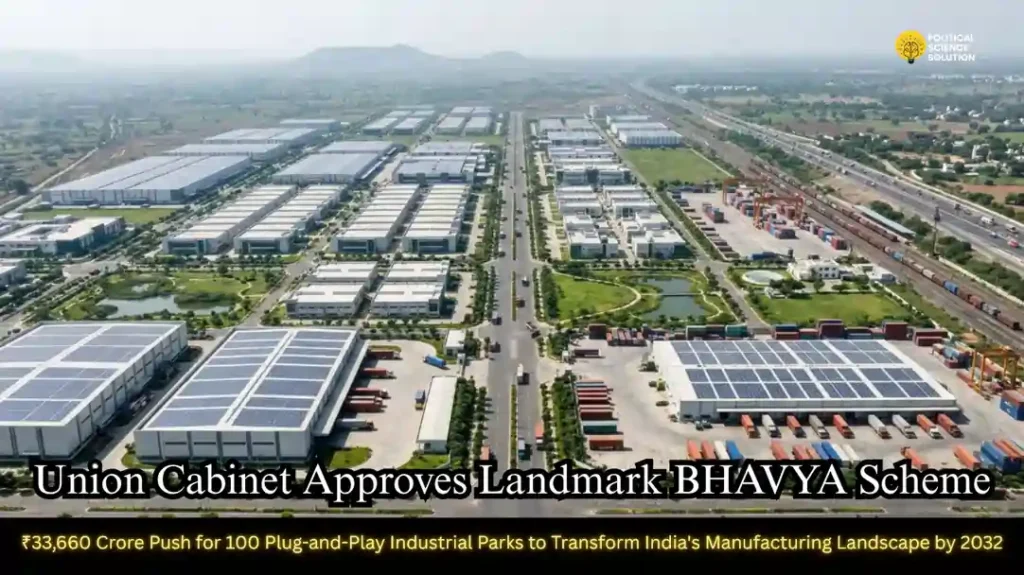
Understanding Plug-and-Play Industrial Parks: The Core of BHAVYA
At its heart, BHAVYA redefines industrial development through the concept of plug-and-play parks. An industrial park, as outlined in the scheme, is a meticulously planned tract of land that may or may not include ready-built factories but is equipped with shared facilities serving multiple industries. These parks create seamless, integrated environments where everything from basic utilities to advanced amenities is pre-arranged, enabling businesses to focus purely on production rather than groundwork.
The scheme targets the development of 100 such parks nationwide, with sizes ranging from a minimum of 100 acres (reduced to 25 acres for projects in the North Eastern states and hilly regions to account for geographical challenges) up to a maximum of 1,000 acres. This flexible sizing ensures inclusivity, allowing participation from diverse regions while maintaining scalability for larger industrial clusters.
Implementation will be led by the National Industrial Corridor Development Corporation (NICDC) under the Department for Promotion of Industry and Internal Trade (DPIIT), Ministry of Commerce and Industry. The rollout will occur in partnership with state governments and the private sector, fostering a collaborative model that leverages local expertise and investment. The first phase alone will see 50 parks established, with the entire project aligned to integrate seamlessly with the PM GatiShakti national master plan for multimodal connectivity and last-mile access.
Comprehensive Financial Support Structure Under BHAVYA
The central government has committed up to ₹1 crore per acre in financial assistance to cover three critical pillars of infrastructure development:
- Core Infrastructure: This includes internal roads, underground utilities, drainage systems, common treatment facilities, information and communication technology (ICT) networks, and administrative systems. These foundational elements ensure operational efficiency and sustainability from day one.
- Value-Added Infrastructure: Ready-built factory sheds, built-to-suit units tailored to specific industry needs, testing laboratories, and warehousing facilities will be developed to support immediate production and supply chain requirements.
- Social Infrastructure: Worker housing and essential support amenities such as healthcare, education, and recreational facilities will be prioritized to create vibrant, livable industrial communities.
Additionally, up to 25% of the total project cost will be allocated for external infrastructure support, including connectivity to highways, railways, and ports, ensuring parks are not isolated but fully integrated into India’s broader logistics network. The scheme also incorporates challenge-based project selection, where only the most investment-ready and reform-oriented proposals from states will be approved, promoting healthy competition and quality outcomes.
The Union Budget 2025-26 had already earmarked ₹2,500 crore specifically for plug-and-play industrial park development, providing an initial momentum that BHAVYA now scales up dramatically. Currently, India boasts 306 operational plug-and-play industrial parks, with an additional 20 such facilities and smart cities under development by NICDC as of December 2025. BHAVYA aims to more than double this ecosystem, creating a robust network of future-ready industrial hubs.
Key Features Driving Ease of Doing Business and Sustainability
BHAVYA places heavy emphasis on ease of doing business reforms. Single-window clearance systems, streamlined approvals, and state-led investor-friendly policies will be mandatory components, drastically cutting down the time from investment decision to actual production. The scheme promotes cluster-based industrial development, which strengthens domestic supply chains and encourages specialization in high-potential sectors.
Sustainability is woven into the design through green energy integration and innovative underground utility corridors following a no-dig model, minimizing environmental disruption while maximizing long-term efficiency. Alignment with PM GatiShakti ensures multimodal transport linkages, reducing logistics costs and enhancing competitiveness for Indian manufacturers on the global stage.
Primary beneficiaries include manufacturing units, MSMEs, startups, and global investors who seek hassle-free, ready-to-use infrastructure. On the secondary front, the scheme will benefit workers through better living conditions, logistics providers via improved connectivity, service sector enterprises through ancillary opportunities, and local communities via employment generation and economic spillover effects.
Experts project that successful implementation could generate lakhs of direct and indirect jobs, significantly boosting employment in both urban and rural-industrial belts while attracting substantial foreign and domestic investments.
Broader Cabinet Decisions: Supporting Farmer Welfare, Renewable Energy, and Infrastructure
The Cabinet meeting was not limited to industrial development alone. In parallel approvals aimed at strengthening multiple pillars of the economy, several other key decisions were taken.
To bolster farmer welfare and reinforce Aatmanirbhar Bharat in agriculture, the Cabinet sanctioned over ₹1,718 crore in Minimum Support Price (MSP) funding to the Cotton Corporation of India for the 2023-24 cotton season. This financial backing enables direct price support to cotton farmers nationwide, particularly protecting them during market downturns when prices dip below MSP levels. Minister Vaishnaw highlighted that these operations are crucial for safeguarding the interests of cotton growers across the country.
In the renewable energy domain, the Small Hydro Power Development Scheme was approved for the period 2026-27 to 2030-31 with an outlay exceeding ₹2,584 crore. The initiative targets the installation of small hydro power (SHP) projects with a combined approximate capacity of 1,500 MW. A unique feature is the provision to incentivize states to prepare detailed project reports (DPRs) for around 200 future projects, creating a robust pipeline for sustained growth in this clean energy segment.
On the infrastructure front, the Cabinet cleared the construction of more than 101 km of a four-lane, access-controlled National Highway-927 stretching from Barabanki to Bahraich in Uttar Pradesh. With an estimated cost surpassing ₹6,969 crore, this project promises seamless connectivity to vital economic, social, and logistics nodes throughout the state, further enhancing regional development and complementing the industrial push under BHAVYA.
Strategic Significance: Positioning India as a Global Manufacturing Hub
The BHAVYA scheme is more than just another infrastructure program—it represents a holistic strategy to address structural bottlenecks in India’s industrial growth story. By reducing entry barriers through pre-approved land, utilities, and clearances, the initiative makes the country far more attractive to both domestic entrepreneurs and international corporations seeking efficient manufacturing bases.
Nodal ministry DPIIT and implementing agency NICDC have been tasked with ensuring that these parks not only meet global standards but also incorporate cutting-edge practices in sustainability and digital integration. The involvement of state governments and private players ensures that projects are tailored to regional strengths, whether in textiles, electronics, automobiles, or emerging sectors like green hydrogen and semiconductors.
As India aims to increase its manufacturing share in GDP, schemes like BHAVYA play a pivotal role in fostering self-reliance while integrating with global value chains. The focus on worker amenities and community development also underscores a people-centric approach, ensuring that industrial growth translates into inclusive prosperity.
Looking ahead, the six-year timeline provides ample opportunity for phased execution, monitoring, and course correction. With the first 50 parks targeted in the initial phase, momentum is expected to build rapidly, potentially transforming underdeveloped regions into thriving industrial corridors.
Conclusion: A New Chapter in India’s Industrial Revolution
The approval of the Bharat Audyogik Vikas Yojna (BHAVYA) alongside complementary decisions on agriculture, renewable energy, and highways signals the government’s comprehensive vision for balanced, sustainable, and accelerated development. By investing ₹33,660 crore in 100 plug-and-play industrial parks, India is not merely building factories but engineering ecosystems of innovation, employment, and economic resilience.
This initiative, rooted in the principles of ease of doing business, cluster development, and multimodal connectivity, is set to redefine industrial infrastructure in the country. As Minister Vaishnaw noted, it will unlock manufacturing potential and propel India’s growth story to new heights. For businesses, investors, workers, and communities alike, BHAVYA heralds a future where industrial setup is no longer a hurdle but a seamless pathway to success.
Stakeholders across sectors are already expressing optimism, viewing the scheme as a timely catalyst that aligns perfectly with national goals of Viksit Bharat. As implementation begins in FY 2026-27, all eyes will be on how these 100 parks reshape India’s economic geography and cement its position as a preferred global manufacturing destination.
FAQs
Ques 1: What is the BHAVYA scheme and what is its main objective?
The Bharat Audyogik Vikas Yojna (BHAVYA) is a central government scheme approved by the Union Cabinet to develop 100 plug-and-play industrial parks across India. Its primary objective is to create world-class, ready-to-use industrial infrastructure that accelerates manufacturing-led growth, unlocks India’s manufacturing potential, enhances ease of doing business, attracts investments, strengthens domestic supply chains, and drives large-scale employment generation under the vision of Aatmanirbhar Bharat and Viksit Bharat.
Ques 2: What is the total budget allocation and duration of the BHAVYA scheme?
The scheme has a total outlay of ₹33,660 crore. It will be implemented over a period of 6 years, from FY 2026–27 to FY 2031–32. The first phase targets the development of 50 industrial parks, with the full target of 100 parks to be achieved by the end of the scheme period.
Ques 3: What are plug-and-play industrial parks under BHAVYA, and what size will they be?
Plug-and-play industrial parks are pre-developed industrial areas with ready land, utilities (roads, drainage, underground utilities, ICT systems, common treatment facilities), approvals, clearances, and shared facilities like factory sheds, testing labs, warehousing, and worker housing. This allows industries to start operations quickly without delays. Parks will range from a minimum of 100 acres (25 acres in North Eastern and hilly regions) to a maximum of 1,000 acres.
Ques 4: What financial support does the central government provide under BHAVYA?
The central government offers up to ₹1 crore per acre for core infrastructure (internal roads, utilities, drainage, etc.), value-added infrastructure (ready-built sheds, labs, warehousing), and social infrastructure (worker housing and amenities). Additionally, up to 25% of the project cost is supported for external connectivity infrastructure (linkages to highways, railways, etc.). Implementation involves partnerships with state governments and the private sector, led by the National Industrial Corridor Development Corporation (NICDC) under the Department for Promotion of Industry and Internal Trade (DPIIT).
Ques 5: Who benefits from the BHAVYA scheme and what is its expected impact?
Primary beneficiaries include manufacturing units, MSMEs, startups, and global investors seeking hassle-free setup. Secondary beneficiaries are workers (through better housing and amenities), logistics providers, service enterprises, and local communities. The scheme is expected to deliver around 34,000 acres of investment-ready land, generate approximately 15 lakh direct jobs, boost employment across sectors, reduce entry barriers for investors, integrate with PM GatiShakti for multimodal connectivity, promote sustainable development (green energy, underground utilities), and position India as a stronger global manufacturing hub.