

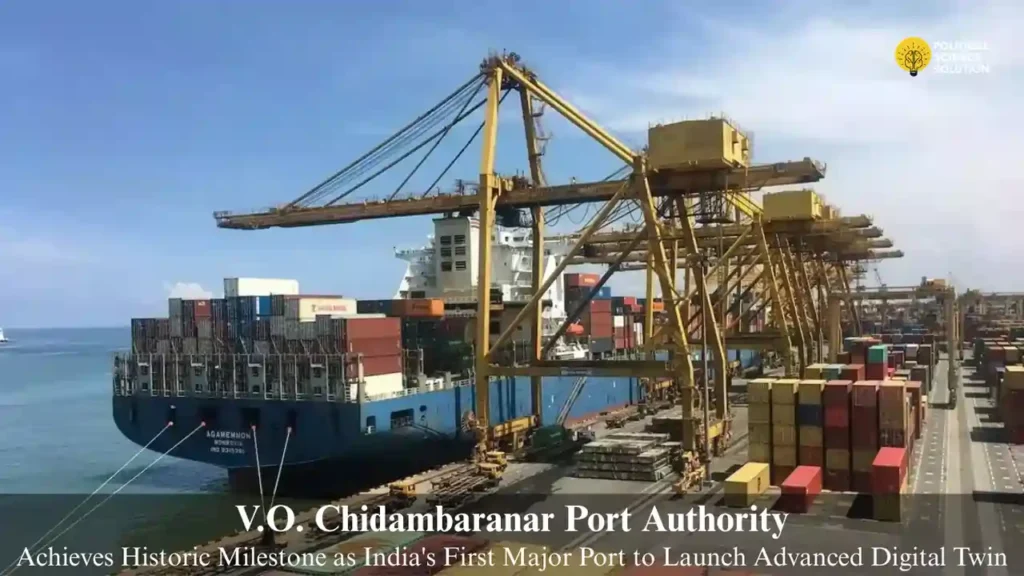
New Delhi: In a groundbreaking advancement for India’s maritime sector, the V.O. Chidambaranar Port Authority (VOC Port), formerly known as Tuticorin Port, has become the pioneering major port in the country to successfully implement a comprehensive Digital Twin platform. This innovative technology marks a transformative leap toward intelligent, data-centric, and sustainable port operations, aligning seamlessly with national goals for maritime modernization.
The Digital Twin initiative was officially inaugurated on February 23, 2026, by Sarbananda Sonowal, the Hon’ble Union Minister of Ports, Shipping and Waterways. The launch represents a key achievement in the port’s ongoing efforts to embrace cutting-edge digital solutions, positioning VOC Port as a leader in smart port development across India.
Located in Thoothukudi, Tamil Nadu, V.O. Chidambaranar Port stands as one of India’s 13 major ports. It functions as an artificial deep-sea harbour, strategically vital for handling diverse cargo types and supporting regional trade. The port’s rich historical legacy traces back centuries, with references dating as early as 123 AD when the Greek geographer Ptolemy highlighted Tuticorin as a thriving centre for maritime commerce connecting Western and Eastern nations. Over time, the region has maintained its prominence, particularly as a longstanding hub for pearl fishery, underscoring its enduring significance in India’s coastal economy.
Understanding Digital Twin Technology in Port Operations
At its core, a Digital Twin serves as a sophisticated virtual counterpart to a physical entity or process. It leverages continuous streams of real-time data to replicate the status, performance, and dynamics of its real-world equivalent with remarkable precision. This virtual model supports ongoing oversight, scenario testing, predictive insights, and lifecycle management—from initial planning and construction phases through routine upkeep and eventual phase-out.
For port management specifically, the Digital Twin at V.O. Chidambaranar Port constructs a dynamic, live digital mirror of the entire facility. This encompasses physical infrastructure elements, key operational equipment, vessel traffic patterns, cargo handling workflows, and the broader maritime surroundings. The result is unprecedented levels of visibility, allowing authorities to anticipate issues, optimize resources, and make informed choices swiftly.
The platform draws on an array of state-of-the-art technologies to ensure accuracy and responsiveness. These include Internet of Things (IoT) sensors deployed across equipment and structures for constant monitoring, GPS systems for precise tracking of vessels and cargo movements, LiDAR technology for detailed spatial mapping, drone-based aerial imaging for comprehensive surveillance, and extensive CCTV networks contributing to security and operational awareness. By fusing these inputs, the system generates a unified, evolving representation that mirrors on-ground realities in real time.
Key Functionalities and Operational Enhancements
The Digital Twin delivers several powerful capabilities designed to revolutionize daily port activities. Real-time operational monitoring stands out as a primary feature, offering live dashboards that display critical metrics such as berth occupancy levels, ongoing vessel arrivals and departures, crane performance and utilization rates, and available yard storage capacity. This instant visibility empowers coordinators to respond immediately to changing conditions.
Another vital aspect is predictive maintenance for cargo handling machinery. Through AI-driven analysis of asset data, the system identifies potential failures before they occur, thereby reducing unplanned stoppages, extending equipment lifespan, and boosting overall dependability.
Berth allocation and vessel traffic management receive significant upgrades via intelligent scheduling algorithms. These tools minimize delays, alleviate bottlenecks, and streamline the flow of ships and goods, leading to smoother operations even during high-volume periods.
Sustainability receives dedicated attention through integrated energy consumption monitoring and emissions tracking. This functionality supports environmentally conscious strategies by providing actionable data to cut unnecessary power usage and lower greenhouse gas outputs.
Additionally, the platform incorporates advanced scenario simulation tools. Operators can run hypothetical “what-if” analyses to evaluate responses to scenarios like sudden surges in cargo volume, adverse weather events, or equipment outages, thereby enhancing preparedness and resilience.
Projected Outcomes and Strategic Impact
Designers of the initiative anticipate substantial improvements in performance indicators. Vessel turnaround time—the duration a ship spends at port from arrival to departure—is expected to decrease by as much as 25%. Equipment uptime and reliability should rise noticeably, while predictive notifications will contribute to safer working environments by flagging risks proactively.
Energy efficiency gains and reduced carbon footprints will further advance green objectives. Overall, these enhancements aim to convert V.O. Chidambaranar Port into a highly efficient, resilient maritime entry point capable of withstanding disruptions and supporting expanded trade volumes.
The rollout follows a structured, phased approach to guarantee seamless adoption and minimal interference with existing workflows. As implementation progresses, the full potential of the Digital Twin will unfold, reinforcing the port’s ability to deliver consistent, high-quality service.
National Alignment and Visionary Context
This achievement directly supports broader governmental priorities in the maritime domain. The Maritime India Vision 2030 outlines ambitious benchmarks for elevating ease of doing business, boosting throughput efficiency, and integrating advanced technologies across ports. Complementing this is the Amrit Kaal Vision 2047, which envisions a digitally empowered, globally competitive maritime ecosystem.
Under the leadership of Prime Minister Narendra Modi, these frameworks emphasize digital transformation as essential for transparency, speed, and international standing. By pioneering the Digital Twin, VOC Port demonstrates concrete progress toward these objectives and sets an inspiring precedent for fellow major ports.
Chairperson’s Perspective on Modernization
Susanta Kumar Purohit, IRSEE, Chairperson of V.O. Chidambaranar Port Authority, emphasized the initiative’s role in the facility’s evolution. He noted that adopting Artificial Intelligence, IoT connectivity, and real-time analytics through the Digital Twin represents a pivotal advancement in modernization. These elements collectively promise heightened efficiency, faster vessel processing, reinforced safety protocols, and stronger environmental stewardship. Ultimately, the platform positions the port to meet and exceed worldwide benchmarks for smart, technology-integrated harbours.
Historical and Strategic Significance of VOC Port
Beyond its technological leap, V.O. Chidambaranar Port holds a special place in India’s maritime narrative. Named after freedom fighter V.O. Chidambaram Pillai, who championed maritime self-reliance during the colonial era, the port embodies both historical pride and forward momentum. Its deep-sea capabilities enable handling of large vessels, while ongoing infrastructure enhancements—including new berths and connectivity upgrades—complement digital innovations to drive capacity growth.
As India accelerates its push for self-reliant, sustainable logistics, initiatives like this Digital Twin underscore the critical intersection of tradition and innovation. V.O. Chidambaranar Port’s leadership in deploying this platform not only elevates its own operations but also contributes to the nation’s ambition of establishing world-class port infrastructure.
Looking ahead, the phased expansion of the Digital Twin will likely incorporate further refinements, deeper AI integration, and expanded data sources. This continuous evolution ensures the port remains agile in an increasingly complex global shipping landscape.
With this milestone, V.O. Chidambaranar Port Authority solidifies its status as a frontrunner in India’s maritime digital revolution, paving the way for smarter, greener, and more competitive port ecosystems nationwide.
FAQs
1. What is the Digital Twin initiative launched at V.O. Chidambaranar Port?
The Digital Twin is a real-time virtual replica of the port’s entire physical setup, including infrastructure, operational assets like cranes and berths, vessel movements, cargo handling processes, and the surrounding maritime ecosystem. It uses live data feeds to mirror actual conditions accurately, allowing port managers to monitor, analyze, and optimize everything digitally without disrupting real-world activities. This creates a “living” model that evolves continuously with on-site changes.
2. Why has V.O. Chidambaranar Port become the first in India to implement this Digital Twin platform?
V.O. Chidambaranar Port (also known as VOC Port or Tuticorin Port) achieved this pioneering status by integrating cutting-edge technologies ahead of other major ports. Inaugurated by Union Minister Sarbananda Sonowal, the platform aligns with national goals under Maritime India Vision 2030 and Amrit Kaal Vision 2047, which prioritize digitalization for better efficiency, transparency, and global competitiveness. As one of India’s 13 major ports, VOC Port’s early adoption sets a benchmark for smart, technology-driven maritime operations nationwide.
3. What technologies power the Digital Twin at V.O. Chidambaranar Port?
The system relies on a combination of modern tools for accurate, real-time replication:
• IoT sensors placed on equipment and infrastructure for constant data collection.
• GPS tracking to monitor vessel positions and cargo movements precisely.
• LiDAR mapping for detailed 3D spatial representations of the port area.
• Drone imaging for aerial views and surveillance.
• CCTV networks for enhanced security and operational visibility. These inputs feed into AI and analytics systems to create a unified, dynamic digital mirror of the port.
4. What are the main features and benefits of this Digital Twin platform?
Key features include:
• Real-time monitoring with live views of berth occupancy, vessel traffic, crane usage, and yard storage capacity.
• AI-based predictive maintenance to spot equipment issues early, cutting downtime.
• Intelligent berth and vessel scheduling to reduce congestion and waiting times.
• Energy usage and emissions tracking for greener operations.
• “What-if” scenario simulations to test responses to peak loads, disruptions, or emergencies.
Expected benefits: Up to 25% reduction in vessel turnaround time, higher equipment reliability, improved safety via predictive alerts, optimized energy use with lower carbon emissions, and stronger resilience against operational challenges.
5. How does this initiative fit into India’s broader maritime and digital goals?
The Digital Twin supports Prime Minister Narendra Modi’s vision for a digitally advanced, efficient, and competitive maritime sector. It advances Maritime India Vision 2030 targets for enhanced ease of doing business, higher throughput, and tech integration across ports. By modernizing operations at VOC Port—under the leadership of Chairperson Susanta Kumar Purohit—it helps align Indian ports with global smart port standards, promotes sustainability, and boosts overall trade efficiency in the long term toward Amrit Kaal Vision 2047. The phased rollout ensures smooth integration and lasting impact.