

New Delhi: India and Oman have taken a decisive step to deepen their economic relationship by signing the Comprehensive Economic Partnership Agreement (CEPA) on December 18, 2025. The agreement, concluded during Prime Minister Narendra Modi’s visit to Muscat, is being viewed as one of the most ambitious trade pacts India has signed in recent years and marks Oman’s first bilateral free trade agreement since 2006.
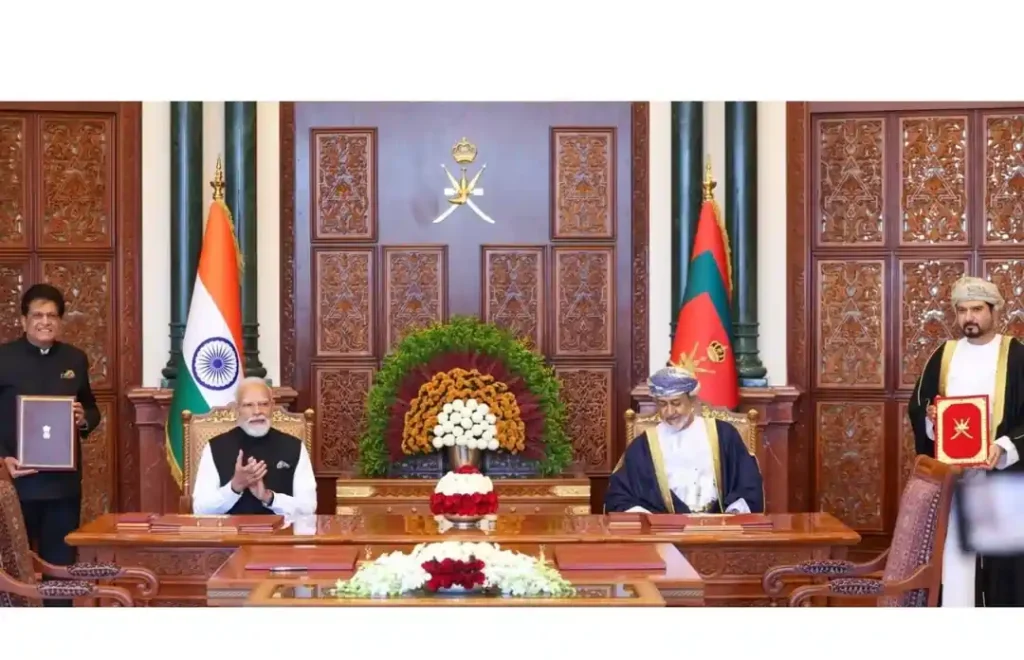
The deal was formally signed by Union Commerce and Industry Minister Piyush Goyal and Oman’s Minister of Commerce, Industry and Investment Promotion, Qais bin Mohammed Al Yousef, in the presence of Prime Minister Modi and His Majesty Sultan Haitham bin Tarik.
Unprecedented Market Access for Indian Exports
Under the CEPA, Oman has agreed to grant zero-duty access on 98.08% of its tariff lines, which account for 99.38% of the value of goods India currently exports to Oman. Of these, nearly 98% will see immediate duty elimination upon entry into force.
The sectors expected to benefit most include:
- Textiles, garments, and home furnishings
- Leather products and footwear
- Gems, jewellery, and handicrafts
- Plastics, rubber, and furniture
- Engineering goods and automobiles
- Agricultural and processed food products
- Pharmaceuticals and medical devices
These concessions are anticipated to significantly increase India’s export volumes, generate employment in labour-intensive industries, and provide fresh opportunities for micro, small, and medium enterprises (MSMEs), artisans, and women-led businesses.
In exchange, India has offered tariff liberalisation on 77.79% of its tariff lines, covering approximately 94.81% of imports from Oman by value. Sensitive sectors such as dairy, tea, coffee, rubber, gold, and certain agricultural commodities have been protected through outright exclusions or tariff-rate quotas.
Services and Investment: Major Breakthroughs
The agreement goes well beyond merchandise trade. Oman has made commitments in 127 services sub-sectors, including:
- Computer and IT-related services
- Professional and business services
- Research and development
- Education and training
- Health and social services
- Audio-visual and entertainment services
These commitments are considered highly ambitious for a Gulf economy and are expected to open high-value opportunities for Indian service providers. Currently, India supplies only 5.31% of Oman’s total services imports (valued at around USD 12.52 billion annually), leaving substantial headroom for growth.
In a significant investment-related provision, Indian companies will be permitted 100% foreign direct investment in major services sectors in Oman, enabling them to set up subsidiaries, branches, or joint ventures.
Historic Mobility Commitments for Indian Professionals
The CEPA includes comprehensive Mode 4 commitments under the WTO’s General Agreement on Trade in Services (GATS), covering the temporary movement of natural persons supplying services.
Key mobility provisions include:
- Increased quota for intra-corporate transferees from 20% to 50%
- Contractual service suppliers allowed to stay for up to two years (with possible extension of another two years) — an eightfold increase from the previous 90-day limit
- Liberalised entry and stay conditions for independent professionals and business visitors
- Special provisions for professionals in accountancy, taxation, architecture, medical, and allied health services
These measures are expected to significantly enhance opportunities for India’s skilled workforce in Oman, where nearly 700,000 Indian nationals already reside, contributing through over 6,000 Indian-owned businesses and sending home approximately USD 2 billion in remittances annually.
World-First Commitment on Traditional Medicine
In a provision that has drawn particular attention, Oman has made the world’s first comprehensive commitments on traditional medicine across all modes of supply. The inclusion of India’s AYUSH systems (Ayurveda, Yoga & Naturopathy, Unani, Siddha, and Homeopathy) is expected to:
- Boost medical value travel to India
- Facilitate exports of AYUSH products and services
- Enable collaboration in research, training, and wellness tourism
Addressing Non-Tariff Barriers
The agreement also tackles non-tariff measures through:
- Faster marketing approvals for pharmaceutical products already cleared by stringent global regulators
- Mutual recognition of Halal certification
- Acceptance of India’s organic certification
- Enhanced cooperation on standards, technical regulations, and conformity assessment
These measures are intended to reduce regulatory friction and improve predictability for Indian exporters.
Strategic Context and Bilateral Trade Snapshot
Bilateral merchandise trade between India and Oman crossed USD 10.5 billion in 2024-25. India exported goods worth approximately USD 4.06 billion (0.93% of India’s total exports) and imported USD 6.54 billion (0.91% of total imports), mainly petroleum products and urea.
Oman ranks as India’s third-largest export market in the Gulf Cooperation Council (GCC) and serves as a strategic gateway to the wider Middle East and Africa.
The CEPA is India’s second major trade agreement in the last six months (following the UK deal) and its second with a GCC country after the 2022 UAE pact.
India’s Broader FTA Strategy
The signing of the India-Oman CEPA reflects New Delhi’s active pursuit of high-standard trade agreements with strategic partners, including the United Kingdom, Australia, EFTA countries, and the UAE.
These agreements aim to:
- Diversify export markets and reduce dependence on traditional destinations
- Attract higher foreign direct investment (FTAs have contributed roughly 30% of India’s FDI equity inflows between 2000–2022)
- Strengthen supply-chain resilience amid global uncertainties
- Leverage India’s competitive advantage in services
Domestic Export-Promotion Measures
The CEPA complements several ongoing government initiatives to boost exports, including:
- RoDTEP (Remission of Duties and Taxes on Exported Products) scheme
- Export Promotion Mission for MSMEs
- Districts as Export Hubs programme
- Foreign Trade Policy 2023, which targets USD 2 trillion in combined merchandise and services exports by 2030
Leadership Statements
Prime Minister Narendra Modi described the agreement as a “blueprint for a bright future” that would infuse new energy into bilateral ties and benefit the youth of both countries.
Commerce Minister Piyush Goyal called the CEPA “ambitious yet balanced,” noting that it provides near-universal duty-free access for Indian goods, unlocks high-value services opportunities, and ensures greater mobility for Indian professionals while fully protecting national interests.
The India-Oman CEPA is expected to act as a catalyst for higher trade volumes, stronger investment linkages, job creation, and deeper economic integration between the two nations in the years ahead.
Frequently Asked Questions (FAQs)
1. What is the India-Oman CEPA, and when was it signed?
The India-Oman Comprehensive Economic Partnership Agreement (CEPA) is a modern, wide-ranging trade and investment pact between India and Oman that covers goods, services, investment, professional mobility, and cooperation in several new areas. It was signed on December 18, 2025, in Muscat during Prime Minister Narendra Modi’s official visit, in the presence of His Majesty Sultan Haitham bin Tarik.
2. What duty-free access has Oman provided to Indian exports under this agreement?
Oman has granted zero-duty access on 98.08% of its tariff lines, which covers 99.38% of the current value of Indian exports to Oman. Nearly 98% of these lines will receive immediate duty elimination. This will particularly benefit labour-intensive Indian sectors such as textiles, gems and jewellery, leather and footwear, pharmaceuticals, engineering goods, automobiles, plastics, furniture, and agricultural products.
3. What concessions has India offered in return, and how are sensitive sectors protected?
India has liberalised tariffs on 77.79% of its tariff lines, covering approximately 94.81% of the value of imports from Oman. Sensitive domestic sectors including dairy, tea, coffee, rubber, gold, precious metals, and certain agricultural products are fully protected through exclusions or tariff-rate quotas.
4. What are the key highlights for services, investment, and Indian professionals?
Oman has opened 127 services sub-sectors with strong commitments, creating major opportunities in IT, professional services, research & development, education, health, and audio-visual sectors.
Indian companies can now undertake 100% foreign direct investment in major services sectors in Oman.
Enhanced Mode 4 mobility provisions allow longer stays and higher quotas for Indian professionals, including an eightfold extension (up to two years, renewable) for contractual service suppliers and increased intra-corporate transferee quotas from 20% to 50%.
5. Are there any unique or first-of-its-kind provisions in the India-Oman CEPA?
Yes, the agreement includes the world’s first comprehensive commitment on traditional medicine (covering India’s AYUSH systems) across all modes of supply. It also addresses non-tariff barriers through faster pharmaceutical approvals, mutual recognition of Halal certification, acceptance of India’s organic certification, and stronger cooperation on standards and conformity assessment.