
New Delhi: A major study published by the Boston Consulting Group (BCG) has quantified what many industry observers have observed for several years: India’s digital creator ecosystem has become one of the most powerful forces shaping consumer purchasing behaviour in the world’s fastest-growing major economy.
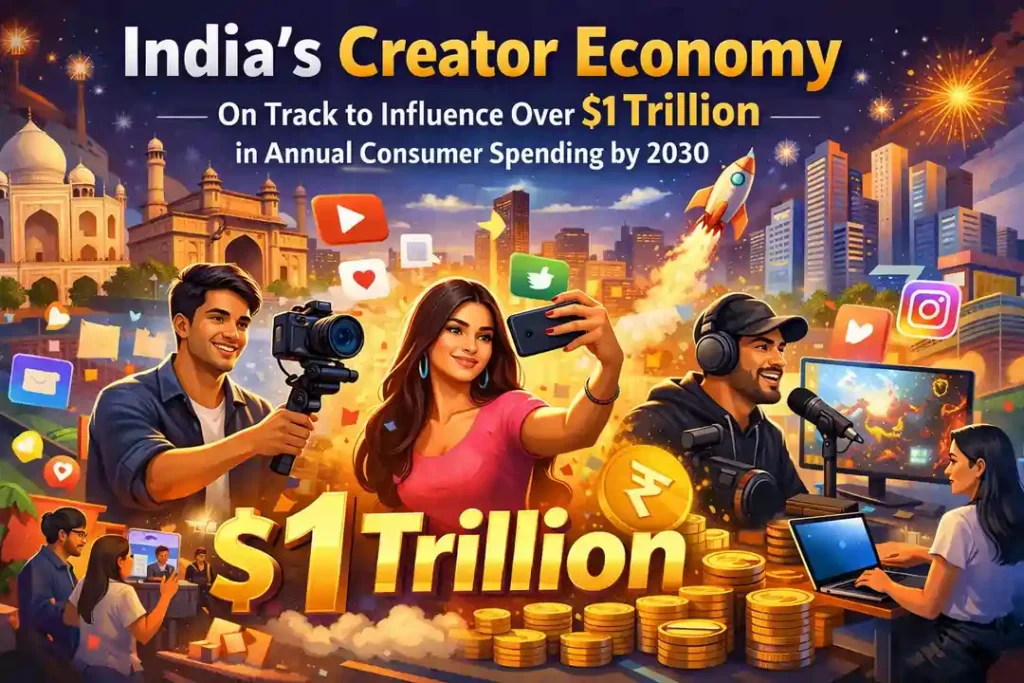
The report projects that by 2030 creator-driven recommendations and content will influence more than USD 1 trillion in annual consumer spending — a sharp increase from the current estimated range of USD 350–400 billion.
Scale of Influence Today
BCG estimates that India currently has 2.0 to 2.5 million monetised digital creators. Collectively they are reported to affect more than 30 percent of all purchase decisions made by Indian consumers across a broad spectrum of categories — fashion, personal care, consumer electronics, home appliances, nutrition products and daily essentials.
Survey data included in the study show that over 60 percent of respondents encounter creator content on a regular basis, while more than one in three consumers explicitly link at least some of their recent purchases to creators they follow.
A Structural Shift in Marketing Logic
Parul Bajaj, who leads BCG’s Marketing, Sales and Pricing Practice in India, described the development as a permanent change in the rules of brand-building.
“The creator economy in India has crossed an irreversible threshold,” she said. “It is no longer an experimental or supplementary channel. For the next decade, meaningful growth will depend on how effectively companies integrate creators into the centre of their customer-acquisition and brand-equity strategies.”
The report argues that the most successful organisations will move away from one-off sponsorship deals and instead build multi-year relationships, implement compensation models tied to tangible business outcomes, and design campaigns that prioritise natural product discovery over interruptive advertising.
Consumption Patterns Fueling Growth
Four years of uninterrupted growth in digital engagement provide the underlying momentum. Average weekly time spent watching digital content rose from 6.6 hours in FY 2020 to 10.9 hours in FY 2024. During the same period India’s internet-using population expanded from roughly 740 million to 950 million people.
Importantly, creator influence is no longer confined to metropolitan Gen Z audiences. The report notes clear expansion into older age brackets and into tier-2, tier-3 and tier-4 cities, bringing premium and lifestyle products into the consideration sets of consumers who were previously less exposed to such categories.
Short-form video continues to dominate consumption, with comedy, film commentary, daily soap discussions and fashion content registering the highest viewership numbers.
Corporate Budget Reallocation Underway
Brand behaviour is adjusting rapidly. Seventy percent of companies surveyed by BCG intend to increase their creator marketing expenditure by 1.5× to 3× over the next two to three years. This planned reallocation reflects growing conviction that creator-led campaigns deliver superior trust, conversion and cost efficiency compared with many legacy channels.
Defining the Creator (Orange) Economy
The creator economy — sometimes referred to as the Orange Economy — describes an interconnected value chain that includes:
- individual content producers
- distribution platforms (YouTube, Instagram, regional short-video apps, etc.)
- brands seeking audience access
- supporting service providers (editing studios, analytics firms, talent agencies)
Monetisation occurs through a combination of platform ad revenue, direct brand partnerships, fan subscriptions, affiliate commissions and integrated e-commerce.
Creators differentiate themselves through content that feels personal, unscripted and rooted in lived experience rather than corporate messaging.
Measured Economic Footprint
YouTube reported that its creator ecosystem contributed more than ₹16,000 crore to India’s GDP in 2024. Beyond headline creators, the sector sustains a wide range of supporting roles — video editors, thumbnail designers, script researchers, lighting and sound technicians, data analysts and community moderators.
Wider industry estimates place the total number of people creating digital content (at any level of regularity) above 80 million. The organised creator economy market was valued at approximately USD 976 million in 2023 and is projected to reach nearly USD 3.93 billion by 2030. Select high-growth segments are expanding at compound annual rates approaching 45 percent through 2028.
India’s broader creative industries already account for close to 8 percent of national employment — a share notably higher than recorded in Turkey (1%), Mexico (1.5%), South Korea (1.9%) or Australia (2.1%).
Active Government Backing
Public policy has moved from passive observation to active support. Key interventions include:
- March 2025 launch of a USD 1 billion public-private fund offering creators access to growth capital, advanced training, production infrastructure and international market linkages
- World Audio Visual and Entertainment Summit (WAVES) 2025 in Mumbai, which featured a new digital marketplace called WAVES Bazaar connecting Indian talent with global buyers and investors
- Create in India Challenge (2024), a nationwide competition series covering animation, short films, game development, music, AI-generated visuals, reel creation and campaigns promoting handloom textiles
- Planned Indian Institute of Creative Technologies (IICT) in Mumbai, focused on professional education in media production, visual effects, gaming and digital storytelling
- Annual National Creators Award presented by the Prime Minister
- Ongoing work by the Animation, Visual Effects, Gaming and Comics (AVGC) Task Force
Persistent Structural Challenges
Despite strong tailwinds, several constraints remain:
- income unpredictability for the majority of creators
- frequent and opaque changes to platform distribution algorithms
- limited legal recourse in cases of intellectual property violation
- persistent trust issues caused by fake followers, purchased engagement and undisclosed paid promotions
Solving or substantially mitigating these pain points will determine whether the ecosystem can scale smoothly toward the projected trillion-dollar influence level.
Strategic Imperative for the Coming Decade
For brands, platforms and policymakers alike, the message is unambiguous: the centre of gravity in Indian consumer decision-making has shifted decisively toward authentic digital voices.
The trajectory now visible suggests that by the end of the decade India will host one of the world’s largest and most economically consequential creator economies — a development that combines cultural dynamism, employment generation and direct commercial impact at unprecedented scale.
FAQs
1. What is the projected impact of India’s creator economy on consumer spending by 2030?
According to the Boston Consulting Group (BCG) report, creator-influenced annual consumer spending in India is expected to exceed $1 trillion by 2030. Currently, it stands at an estimated $350–400 billion, driven by the recommendations and content of digital creators.
2. How many monetised creators are active in India today, and how much influence do they have?
India has approximately 2 to 2.5 million monetised digital creators. These creators collectively influence more than 30% of all consumer purchase decisions across categories such as fashion, beauty, electronics, and daily essentials.
3. Why are brands planning to increase their spending on creator marketing?
Seventy percent of brands surveyed plan to boost their creator marketing budgets by 1.5 to 3 times over the next two to three years. They recognise that creators deliver authentic, trust-based engagement that drives higher conversion rates compared with traditional advertising channels.
4. What is the creator economy (or Orange Economy), and how does it generate revenue?
The creator economy is an ecosystem connecting individual content producers, digital platforms, brands, and service providers. Creators earn through multiple streams including platform ad revenue shares, brand sponsorships, fan subscriptions, affiliate commissions, and direct e-commerce integrations. It is also called the Orange Economy due to its focus on creative and cultural industries.
5. What government initiatives are supporting the growth of India’s creator economy?
Key initiatives include:
Support from the AVGC (Animation, Visual Effects, Gaming, and Comics) Task Force
A $1 billion public-private fund launched in March 2025 for capital, training, and global market access
The World Audio Visual and Entertainment Summit (WAVES) 2025 and its WAVES Bazaar marketplace
The Create in India Challenge (2024) with nationwide competitions
The upcoming Indian Institute of Creative Technologies (IICT) in Mumbai
The annual National Creators Award presented by the Prime Minister