

New Delhi: In a short yet highly productive official visit, President of the United Arab Emirates (UAE), His Highness Sheikh Mohamed bin Zayed Al Nahyan, popularly known as MBZ, traveled to New Delhi on January 19, 2026, at the personal invitation of Prime Minister Narendra Modi. Lasting approximately three hours—or even less according to some accounts—the visit generated significant online discussion due to its brevity, but official statements from both governments revealed a packed agenda of substantial outcomes that further solidified the India-UAE Comprehensive Strategic Partnership.
This marked Sheikh Mohamed bin Zayed’s third official visit to India since becoming UAE President and his fifth trip to the country in the past decade. The visit came on the heels of several high-level exchanges, including those by Abu Dhabi Crown Prince Sheikh Khaled bin Mohamed bin Zayed Al Nahyan in September 2024 and Dubai Crown Prince Sheikh Hamdan bin Mohammed bin Rashid Al Maktoum in April 2025. Diplomatic relations between India and the UAE, established in 1972, have grown steadily, with the UAE opening its embassy in New Delhi that year and India following suit in Abu Dhabi in 1973.
Arrival and Warm Reception Highlight Personal Ties
Upon landing at Palam Air Base in New Delhi on the evening of January 19, Sheikh Mohamed bin Zayed was greeted personally by Prime Minister Narendra Modi, who broke traditional protocol to offer a warm embrace—a gesture widely interpreted as symbolizing the deep “brotherhood” between the two nations. Accompanied by a high-powered delegation that included key ministers and senior figures such as Sheikh Hamdan bin Mohammed Al Maktoum (Crown Prince of Dubai, Deputy Prime Minister, and Minister of Defence), Sheikh Hamed bin Zayed Al Nahyan, Sheikh Abdullah bin Zayed Al Nahyan (Minister of Foreign Affairs), and others, the UAE leader proceeded directly to meetings with the Indian Prime Minister at his residence.
The discussions focused on reviewing the entire spectrum of bilateral cooperation, with both leaders expressing satisfaction over the steady strengthening of ties over the past decade. They emphasized mutual respect for sovereignty, territorial integrity, and strategic autonomy, while underscoring defence and security collaboration as a foundational element of their comprehensive partnership.
Social Media Speculation Over the Short Duration
The visit’s condensed timeline—reports varied from about one hour and 45 minutes to around three hours—prompted widespread speculation on social media platforms like X (formerly Twitter). Users described it as “He came, met Modi, left,” questioning the urgency behind such a brief stopover that included virtually the entire UAE leadership team. Comments ranged from observations of “extreme importance and urgency” to suggestions that “something significant happened” during the quick engagement. One user noted, “MBZ brought almost everyone that matters in the UAE along with him for a 2-hour visit,” reflecting the intrigue.
However, the subsequent joint statement and list of outcomes released by the governments of India and the UAE clarified that the visit was carefully planned and invitation-based, yielding concrete results that would require prior coordination. The brevity appeared to reflect efficiency rather than haste, allowing focused, high-impact deliberations without extended ceremonial elements.
Strong Condemnation of Terrorism and Security Cooperation
A central theme of the talks was unwavering opposition to terrorism. Both leaders reiterated their unequivocal condemnation of terrorism in all forms, including cross-border terrorism, and stressed that no country should offer safe haven to those who finance, plan, support, or carry out terrorist acts. They committed to enhanced cooperation through the Financial Action Task Force (FATF) framework to combat terror financing and bolster anti-money laundering measures.
This stance gained added context amid regional dynamics, including reported tensions between the UAE and Saudi Arabia over issues like oil production policies within OPEC+, economic competition, approaches to Yemen, relations with Iran, and engagement with global powers. Recent allegations by a Saudi-backed Yemeni official regarding a supposed UAE-run secret prison in southern Yemen—denied by Abu Dhabi—further highlighted Gulf rivalries. Additionally, Saudi Arabia’s recent defence agreement with Pakistan, which treats an attack on one as aggression against both, provided backdrop to the India-UAE focus on countering terror financing.
Ambitious Trade Target and Economic Initiatives
One of the standout announcements was the agreement to double bilateral trade to over US$ 200 billion by 2032. This builds on the momentum from the Comprehensive Economic Partnership Agreement (CEPA) signed in 2022, which propelled bilateral trade to nearly USD 100 billion by FY 2024–25. The UAE remains India’s third-largest trading partner overall and second-largest export destination, while serving as a major supplier of crude oil, LNG, and LPG.
To achieve the new target, both sides pledged to explore new markets via initiatives such as Bharat Mart, the Virtual Trade Corridor, and Bharat-Africa Setu. The UAE also continues to support India’s Strategic Petroleum Reserves (SPR) enhancement.
Energy Security Through Long-Term LNG Deal
Energy cooperation featured prominently with the signing of a Sales and Purchase Agreement (SPA) for 0.5 million tonnes per annum (MTPA) of LNG supply from ADNOC Gas to Hindustan Petroleum Corporation Limited (HPCL) over 10 years. Leaders expressed satisfaction with the robust energy partnership and the UAE’s role in India’s energy security.
Defence, Nuclear, AI, and Emerging Tech Collaborations
A Letter of Intent was signed toward concluding a Strategic Defence Partnership, establishing a framework for deepened cooperation in technology, training, and cyber domains.
In civil nuclear cooperation, the two countries agreed to explore partnerships in advanced technologies, including Small Modular Reactors (SMRs), large reactors, and nuclear safety, facilitated by India’s recent enactment of the SHANTI Act 2025.
Technology ties advanced with plans for a supercomputing cluster under India’s AI Mission. The UAE expressed support for India’s AI Impact Summit scheduled for February 2026.
Other areas included joint infrastructure for space development and commercialization, such as launch complexes, and discussions on establishing Digital/Data Embassies—offshore facilities for storing critical digital data to ensure continuity against cyberattacks, disasters, or conflicts.
Broader Context of Multifaceted Ties
The India-UAE relationship encompasses strong political, cultural, and economic dimensions. Supported by CEPA, the Local Currency Settlement system, and the Bilateral Investment Treaty, the partnership includes long-term energy arrangements and investments. Both nations collaborate at the United Nations and participate in platforms like BRICS, I2U2 (India-Israel-UAE-USA), and the UAE-France-India Trilateral. The UAE attended the G20 Summit as a guest during India’s presidency.
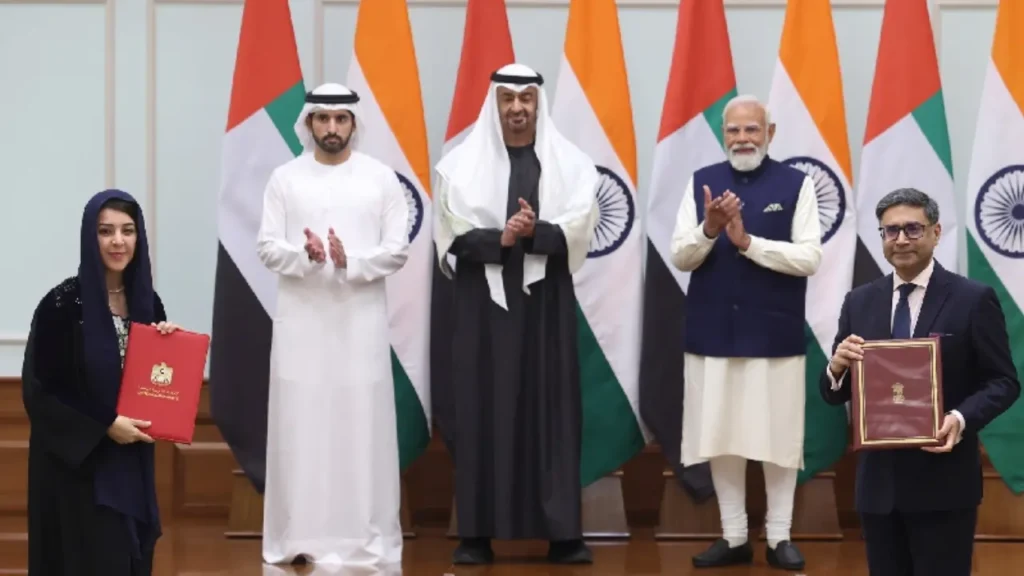
Prime Minister Modi shared a photograph with the full UAE delegation, expressing delight at hosting the group. Sheikh Mohamed bin Zayed posted on X, noting pleasure in discussing ways to strengthen historical ties and committing to sustainable development, economic growth, and progress in future-focused sectors for mutual benefit.
Conclusion: A Milestone in Deepening Ties
Despite its short duration, Sheikh Mohamed bin Zayed Al Nahyan’s January 19, 2026, visit to India delivered a series of strategic announcements and agreements that promise to elevate bilateral relations to new heights. From doubling trade ambitions and securing energy supplies to advancing defence, nuclear, AI, and digital sovereignty initiatives, the outcomes reflect shared priorities in a complex global landscape. As India and the UAE continue to converge on regional and international issues, this visit underscores the enduring strength and forward momentum of their comprehensive strategic partnership.
FAQs
1. Why was the UAE President’s visit to India so short, and what sparked the online buzz?
The visit lasted only about three hours (with some reports estimating as little as 1 hour 45 minutes to around 3 hours), from arrival in the late afternoon to departure in the evening. Sheikh Mohamed bin Zayed Al Nahyan landed at Palam Air Base, where he was personally received by PM Modi with a warm embrace, held focused talks at the Prime Minister’s residence, witnessed the exchange of agreements, and departed shortly after.
The brevity led to widespread speculation on social media platforms like X, with users calling it a “he came, met Modi, and left” trip and questioning the urgency since the UAE leader was accompanied by a powerful delegation including key Crown Princes, the Foreign Minister, and other senior figures. Many described it as unusual for a state visit, suggesting “something significant” or “extreme importance” must have been discussed. Official sources clarified that it was a planned, invitation-based working visit focused on substantive outcomes rather than extended ceremonies, making it efficient and high-impact despite the short duration.
2. What is the new bilateral trade target set during the visit, and how does it build on existing ties?
During the meeting, India and the UAE agreed to double bilateral trade to over US$ 200 billion by 2032. This ambitious goal builds directly on the success of the Comprehensive Economic Partnership Agreement (CEPA) signed in 2022, which drove trade to nearly USD 100 billion by FY 2024–25.
The UAE is already India’s third-largest trading partner overall and second-largest export destination. To reach the new target, both sides committed to promoting new markets through initiatives like Bharat Mart, the Virtual Trade Corridor, and Bharat-Africa Setu. The partnership also includes strong investment flows, the Local Currency Settlement system, and the Bilateral Investment Treaty, with the UAE continuing to support India’s Strategic Petroleum Reserves.
3. What major energy agreement was signed, and why is it important for India?
A key highlight was the Sales and Purchase Agreement (SPA) for the supply of 0.5 million tonnes per annum (MTPA) of LNG from ADNOC Gas (Abu Dhabi National Oil Company) to Hindustan Petroleum Corporation Limited (HPCL) over 10 years, starting in 2028. Valued at up to around $3 billion, this long-term deal strengthens India’s energy security by ensuring a reliable supply of liquefied natural gas.
The UAE remains one of India’s major suppliers of crude oil, LNG, and LPG. The agreement underscores the robust energy partnership and aligns with India’s efforts to diversify and secure stable energy imports amid global uncertainties.
4. What were the main defence and security outcomes from the talks?
The leaders signed a Letter of Intent toward concluding a Strategic Defence Partnership, creating a framework for deeper cooperation in defence technology, training, and cyber domains. Both sides reiterated their strong condemnation of terrorism in all forms, including cross-border terrorism, and committed to no safe havens for those involved in financing, planning, supporting, or committing terrorist acts. They pledged continued collaboration through the Financial Action Task Force (FATF) to counter terror financing and enhance anti-money laundering efforts. The discussions occurred against the backdrop of regional Gulf tensions (including UAE-Saudi differences over Yemen and other issues) and recent developments like Saudi Arabia’s defence pact with Pakistan.
5. What other key areas of cooperation were advanced during the visit?
Beyond trade, energy, and defence, the visit yielded progress in several forward-looking sectors:
- Civil nuclear cooperation — Exploring partnerships in advanced technologies like Small Modular Reactors (SMRs), large reactors, and nuclear safety, enabled by India’s SHANTI Act 2025.
- AI and technology — Plans for a supercomputing cluster under India’s AI Mission, with UAE support for the upcoming AI Impact Summit in February 2026.
- Digital sovereignty — Discussions on establishing Digital/Data Embassies (offshore centres for storing critical data to protect against cyberattacks, disasters, or conflicts).
- Space and infrastructure — Joint efforts in space development, commercialization, and launch facilities.
- Other MoUs/LoIs covered food safety, infrastructure investment (including UAE sovereign wealth funds in India’s upcoming Infrastructure Fund), and more.
Overall, the visit—Sheikh Mohamed bin Zayed’s fifth to India in the last decade and third as President—reinforced the deep-rooted, multi-faceted Comprehensive Strategic Partnership, with both leaders emphasizing mutual respect for sovereignty, strategic autonomy, and shared convergence on regional and global issues.