

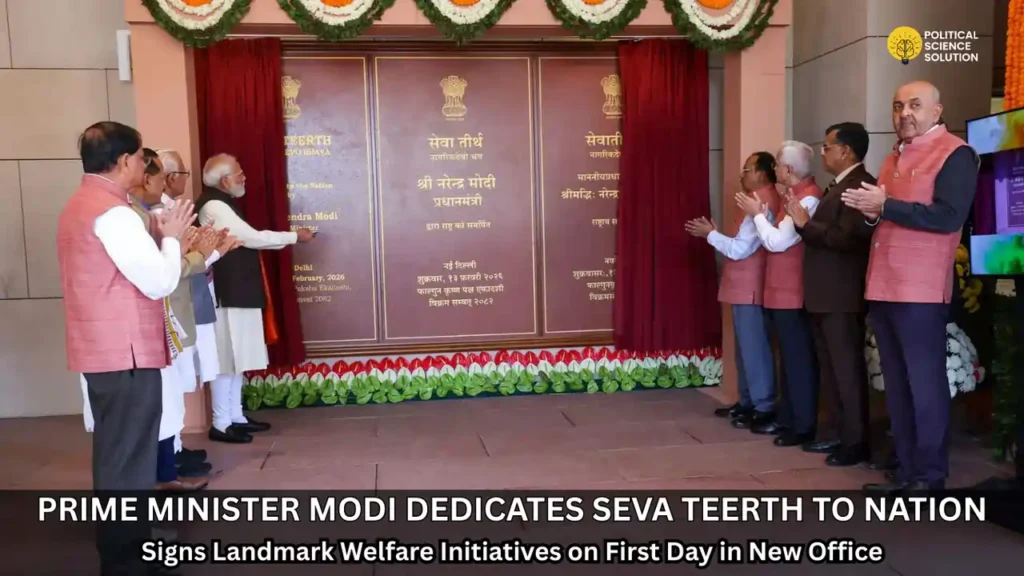
New Delhi: In a symbolic step toward modern, citizen-focused governance, Prime Minister Narendra Modi formally inaugurated the Seva Teerth complex in the national capital on February 13, 2026. This new integrated facility now serves as the headquarters for the Prime Minister’s Office (PMO), the National Security Council Secretariat, and the Cabinet Secretariat, consolidating operations that were previously spread across multiple locations.
The inauguration coincided with the 95th anniversary of New Delhi being declared India’s modern capital, lending extra historical weight to the occasion. Prime Minister Modi unveiled the name plaque of Seva Teerth, featuring the title in elegant Devanagari script alongside the guiding motto Nagrik Devo Bhava — meaning the citizen is divine. He described the complex as a pivotal milestone in India’s path to becoming a Viksit Bharat (Developed India), moving away from colonial-era structures toward buildings designed for efficient, service-oriented administration.
In his remarks and subsequent social media posts, the Prime Minister emphasized selfless service as the core philosophy. He stated that Seva Teerth stands as a beacon of duty, compassion, and unwavering commitment to putting India first, inspiring future generations to embrace selfless dedication for the nation’s welfare.
As part of the Central Vista redevelopment project, the shift relocates the PMO from the iconic but space-constrained South Block. The older premises are set to be transformed into a museum, preserving their heritage while allowing contemporary governance to flourish in purpose-built surroundings. The complex also includes Kartavya Bhavan-1 and Kartavya Bhavan-2, accommodating several important ministries for improved coordination.
Reflecting the name’s emphasis on service (“Seva”), Prime Minister Modi’s inaugural actions from the new office centered on impactful welfare measures. He personally signed key approvals benefiting vulnerable groups, women, farmers, youth, and accident victims, demonstrating a governance model rooted in empathy and rapid response to societal needs.
Revolutionary PM RAHAT Scheme Launched to Save Lives on Roads
Among the most immediate and compassionate decisions was the approval of the PM RAHAT (Road Accident Victim Hospitalization and Assured Treatment) scheme. This initiative directly addresses the tragic reality where many road accident victims lose their lives due to delayed or unaffordable medical care during the critical early hours.
Under PM RAHAT, eligible victims of road accidents — regardless of road category — qualify for cashless treatment up to ₹1.5 lakh per person, valid for seven days from the accident date. Stabilization care extends up to 24 hours for non-life-threatening injuries and up to 48 hours for critical cases, contingent on timely police verification via a digital platform.
The scheme operates through advanced technological integration, linking the Ministry of Road Transport and Highways’ Electronic Detailed Accident Report (eDAR) system with the National Health Authority’s Transaction Management System (TMS 2.0). This creates an end-to-end digital workflow covering accident reporting, hospital admission, authentication, treatment delivery, claim submission, and reimbursement — reducing administrative delays and ensuring swift emergency intervention.
By guaranteeing financial security for hospitals and prioritizing life-saving action, PM RAHAT aims to eliminate preventable deaths caused by economic barriers in the “golden hour” after crashes.
Lakhpati Didi Program Scaled Up to Empower 6 Crore Rural Women
In a resounding endorsement of women’s economic independence, the Prime Minister doubled the ambitious target under the Lakhpati Didi Initiative. Having already exceeded the earlier goal of 3 crore Lakhpati Didis well before the March 2027 deadline, the government now aims for 6 crore Lakhpati Didis by March 2029.
Managed by the Ministry of Rural Development through the Deendayal Antyodaya Yojana-National Rural Livelihoods Mission (DAY-NRLM), the program targets women in self-help groups (SHGs). It equips them with skills, access to finance, market linkages, and opportunities to diversify income sources — from operating micro-enterprises to managing livestock or other sustainable ventures.
A Lakhpati Didi is officially recognized as an SHG member whose household sustains an annual income of at least ₹1 lakh. The accelerated achievement and expanded vision underscore the scheme’s success in driving rural poverty reduction and gender equity.
Agriculture Infrastructure Fund Expanded to ₹2 Lakh Crore for Stronger Farm Ecosystem
Farmers stand to gain substantially from the doubling of the Agriculture Infrastructure Fund loan target, raised from ₹1 lakh crore to ₹2 lakh crore. This central sector scheme, originally spanning 2020-21 to 2029-30, provides affordable financing for post-harvest infrastructure, storage facilities, processing units, and related assets.
Beneficiaries enjoy a 3% annual interest subvention and credit guarantee support (up to ₹2 crore loans) via the Credit Guarantee Fund Trust for Micro and Small Enterprises. The enhanced allocation seeks to minimize post-harvest losses, boost value addition, stabilize farmer incomes, and modernize the agriculture value chain from farm to market.
Startup India Fund of Funds 2.0 Approved with ₹10,000 Crore Corpus
To catalyze the next wave of entrepreneurial growth, the Prime Minister greenlit Startup India Fund of Funds 2.0 (FFS 2.0), backed by a fresh ₹10,000 crore corpus. Announced in the 2025-26 Budget and overseen by the Department for Promotion of Industry and Internal Trade (DPIIT), this successor to the original FFS prioritizes manufacturing, high-technology, deep tech innovations, early-stage ventures, and breakthrough ideas needing extended capital.
Administered by the Small Industries Development Bank of India (SIDBI), it channels resources through SEBI-registered Alternative Investment Funds (AIFs) that invest in startups. Building on FFS 1.0’s track record — which backed 145 AIFs, mobilized over ₹25,500 crore, and supported more than 1,370 startups — the new version focuses on patient capital for high-risk sectors, non-metro ecosystems, first-time entrepreneurs, and self-reliant innovation.
These four landmark approvals, executed on day one at Seva Teerth, illustrate a comprehensive strategy for inclusive progress. From emergency healthcare and women’s empowerment to agricultural resilience and startup vitality, the measures align with the government’s vision of service-driven development that uplifts every segment of society.
As Seva Teerth begins its journey as the nerve center of Indian governance, it embodies a renewed pledge to place citizens at the heart of policy and action — truly living up to its name as a sacred space of service.
FAQs
1. What is the PM RAHAT scheme, and who can benefit from it?
The PM RAHAT (Road Accident Victim Hospitalization and Assured Treatment) scheme provides cashless medical treatment up to ₹1.5 lakh for victims of road accidents on any category of road. Coverage lasts for up to 7 days from the accident date, with stabilization treatment for 24 hours (non-life-threatening cases) or 48 hours (life-threatening cases), subject to police authentication via a digital system. It integrates the Ministry of Road Transport and Highways’ eDAR platform with the National Health Authority’s TMS 2.0 for seamless reporting, admission, verification, treatment, and claims. The goal is to prevent deaths due to delayed care from financial barriers, benefiting any eligible road accident victim in India.
2. What does the doubling of the Lakhpati Didi target mean, and how is it achieved?
The government has revised the Lakhpati Didi Initiative target from 3 crore to 6 crore by March 2029, after surpassing the original 3 crore milestone more than a year ahead of the March 2027 deadline. Under the Ministry of Rural Development’s Deendayal Antyodaya Yojana-National Rural Livelihoods Mission (DAY-NRLM), it supports rural women in self-help groups (SHGs) to earn a sustainable annual household income of at least ₹1 lakh through skilling, financial inclusion, market access, and diversified livelihoods like micro-enterprises or livestock management. This expansion aims to accelerate women’s economic empowerment and rural poverty alleviation on a larger scale.
3. How has the Agriculture Infrastructure Fund been enhanced, and what will it support?
The loan target under the Agriculture Infrastructure Fund has been doubled from ₹1 lakh crore to ₹2 lakh crore. This central sector scheme (running from 2020-21 to 2029-30) offers 3% annual interest subvention and credit guarantee coverage (up to ₹2 crore loans) via the Credit Guarantee Fund Trust for Micro and Small Enterprises. The increased allocation strengthens the entire agriculture value chain by funding post-harvest infrastructure, storage, processing units, and related facilities to reduce losses, add value, improve farmer incomes, and promote modern practices across rural India.
4. What is Startup India Fund of Funds 2.0, and why was it approved now?
Startup India Fund of Funds 2.0 (FFS 2.0) has been approved with a ₹10,000 crore corpus to mobilize venture capital for the startup ecosystem. Managed by SIDBI under the Department for Promotion of Industry and Internal Trade (DPIIT), it invests through SEBI-registered Alternative Investment Funds (AIFs) and focuses on deep tech, innovative manufacturing, early-stage ideas, breakthrough technologies, and long-term funding needs. Building on FFS 1.0 (which supported over 1,370 startups via ₹25,500+ crore investments), this version targets high-risk sectors, non-metro areas, first-time founders, and self-reliant innovation to drive India’s next phase of entrepreneurial growth.
5. What is Seva Teerth, and why is its inauguration significant?
Seva Teerth is the new integrated complex in New Delhi that houses the Prime Minister’s Office (PMO), National Security Council Secretariat, and Cabinet Secretariat, along with Kartavya Bhavan-1 and -2 for key ministries. Inaugurated by PM Modi on February 13, 2026 (coinciding with New Delhi’s 95th capital anniversary), it marks the PMO’s relocation from South Block under the Central Vista project. The name, inscribed in Devanagari with the motto Nagrik Devo Bhava (citizen is divine), symbolizes citizen-centric, efficient governance and the shift to modern facilities for better coordination. The first decisions from this new office—launching welfare schemes for vulnerable citizens, women, farmers, and youth—reflect its guiding spirit of selfless service (Seva) toward building a Viksit Bharat.