

New Delhi: India has solidified its position as a global leader in biodiversity governance by submitting its First National Report (NR1) on the implementation of the Nagoya Protocol on Access and Benefit Sharing (ABS) to the Secretariat of the Convention on Biological Diversity (CBD). The report, delivered on February 27, 2026, by the Ministry of Environment, Forest and Climate Change (MoEFCC) in collaboration with the National Biodiversity Authority (NBA), covers the period from November 1, 2017, to December 31, 2025.
This submission fulfills India’s obligations under Article 29 of the Nagoya Protocol and contributes directly to Target 13 of the country’s updated National Biodiversity Strategy and Action Plan (NBSAP) 2024–2030. It follows the submission of India’s Seventh National Report (NR-7) to the CBD just one day earlier on February 26, 2026.
Understanding the Nagoya Protocol: A Cornerstone of Global Biodiversity Equity
The Nagoya Protocol, formally known as the Nagoya Protocol on Access to Genetic Resources and the Fair and Equitable Sharing of Benefits Arising from their Utilization, serves as a supplementary agreement to the Convention on Biological Diversity. The CBD itself originated at the 1992 Rio Earth Summit and entered into force in 1993.
Adopted in 2010 and effective from 2014, the Protocol’s primary goal is to ensure fair and equitable benefit sharing from the utilization of genetic resources while promoting biodiversity conservation and sustainable use. It applies to genetic resources from plants, animals, and microorganisms, as well as associated traditional knowledge (TK) held by indigenous and local communities.
Key obligations under the Protocol include:
- Access requiring Prior Informed Consent (PIC) from the providing party.
- Benefit Sharing governed by Mutually Agreed Terms (MAT).
- Compliance mechanisms to verify adherence to PIC and MAT conditions.
India has domesticated these international commitments through the Biological Diversity Act, 2002, supported by the Biological Diversity Rules, 2024, and ABS Regulations, 2025.
India’s Robust Three-Tier Institutional Framework for ABS Implementation
India operates a well-structured, decentralized system comprising three levels of governance:
- National Biodiversity Authority (NBA) – Handles approvals for foreign entities, research, IPR-related activities, and high-level oversight.
- State Biodiversity Boards (SBBs) / Union Territory Biodiversity Councils – Manage approvals for domestic commercial utilization.
- Biodiversity Management Committees (BMCs) – Local-level bodies (over 276,653 established nationwide) that ensure grassroots participation in conservation and benefit sharing.
This architecture empowers communities, farmers, and traditional knowledge holders to play active roles in biodiversity decision-making.
Key Achievements Highlighted in the First National Report
Between 2017 and 2025, India demonstrated exceptional performance in ABS implementation:
- Issued a total of 12,830 ABS approvals:
- 5,913 by the NBA (under Section 3(2) of the Act) for research, commercial use, bio-surveys, IPR, and transfers.
- 6,917 by SBBs/UTBCs (under Section 7) for domestic commercial utilization.
- Published 3,556 Internationally Recognised Certificates of Compliance (IRCCs) on the ABS Clearing-House — representing over 60% of the global total, showcasing India’s leadership in transparency.
Monetary benefits generated include:
- ₹216.31 crore (≈ USD 28.04 million) mobilized through NBA approvals.
- ₹139.69 crore (≈ USD 16.83 million) disbursed to benefit claimers — BMCs, local communities, farmers, and traditional knowledge holders.
- ₹51.96 crore generated via SBB approvals for domestic entities.
Non-monetary benefits featured in 395 NBA approvals, including technology transfer, collaborative research, and capacity building.
India also monitored foreign-sourced bioresources, receiving 41 declarations in Form 10 as required under the 2024 Rules and Section 36A of the Act.
Massive Capacity Building and Community Empowerment Efforts
India invested heavily in awareness and training:
- Trained 256,393 individuals through 3,724 workshops and programmes.
- Conducted over 600 additional capacity-building initiatives nationwide.
These efforts have strengthened local governance and ensured effective participation in ABS mechanisms.
Broader Biodiversity Progress in the Seventh National Report
The Nagoya report complements India’s Seventh National Report, which assesses progress against 23 National Biodiversity Targets using 142 indicators. All targets are reported as “on track”, aligning with the Kunming-Montreal Global Biodiversity Framework (aiming to halt and reverse biodiversity loss by 2030).
Notable highlights include:
- Forest and tree cover: 25.17% of geographical area (827,356.95 sq km).
- Ramsar wetlands increased from 26 (2014) to 98 (2026).
- Protected areas: 58 tiger reserves, 33 elephant reserves, 18 biosphere reserves, 106 national parks, 574 wildlife sanctuaries.
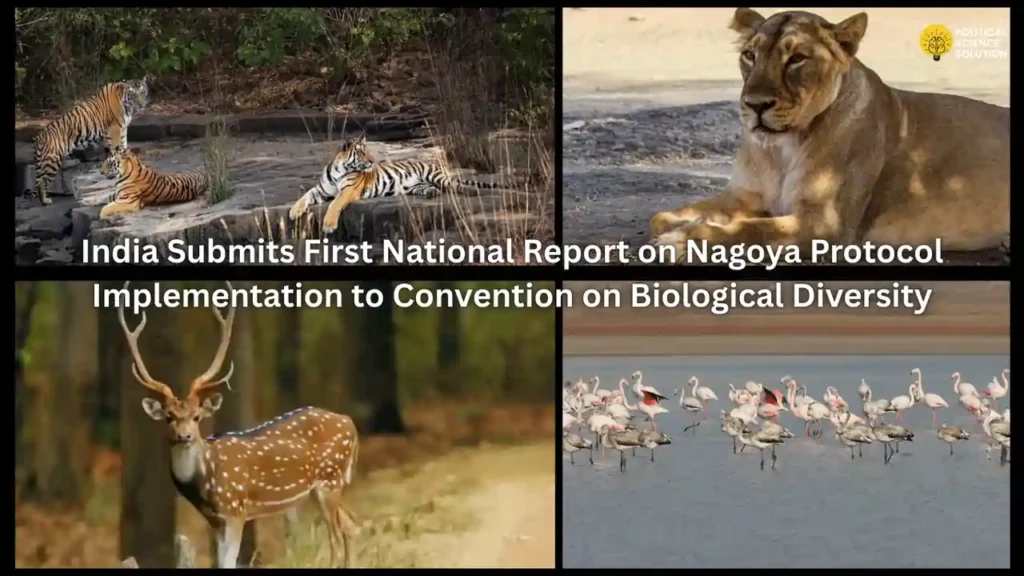
- Wildlife populations: 3,682 tigers (>70% of global total), 4,014 one-horned rhinos, 22,446 wild elephants, 891 Asiatic lions, 718 snow leopards, and 6,327 river dolphins (Project Dolphin estimate).
- Agrobiodiversity: 22 hotspots identified; conservation prioritized for 769 crop wild relatives across 171 native crops and 230 native animal breeds.
Advanced monitoring tools — remote sensing, GIS, drones, camera traps, satellite telemetry, and DNA-based methods — support these conservation gains.
India’s Leadership and Future Outlook
With a strong legal foundation, extensive institutional network, and proven benefit-sharing outcomes, India has emerged as a model for Nagoya Protocol implementation. The dual submissions in February 2026 reflect a “whole-of-government and whole-of-society” commitment involving 33 Central Ministries, states, research bodies, and communities.
The reports reaffirm India’s dedication to global biodiversity goals, equitable resource use, and sustainable development. Full details of the First National Report on Nagoya Protocol are available on the CBD’s ABS Clearing-House portal for India.
As the international community works toward 2030 targets, India’s transparent, community-centered approach offers valuable lessons and inspiration worldwide.
FAQs
1. What is the Nagoya Protocol, and why did India submit its First National Report?
The Nagoya Protocol is a supplementary international agreement to the Convention on Biological Diversity (CBD), adopted in 2010 and entering into force in 2014. It focuses on ensuring the fair and equitable sharing of benefits arising from the utilization of genetic resources (from plants, animals, microorganisms) and associated traditional knowledge, while supporting biodiversity conservation and sustainable use. Countries must obtain Prior Informed Consent (PIC) for access and negotiate Mutually Agreed Terms (MAT) for benefit sharing.
India submitted its First National Report (NR1) to the CBD Secretariat on February 27, 2026, as required under Article 29 of the Protocol for monitoring and reporting progress. This report covers November 1, 2017, to December 31, 2025, and demonstrates India’s strong implementation while aligning with Target 13 of the updated National Biodiversity Strategy and Action Plan (NBSAP) 2024–2030. (India previously submitted an interim report in 2017.)
2. How does India implement the Nagoya Protocol domestically?
India implements the Protocol primarily through the Biological Diversity Act, 2002, reinforced by the Biological Diversity Rules, 2024, and ABS Regulations, 2025. It uses a robust three-tier institutional structure:
- National Biodiversity Authority (NBA) — Handles approvals for foreign entities, research, commercial utilization, IPR applications, and transfers.
- State Biodiversity Boards (SBBs) / Union Territory Biodiversity Councils — Manage approvals for domestic commercial use.
- Biodiversity Management Committees (BMCs) — Local-level bodies (over 276,653 established nationwide) that ensure community participation, especially among farmers, indigenous groups, and traditional knowledge holders.
This decentralized framework promotes transparency, compliance, and grassroots involvement in biodiversity governance.
3. What are the key achievements highlighted in India’s First National Report on the Nagoya Protocol?
During 2017–2025, India achieved significant milestones in ABS implementation:
- Issued 12,830 ABS approvals (5,913 by NBA under Section 3(2) for activities like research, bio-surveys, commercial use, and IPR; 6,917 by SBBs under Section 7 for domestic entities).
- Published 3,556 Internationally Recognised Certificates of Compliance (IRCCs) on the ABS Clearing-House — representing over 60% of the global total, showcasing leadership in transparency.
- Mobilized ₹216.31 crore (≈ USD 28.04 million) through NBA approvals, with ₹139.69 crore (≈ USD 16.83 million) disbursed to benefit claimers (BMCs, communities, farmers, traditional knowledge holders). An additional ₹51.96 crore came from SBB approvals.
- Included non-monetary benefits (e.g., technology transfer, collaborative research, training) in 395 approvals.
- Received 41 declarations for utilization of foreign-sourced bioresources.
These outcomes support livelihoods, conservation, and equitable benefit distribution.
4. What capacity-building and community empowerment efforts has India undertaken under the Nagoya Protocol?
India has prioritized awareness and training to strengthen ABS implementation:
- Established more than 2,76,653 Biodiversity Management Committees (BMCs) nationwide to enable local communities to participate in governance and benefit sharing.
- Trained 256,393 individuals through 3,724 workshops and programmes.
- Conducted over 600 additional capacity-building initiatives.
These efforts empower local stakeholders, enhance understanding of biodiversity laws, and ensure effective community roles in conservation and equitable resource use.
5. How does the Nagoya Protocol report connect to India’s broader biodiversity progress?
The First National Report on the Nagoya Protocol was submitted alongside India’s Seventh National Report (NR-7) to the CBD (on February 26, 2026). NR-7 assesses 23 National Biodiversity Targets (using 142 indicators) under the updated NBSAP and reports all targets as “on track”, aligning with the Kunming-Montreal Global Biodiversity Framework (to halt and reverse biodiversity loss by 2030).
Key broader highlights include expanded forest/tree cover (25.17% of geographical area), increase in Ramsar wetlands (from 26 in 2014 to 98 in 2026), strong protected area network (58 tiger reserves, 106 national parks, etc.), thriving wildlife populations (e.g., 3,682 tigers — over 70% of global total), and conservation priorities for agrobiodiversity (22 hotspots, 769 crop wild relatives). Advanced tools like drones, GIS, and DNA-based monitoring support these gains.
Together, the reports showcase India’s “whole-of-government and whole-of-society” commitment to sustainable biodiversity management and global leadership in fair benefit sharing.