

New Delhi: In a landmark step toward cleaner energy and reduced dependence on imported fossil fuels, the Ministry of Petroleum and Natural Gas has enforced a nationwide directive effective April 1, 2026, mandating the dispensing of E20 fuel with a minimum Research Octane Number (RON) rating of 95 at all petrol pumps across India. This move represents a decisive acceleration in the country’s biofuel integration strategy, directly impacting every vehicle owner, oil marketing company, and agricultural stakeholder. With the policy now active in every state and Union Territory, motorists are encountering the new fuel standard at refuelling stations, prompting widespread questions about performance, engine health, and economic ripple effects.
The directive, issued through a formal notification on February 17, requires oil marketing companies to supply petrol blended with up to 20 percent ethanol while strictly adhering to Bureau of Indian Standards (BIS) specifications. This ensures consistent quality and uniform performance nationwide. Although the Centre has permitted limited exemptions for specific regions or exceptional circumstances on a short-term basis, the default expectation is full compliance to maintain the integrity of the fuel supply chain. The timing aligns precisely with the advanced targets set under the National Policy on Biofuels, originally introduced in 2018 and amended in 2022, which brought forward the 20 percent ethanol blending goal to the Ethanol Supply Year (ESY) 2025-26 instead of the earlier 2030 deadline.
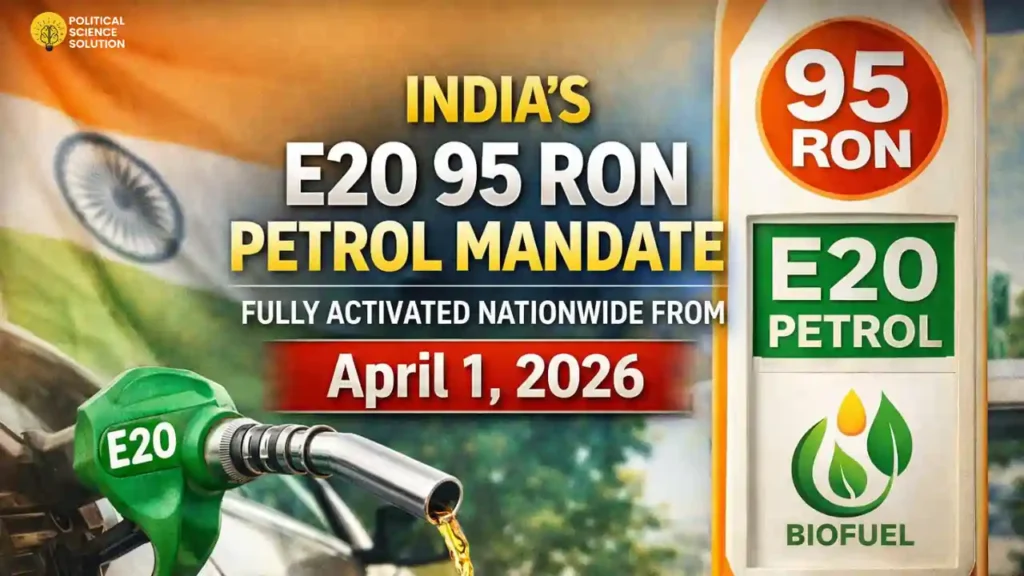
Decoding E20 Fuel: Composition, RON Significance, and Technical Foundations
At its core, E20 fuel consists of an 80:20 mixture of conventional petrol and ethanol. Ethanol, chemically known as ethyl alcohol and composed of carbon, hydrogen, and oxygen atoms, functions as a high-octane biofuel derived through the fermentation process from plant-based sugars and starches. Primary feedstocks include crops such as sugarcane, maize, corn, barley, wheat, and sorghum, all of which are domestically cultivated, thereby creating direct linkages to India’s agricultural sector.
RON serves as a critical indicator of fuel stability, measuring the level of pressure generated during combustion inside a vehicle’s engine cylinders. A higher RON rating translates to greater resistance against premature ignition or “knocking,” which can otherwise cause uneven combustion, reduced efficiency, and accelerated long-term engine wear. Prior to widespread E20 adoption, standard petrol in India typically carried an octane rating of around 91 to 92 RON. Ethanol, by contrast, boasts a naturally high octane value of approximately 108 RON. Industry estimates indicate that blending 20 percent ethanol elevates the overall octane level by nearly 6 points, resulting in E20 petrol achieving roughly 97 to 98 RON in practice. The mandated minimum of 95 RON thus provides a substantial buffer, enhancing combustion stability especially under high compression ratios common in modern engines.
This technical upgrade builds upon earlier blending phases. India progressed from E5 blending in 2003 to E10 by 2022. The current shift to E20 five years ahead of the original schedule underscores a proactive policy stance aimed at addressing multiple national priorities simultaneously.
Policy Evolution and the Broader Ethanol Blending Roadmap
The National Policy on Biofuels framework, updated in 2022, explicitly advanced the 20 percent blending target to capitalize on domestic production capabilities. Ethanol’s role extends beyond mere fuel supplementation; as an octane booster, it reduces the need for additional chemical additives in base petrol formulations. Traditional petrol blends incorporate various enhancers, including detergents for cleaning engine components, antioxidants to prevent degradation, corrosion inhibitors for system protection, and dedicated octane boosters to optimize performance and minimize knocking.
The February 17 notification emphasizes that all dispensed E20 must meet BIS specifications, promoting reliability across diverse climatic conditions and vehicle types. This standardized approach minimizes variability that could otherwise arise from regional supply differences. The policy’s implementation also includes provisions for monitoring and phased rollouts, with oil companies now obligated to prioritize E20 distribution while maintaining supplies of higher-grade, ethanol-free options like 100-octane premium fuels (such as XP100 or Power 100) for specialized applications.
Multifaceted Benefits Driving the E20 Transition
The rollout delivers tangible advantages across economic, environmental, and strategic domains. By incorporating 20 percent domestically produced ethanol, the mandate directly strengthens energy security by curtailing reliance on imported crude oil. India currently faces an annual oil import bill exceeding USD 130 billion, equivalent to approximately Rs 1.1 lakh crore. Each percentage point increase in ethanol blending translates to meaningful foreign exchange savings, with the E20 phase expected to amplify these gains substantially.
Environmentally, the blend promotes cleaner combustion, contributing to lower tailpipe carbon dioxide emissions and improved air quality. Ethanol burns more completely than pure hydrocarbon fuels, reducing overall greenhouse gas output. On the agricultural front, heightened demand for sugarcane, maize, and other feedstock crops bolsters rural economies and supports farmer incomes. The programme has already generated significant economic returns through prior blending stages, and the new mandate is projected to scale these benefits further while advancing sustainable mobility objectives.
From a vehicle performance perspective, the elevated octane rating enhances engine smoothness and combustion efficiency. Higher RON levels allow engines to operate closer to optimal parameters without detonation risks, potentially translating to more responsive acceleration and reduced mechanical stress during demanding conditions.
Addressing Concerns: Fuel Efficiency, Corrosion Risks, and Vehicle Longevity
Despite the upsides, the transition has raised valid concerns among motorists, particularly regarding compatibility with existing fleets. Reports highlight potential reductions in fuel efficiency for certain vehicles, alongside risks of corrosion or material degradation in older models. Ethanol’s inherent properties—its ability to attract and absorb moisture from the atmosphere—can introduce water into fuel systems over time. When vehicles remain idle for extended periods, this moisture separation may exacerbate issues, leading to corrosion of metal components and accelerated wear on plastic and rubber elements such as fuel lines, hoses, and gaskets.
These challenges are most pronounced in vehicles manufactured before April 2023. While E20 will not cause immediate mechanical failure in any car, prolonged exposure in non-compatible systems could hasten deterioration of fuel system components. Additionally, some owners have observed noticeable drops in mileage, prompting questions about real-world performance versus laboratory projections.
The government has responded by citing comprehensive testing from the Automotive Research Association of India (ARAI). Independent evaluations demonstrate only a modest 1 to 6 percent decline in fuel efficiency, with no significant signs of wear and tear even after extended E20 usage. Officials point out that the fuel has been quietly available in select markets for several years without widespread reports of mechanical failures, reinforcing confidence in the rollout’s safety.
Carmakers, however, maintain a cautious stance. Several manufacturers, including Toyota, have explicitly advised against using E20 in vehicles not designed for it, noting that such usage may void manufacturer warranties if the owner’s manual does not recommend the blend. The industry remains reticent about accepting liability for any damage in non-compliant engines, shifting the onus onto owners to monitor vehicle health proactively.
Vehicle-Specific Impacts: New Cars Versus Pre-2023 Models
All vehicles currently on sale in the Indian market are fully E20-compliant, incorporating updated materials and engineering to withstand the blend’s properties. Most cars produced after April 2023 benefit from manufacturer adaptations that mitigate ethanol’s corrosive tendencies and moisture absorption characteristics. These models experience no adverse effects and can leverage the higher octane for optimized performance.
In contrast, the majority of cars manufactured between 2012 and 2023 were engineered primarily for E10 compatibility. Pre-2023 vehicles, especially those over five to ten years old, require heightened vigilance. Owners are advised to consult their vehicle’s owner’s manual to confirm recommended fuel specifications, as implementation varied across model portfolios in a phased manner prior to the mandatory deadline.
For pre-April 2023 cars, practical steps include regular inspection of fuel system components, avoiding prolonged idling with low fuel levels, and considering premium ethanol-free 100-octane alternatives when available for high-value or vintage vehicles. While the Supreme Court dismissed a Public Interest Litigation challenging the E20 rollout, the judicial outcome underscores that individual vehicle maintenance remains the responsibility of owners.
Economic and Strategic Ramifications for India
Beyond immediate fuel pump changes, the mandate reinforces India’s position in global energy markets. By fostering domestic biofuel production, the policy diversifies energy sources and insulates the economy against volatile international crude prices. Agricultural linkages are particularly noteworthy: expanded cultivation of ethanol feedstocks is anticipated to create additional revenue streams for farmers, stimulating rural development in sugarcane- and maize-growing regions.
The cumulative foreign exchange savings from successive blending increases have already proven substantial, and E20 is positioned to deliver further reductions in the oil import burden. This financial relief can be redirected toward infrastructure, renewable energy projects, and other developmental priorities, aligning with broader goals of energy independence and environmental sustainability.
Practical Guidance for Motorists: Compatibility Checklist and Maintenance Tips
Determining E20 suitability is straightforward yet crucial. Vehicles manufactured after April 1, 2023, are required to be E20-ready by regulatory standards. Earlier models (2012-2023) were generally E10-compliant, but confirmation via the owner’s manual is essential due to phased manufacturer rollouts. If the manual specifies compatibility only up to E10 or does not mention higher blends, precautionary measures are recommended.
Routine maintenance becomes more important than ever. This includes periodic checks of fuel filters, hoses, and injectors for signs of degradation. Using fuel stabilizers during extended storage can minimize moisture-related issues. For those concerned about efficiency drops or warranty implications, consulting authorized service centers provides tailored advice based on specific make and model.
Frequently Asked Questions on the E20 Mandate
What exactly constitutes E20 petrol?
E20 petrol comprises 80 percent conventional petrol and 20 percent ethanol, where ethanol is a biofuel produced via fermentation of sugar- and starch-rich crops including sugarcane, corn, barley, wheat, and sorghum.
How can I verify if my car is compatible with E20?
Check the owner’s manual for explicit fuel recommendations. Most 2012-2023 vehicles were E10-compliant, while all post-April 1, 2023, models must meet E20 standards. Manufacturers implemented compliance gradually across their ranges.
Does E20 fuel pose risks of damaging my vehicle?
In non-compatible cars, it may accelerate wear on certain components depending on the engine’s age and technology. However, no sudden breakdowns are expected, and ARAI testing indicates minimal long-term issues.
Will using E20 void my vehicle’s warranty?
Yes, if the owner’s manual does not explicitly recommend or approve E20 blending, usage could invalidate warranty coverage.
Are there alternatives to E20 for sensitive vehicles?
Premium 100-octane fuels such as XP100 or Power 100 remain ethanol-free options at select outlets.
Looking Ahead: Sustained Momentum in India’s Biofuel Journey
As the E20 95 RON mandate settles into daily operations, its success will depend on seamless supply chain management, continued technological adaptations by automakers, and informed participation from vehicle owners. The policy not only advances cleaner mobility but also cements India’s leadership in biofuel adoption within the developing world. With potential for even higher blending ratios on the horizon, the coming years promise further innovations in fuel technology and agricultural integration.
Motorists across the country are encouraged to embrace the change while exercising due diligence in vehicle care. The transition, though demanding adjustments from legacy fleets, positions India closer to energy self-reliance and environmental stewardship. For the latest updates on regional exemptions, BIS compliance, or vehicle-specific advisories, refer to official Ministry of Petroleum and Natural Gas communications and manufacturer service bulletins.
This nationwide implementation of E20 with a mandated 95 RON rating marks more than a fuel upgrade—it embodies a strategic recalibration of India’s energy landscape, balancing immediate practicalities with long-term national aspirations. As April 2026 unfolds, the full spectrum of benefits and challenges will continue to reveal themselves through real-world usage, shaping the next chapter of sustainable transportation in the world’s fifth-largest economy.
FAQs
1. What is E20 Blended Petrol and why has the government made 95 RON mandatory from April 1, 2026?
E20 petrol is a blend consisting of 80% conventional petrol and 20% ethanol. The Ministry of Petroleum and Natural Gas has enforced a nationwide directive effective April 1, 2026, requiring all petrol pumps across India to dispense E20 fuel with a minimum Research Octane Number (RON) of 95. RON indicates fuel stability and resistance to engine knocking. Ethanol naturally has a high octane value of around 108 RON, which helps push the blended fuel to approximately 97-98 RON, improving combustion efficiency and engine performance while supporting the National Policy on Biofuels target for 20% ethanol blending.
2. Will E20 95 RON petrol damage my old car or reduce fuel efficiency?
For vehicles manufactured after April 2023, E20 petrol causes no adverse effects as they are fully E20-compliant. However, most cars produced before April 2023 (especially those older than 5–10 years) were designed primarily for E10 and may experience accelerated wear on rubber, plastic, and metal components due to ethanol’s corrosive nature and moisture absorption. Many owners have reported a drop in fuel efficiency. According to ARAI tests, the efficiency loss is limited to 1–6%, but using E20 in non-compatible vehicles can void the manufacturer’s warranty if not recommended in the owner’s manual.
3. How do I check if my car is compatible with the new E20 95 RON fuel?
The best way is to refer to your vehicle’s owner’s manual for the recommended fuel specification. All new vehicles currently on sale in India are E20-compliant. Most cars manufactured after April 1, 2023, are designed to run safely on E20. Vehicles made between 2012 and 2023 were generally E10-compliant, though some manufacturers introduced E20 compatibility earlier in a phased manner. If the manual does not mention E20 compatibility, it is advisable to exercise caution and monitor the vehicle’s performance closely.
4. What are the main benefits of the E20 95 RON petrol mandate for India?
The mandate aims to reduce India’s massive crude oil import bill (over USD 130 billion annually), lower tailpipe CO2 emissions, improve air quality, and strengthen energy security. Since ethanol is produced domestically from crops like sugarcane, maize, and grains, it boosts demand for agricultural produce, supports farmer incomes, and contributes to rural economy growth. The higher 95 RON rating also enhances engine smoothness and combustion stability, helping reduce engine knocking and potential long-term wear.
5. Can I still get ethanol-free petrol after the E20 mandate, and what should I do if I own an older car?
Yes, ethanol-free 100-octane premium petrol variants (such as XP100 or Power 100) continue to be available at select fuel stations for vehicles that are not E20-compatible. Owners of pre-2023 cars should keep a close eye on fuel system components (hoses, gaskets, fuel lines), avoid leaving the tank low for long periods, and consider using premium ethanol-free fuel when possible. Regular maintenance and periodic inspection of the fuel system are strongly recommended to minimize any potential damage from ethanol’s properties.