

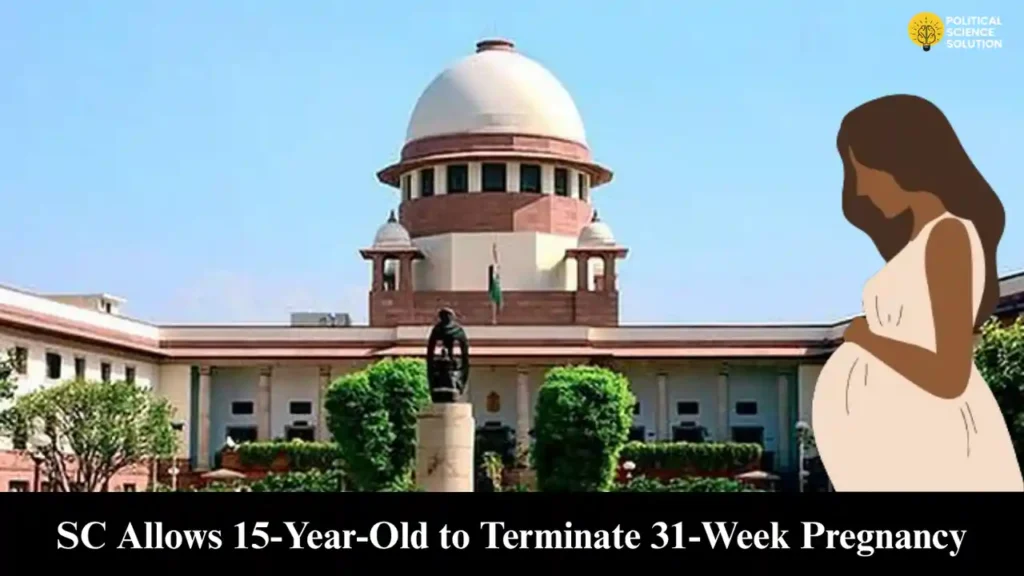
New Delhi: In a landmark ruling delivered on April 25, 2026, the Supreme Court of India significantly expanded the contours of reproductive rights in India by permitting a 15-year-old girl to medically terminate her pregnancy at 31 weeks—well beyond the statutory limit under the Medical Termination of Pregnancy Act.
A bench comprising Justices B V Nagarathna and Ujjal Bhuyan underscored that no judicial or statutory framework can compel a woman—particularly a minor—to carry an unwanted pregnancy against her will. Delivering the judgment on April 25, 2026, the Court held that reproductive autonomy is a core constitutional right that cannot be subordinated to rigid legal timelines.
The plea was filed by the minor’s mother after the pregnancy had crossed 28 weeks. The girl, who has been undergoing care at AIIMS Delhi since April 10, 2026, was ultimately granted permission to terminate the pregnancy, with the Court prioritizing her bodily integrity, mental well-being, and decisional autonomy over procedural constraints.
Reproductive Autonomy Under Article 21 Takes Precedence Over Foetal Rights
The Supreme Court bench unequivocally held that the right to make decisions concerning one’s body, particularly in matters of reproduction, is an integral facet of personal liberty and privacy under Article 21 of the Constitution of India. The court emphasized that this right cannot be rendered ineffective by imposing unreasonable restrictions, especially in cases involving minors and unwanted pregnancies.
“No court ought to compel any woman, and more so a minor child, to carry a pregnancy to full term against her express will,” the bench declared in its order. “Such compulsion would not only disregard her decision autonomy but also inflict grave mental, emotional, and physical trauma in case she is compelled to give birth.”
The court further observed that directing a woman to continue with her unwanted pregnancy would be a direct affront on her right to live with dignity and reproductive autonomy, while rendering her “subordinate” to the child yet to be born. The bench stressed that in such instances, the interest of the woman would outweigh that of the unborn foetus, stating, “What is relevant here is the choice of the pregnant woman rather than that of the child to be born.”
Court Rejects Adoption Alternative as Valid Ground for Forced Continuation of Pregnancy
During the hearing, Solicitor General Tushar Mehta, appearing for the Union government, raised concerns about the advanced stage of the pregnancy. He informed the bench that the medical report pointed to a threat to the life of both the girl and the foetus if the termination was carried out at this stage. Mehta suggested that it would be preferable to give the child up for adoption through the Central Adoption Resource Authority, which would protect the privacy of the minor and her family. He also proposed that financial assistance could be provided to the girl’s family.
The bench, however, remained unconvinced by this argument. The court firmly rejected the adoption alternative, stating: “It is easy to say that if the pregnant woman is not interested in raising the child, she may give it away in adoption, and therefore she must give birth to the child. That cannot be a consideration, particularly in cases where the child to be born is unwanted. In such a situation, directing the pregnant woman to give birth to the child against her wishes and therefore continue her pregnancy would negate the welfare of the pregnant woman and make it subordinate to the child yet to be born.”
Justice Nagarathna made a sharp observation regarding the impracticality of directing petitioners to seek financial help instead of termination, remarking, “Every time someone comes for MTP (medical termination of pregnancy), we cannot tell them to seek financial help.” The bench also noted that girls sometimes do not report pregnancies—either due to fear or a lack of awareness—until after the 24-week mark has been crossed.
Minor’s Psychological Trauma and Suicide Attempts Central to Court’s Reasoning
The Supreme Court placed significant emphasis on the psychological condition of the 15-year-old girl. The court noted that the minor had undergone severe psychological trauma due to the pregnancy and had clearly expressed her unwillingness to continue with it. Most alarmingly, the court recorded that the girl had twice attempted to die by suicide, a factor that weighed heavily in the bench’s decision-making process.
“Forcing her to continue is a direct affront to her right to live with dignity,” the court observed. The bench warned that compelling the minor to continue with the pregnancy could have a lasting impact on her overall development, including her mental health, education, social standing, and long-term well-being.
The court further articulated that “an unwanted pregnancy and the mindset of a pregnant woman have a bearing on the child to be born too.” The bench emphasized that the decision not to continue a pregnancy and seek termination with all attendant medical risks must be respected rather than compelling such a pregnant woman to continue such a pregnancy.
The petitioner had argued that the pregnancy had already severely affected the girl’s life, including her education which could be disrupted for months, with every single day being extremely traumatic for the minor.
Legal Framework Under Medical Termination of Pregnancy Act and Constitutional Remedies
The Supreme Court provided a detailed examination of the legal framework governing medical termination of pregnancies in India. The Medical Termination of Pregnancy Act of 1971, which was subsequently amended in 2021, allows termination of pregnancy up to 20 weeks based on the opinion of one doctor. For special categories including minors, the Act permits termination up to 24 weeks based on the opinion of two doctors. Pregnancy beyond 24 weeks can only be terminated in cases of substantial foetal abnormalities diagnosed by a Medical Board.
However, the bench clarified the role of constitutional courts when statutory remedies are unavailable, particularly in cases where pregnancies cross the gestational limits prescribed under the MTP Act. Rejecting a rigid application of statutory timelines, the bench held that courts exercising writ jurisdiction under Articles 226 and 32 of the Constitution must weigh the facts from the perspective of the woman seeking termination.
“Can the constitutional court say that since the statutory remedy is not available, no constitutional remedy would also be available? That cannot be the approach,” held the court. The bench warned that such an interpretation would drive women towards unsafe and illegal abortion centres. The court cautioned that if judicial bodies stop entertaining such pleas, women will be forced to go to illegal centres and quacks, exposing them to grave risks including unregulated procedures that may cause irreversible harm.
Court Sets Aside Delhi High Court Order, Emphasizes Constitutional Protections Cannot Be Curtailed
The Supreme Court’s ruling set aside the Delhi High Court’s April 21 order, which had dismissed a petition filed by the minor’s mother seeking permission to abort the 28-week foetus. The apex court held that constitutional protections of dignity, autonomy, and decisional privacy cannot be curtailed by rigid statutory thresholds where the pregnancy is unwanted.
The bench noted that the pregnancy arose out of a consensual relationship between two minors and was unequivocally unwanted. The girl had clearly expressed her unwillingness to continue with it and was prepared to undergo the medical risks associated with termination. The court held that denying relief to her would compel her to endure irreversible consequences and would run contrary to settled constitutional principles recognizing reproductive choice as a fundamental right.
During the hearing, the bench repeatedly emphasized that a court cannot substitute its own sense of compassion for the express wishes of the pregnant minor. “We cannot compel a lady to undergo pregnancy. It will be against her bodily autonomy and liberty,” the court remarked.
Core Issues of Reproductive Autonomy Highlighted by the Ruling
The Supreme Court’s judgment brings into sharp focus several critical issues surrounding reproductive autonomy in India. The ruling highlights the inherent friction between bodily autonomy and the state’s interest in foetal rights, establishing clear boundaries where the woman’s constitutional rights must take precedence.
The court also addressed concerns regarding safety and access, emphasizing that denying legal abortions risks pushing vulnerable women toward unsafe, illegal procedures and the associated psychological and physical burden. The bench warned that if constitutional courts refuse to entertain such pleas, women will have no option but to resort to unregulated and dangerous abortion centres.
The judgment also implicitly challenges patriarchal control structures where women are often treated as reproductive instruments rather than autonomous individuals with reproductive choice. Statistics from the National Family Health Survey-5 (NFHS-5) indicate that only 10 percent of women in India are able to independently make decisions about their own health, underscoring the broader societal context in which this ruling has been delivered.
Wider Implications for Late-Term Abortion Cases Involving Minors
The ruling is expected to have far-reaching implications for how courts approach late-term abortion cases, particularly those involving minors. By reinforcing that constitutional protections of dignity, autonomy, and decisional privacy cannot be curtailed by rigid statutory thresholds where the pregnancy is unwanted, the Supreme Court has established a significant judicial precedent.
The court directed that the medical termination procedure be carried out at AIIMS Delhi with all necessary medical safeguards. The bench required the minor’s guardian to submit an undertaking consenting to the termination. In a telling remark capturing the complexity of the issue, the court observed, “In a case like this, there is no question of winning. Everyone loses.”
The Supreme Court’s judgment stands as a powerful affirmation that reproductive choice is a fundamental right and that denying relief in such cases would subject minors to irreversible consequences while violating their right to live with dignity. The bench concluded that if the girl is forced to continue the pregnancy and give birth, the consequence would be adverse, and no court ought to compel any woman—and more so a minor child—to carry a pregnancy to full term against her express will.
FAQs
1. What was the Supreme Court’s primary legal reasoning for allowing a 15-year-old minor to terminate her pregnancy beyond 28 weeks?
The Supreme Court ruled that reproductive autonomy is a core constitutional guarantee under Article 21 of the Constitution, which protects personal liberty and privacy. The bench of Justices B V Nagarathna and Ujjal Bhuyan held that the right to make decisions concerning one’s own body, particularly in matters of reproduction, is an integral facet of this right. The court emphatically stated that no judicial body can compel any woman—especially a minor—to carry an unwanted pregnancy to full term against her express will. Forcing a woman to continue such a pregnancy would be a direct affront to her right to live with dignity and would render her subordinate to the child yet to be born. The court clarified that constitutional protections cannot be curtailed by rigid statutory thresholds where the pregnancy is unwanted.
2. What does the Medical Termination of Pregnancy (MTP) Act say about gestational limits, and how did the court bypass it?
The Medical Termination of Pregnancy (MTP) Act of 1971 (amended in 2021) allows termination of pregnancy up to 20 weeks based on the opinion of one doctor. For special categories like minors, termination is permitted up to 24 weeks based on the opinion of two doctors. Pregnancy beyond 24 weeks can only be terminated in cases of substantial foetal abnormalities diagnosed by a Medical Board. In this case, the pregnancy had crossed 28 weeks (later noted as 31 weeks). The Supreme Court bypassed these statutory limits by exercising its writ jurisdiction under Articles 226 and 32 of the Constitution. The court held that when statutory remedies are unavailable, constitutional courts must weigh the facts from the perspective of the woman seeking termination. The bench ruled that it cannot say that since the statutory remedy is unavailable, no constitutional remedy would be available, as such an interpretation would drive women towards unsafe and illegal abortion centres.
3. Why did the Supreme Court reject the government’s suggestion that the minor give the child up for adoption?
The Solicitor General Tushar Mehta, appearing for the government, suggested that it would be preferable for the minor to give the child up for adoption through the Central Adoption Resource Authority, which would protect the privacy of the minor and her family. The Supreme Court firmly rejected this argument, stating that it is easy to say that if a pregnant woman is not interested in raising the child, she may give it away in adoption, and therefore she must give birth to the child. The court held that this cannot be a consideration, particularly in cases where the child to be born is unwanted. Directing a pregnant woman to give birth to a child against her wishes would negate the welfare of the pregnant woman and make it subordinate to the child yet to be born. Justice Nagarathna also remarked that every time someone comes for medical termination of pregnancy, the court cannot tell them to seek financial help or adoption.
4. What role did the minor’s mental health and suicide attempts play in the court’s decision?
The Supreme Court placed significant emphasis on the minor’s psychological condition. The court noted that the girl had undergone severe psychological trauma due to the pregnancy and had clearly expressed her unwillingness to continue with it. Most critically, the court recorded that the girl had twice attempted to die by suicide. The bench observed that forcing her to continue the pregnancy was a direct affront to her right to live with dignity. The court warned that compelling a minor to continue with an unwanted pregnancy could have a lasting impact on her overall development, including her mental health, educational prospects, social standing, and long-term well-being. The court also noted that an unwanted pregnancy and the mindset of a pregnant woman have a bearing on the child to be born as well, and that every single day of such a pregnancy was extremely traumatic for the minor.
5. What are the wider implications of this ruling for future late-term abortion cases in India?
The ruling is expected to have significant wider implications for how courts approach late-term abortion cases, particularly those involving minors. The Supreme Court has established that constitutional protections of dignity, autonomy, and decisional privacy cannot be curtailed by rigid statutory thresholds under the MTP Act where the pregnancy is unwanted. The court clarified that constitutional courts exercising writ jurisdiction under Articles 226 and 32 must weigh the facts from the perspective of the woman seeking termination, and that no court ought to compel any woman to carry a pregnancy to term against her will. The bench also warned that if courts stop entertaining such pleas, women will be forced to go to illegal centres and quacks, exposing them to grave risks. The ruling reinforces that reproductive choice is a fundamental right, and that the welfare and best interests of the mother must take precedence over procedural limitations.