

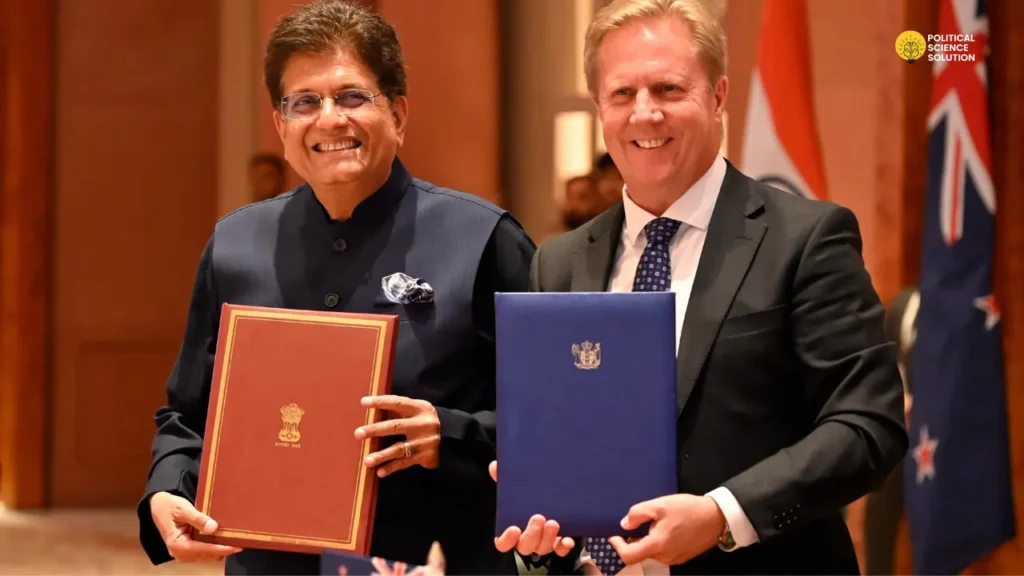
New Delhi: In a historic development that redefines bilateral economic engagement, India and New Zealand formally signed a comprehensive Free Trade Agreement (FTA) on Monday, April 27, 2026, at Bharat Mandapam in New Delhi. The pact, hailed by Prime Minister Narendra Modi as a “landmark moment,” delivers an unprecedented 100% duty-free access for all Indian exports to New Zealand from day one, while Wellington has made a committed pledge to facilitate USD 20 billion in investment into India over the next 15 years.
The agreement, concluded in just nine months after negotiations were launched on March 16, 2025, marks India’s ninth trade pact with developed nations in recent years. It is built on five formal negotiation rounds and several intersessions, culminating in a finalised text on December 22, 2025.
A Strategic Pivot in a Time of Global Uncertainty
The signing ceremony was led by Union Minister of Commerce and Industry Shri Piyush Goyal and New Zealand’s Minister for Trade and Investment Hon. Todd McClay, who headed a cross-party delegation of Members of Parliament and over 30 New Zealand businesses. Prime Minister Narendra Modi, in a message read by Minister Goyal, stated that the FTA “reflects the deep trust, shared values and ambition that bind our two nations.”
New Zealand Prime Minister Christopher Luxon, responding on X (formerly Twitter), underscored the strategic heft of the agreement. “This agreement matters not just because of what it does economically, but because of what it says strategically. At a time of global uncertainty, this FTA is a clear commitment by both sides to stable, predictable, and rules-based trade,” Luxon said. He noted that it was only 13 months ago that he traveled to India to launch negotiations, calling the outcome a “once-in-a-generation” opportunity.
Goods Market Access: A Tale of Two Markets
The core of the merchandise trade chapter reveals a calibrated asymmetry reflecting the differing economic structures of the two nations.
For India: The Commerce Ministry confirmed that the FTA provides duty-free access for 100% of India’s exports to New Zealand, covering all tariff lines. This is a significant upgrade, as New Zealand previously maintained peak tariffs of up to 10% on key Indian exports including ceramics, carpets, automobiles, and auto components. In the fiscal year 2026 (FY26), India’s exports to New Zealand stood at USD 711 million, comprising largely aviation fuel, textiles, pharmaceuticals, and machinery. With zero-duty access, Indian products—from textiles and leather to engineering goods and processed foods—will now enjoy a level playing field against competitors who already had preferential access.
For New Zealand: India has offered tariff liberalisation on 70.03% of tariff lines, which covers 95% of the bilateral trade value. Simultaneously, India has kept 29.97% of tariff lines in an exclusion category to protect sensitive domestic sectors. These exclusions include dairy (milk, cream, whey, yoghurt, cheese), animal products (other than sheep meat), agricultural products (onions, chana, peas, corn, almonds), sugar, artificial honey, animal and vegetable fats and oils, arms and ammunition, gems and jewellery, copper cathodes, and aluminium ingots.
Despite the exclusions, New Zealand secured significant wins. Tariffs on key fish and seafood exports will be phased out over seven years. Tariffs on New Zealand wine will be reduced by 66-83% over ten years. The agreement also provides for immediate duty elimination on 30% of tariff lines, covering wood, wool, sheep meat, and raw hides.
The Apple of the Eye: Preferential Access with Safeguards
In a significant first, New Zealand has become the first country to secure preferential access for apples in any Indian FTA. Under a complex Tariff Rate Quota (TRQ) system, the quota for apples begins at 32,500 metric tonnes (MT) in the first year, rising to 45,000 MT from the sixth year. Imports under the quota will face a 25% duty with a Minimum Import Price (MIP) of USD 1.25/kg during the seasonal window of April 1 to August 31. Imports below the price threshold receive no concession, and out-of-quota imports face the normal Most Favoured Nation (MFN) duty.
This concession is explicitly linked to New Zealand’s cooperation under an Apple Action Plan, monitored by a Joint Agriculture Productivity Council (JAPC). If New Zealand fails to meet its commitments, India retains the right to suspend market access.
However, the deal has drawn caution from experts. Ajay Srivastava, former trade officer and founder of the Global Trade Research Initiative, warned: “Apple imports already account for nearly one-fifth of India’s domestic production. Lower-duty apples from New Zealand, the US and the EU could soon compete in mid-premium and premium markets, especially in cities and during the off-season. This could hurt apple growers in Kashmir and Himachal Pradesh, who already face high transport costs, poor cold-chain facilities, and unstable prices.”
Other agricultural TRQs include kiwi fruit (quota rising from 6,250 MT to 15,000 MT over six years at 0% duty) and Mānuka honey (200 MT annual quota with a 75% tariff reduction over five years, reducing duty from 66% to 16.5%).
The USD 20 Billion Investment Commitment: Ambition and Caveats
A headline feature of the FTA is New Zealand’s commitment to facilitate USD 20 billion in investment into India over 15 years. Speaking on the signing, Minister Piyush Goyal said the commitment “signals strong confidence in India’s growth story” and will fuel agriculture, manufacturing, infrastructure, start-ups, and emerging technologies under the ‘Make in India’ vision.
However, the investment pledge comes with several riders detailed in the agreement’s text. The commitment is based on India’s estimated nominal GDP growth rate over the next 15 years. Critically, the text includes a rebalancing clause: “in case of occurrence of any unforeseen circumstances including global pandemic, war, geopolitical disruptions, financial crisis or sustained economic underperformance… beyond New Zealand’s control… the parties may adjust the investment objective by mutual agreement.”
Ajay Srivastava urged caution, noting that New Zealand’s actual investment in India has been below USD 1 billion over the past 25 years. “The EFTA experience shows that headline investment promises do not always turn into real inflows,” he said.
Mobility Breakthrough: Visas, Work Rights, and Student Pathways
For the first time with any country, New Zealand has created a dedicated pathway for Indian student mobility and post-study work visas. The agreement removes numerical caps on Indian students, guarantees a minimum of 20 hours per week work during study, and provides extended post-study work opportunities: up to three years for STEM Bachelor’s and Master’s graduates, and up to four years for Doctorate holders.
Furthermore, a new Temporary Employment Entry (TEE) Visa pathway will allow 5,000 skilled Indian professionals to work in New Zealand at any given time for up to three years, covering sectors such as IT, healthcare, education, and unique professions like AYUSH practitioners, yoga instructors, and Indian chefs. Additionally, a Work and Holiday visa scheme will permit 1,000 young Indians annually to live and work in New Zealand for 12 months.
This mobility boost addresses a structural imbalance. Data shows New Zealand has a large services surplus with India, driven by spending from Indian students and tourists. In FY2025, India’s services imports from New Zealand were USD 550 million, against services exports of just USD 255.8 million.
Services, IP, and Cultural Cooperation: A Modern Pact
In the services sector, New Zealand has offered market access commitments to India in about 118 service sectors, including computer-related services, professional services, audio-visual, telecom, construction, distribution, education, financial, and tourism services. It has also extended Most-Favoured Nation (MFN) commitments in about 139 sub-sectors.
On intellectual property, New Zealand has committed to amending its domestic Geographical Indications (GI) law within 18 months of the agreement’s entry into force. Currently, New Zealand’s GI law only allows registration for India’s wines and spirits. The amendment will extend protection to India’s ‘other goods’, opening the door for formal protection of iconic Indian GIs like basmati rice, Darjeeling tea, and handicrafts.
The FTA also pioneers a chapter on Culture, Trade, Traditional Knowledge, and Economic Cooperation. For the first time in its trade agreements, New Zealand has included dedicated access for Health and Traditional Medicine services. This promotes global recognition of India’s AYUSH systems (Ayurveda, Yoga, Unani, Siddha, and Homeopathy) alongside Maori Health practices.
Safeguards, Rules of Origin, and Trade Facilitation
To protect domestic industry, the FTA includes a bilateral safeguard mechanism. If a surge in imports due to tariff reductions causes or threatens serious injury to a domestic industry, India can suspend further duty reductions or increase duty rates up to the prevailing MFN rate.
The Rules of Origin framework is described as “balanced and robust,” with Product Specific Rules (PSRs) ensuring substantial transformation within the territories of both parties. A comprehensive verification mechanism, including provisions for denial and temporary suspension of preferential treatment, aims to prevent circumvention and misuse.
On trade facilitation, the agreement commits to standard cargo clearance within 48 hours, with express shipments and perishable goods cleared within 24 hours. It provides for fast-track mechanisms for imports used as inputs for export manufacturing, benefiting MSMEs and agricultural exporters.
Political and Economic Reactions
Prime Minister Modi, in a detailed post on X, said the FTA “will open new avenues for growth, create opportunities and deepen our synergy across sectors… The investment commitment of USD 20 billion by New Zealand will further strengthen our cooperation in agriculture, manufacturing, innovation and technology, paving the way for a more prosperous and dynamic future.”
Minister Piyush Goyal noted that this is India’s seventh FTA in the last three and a half years, with plans for agreements with the European Union and the United States. “At the heart of the agreement is the empowerment for exports, agricultural productivity, student mobility, skills, investment and services,” Goyal said.
New Zealand’s Minister Todd McClay called the pact a “defining milestone,” emphasizing that it will boost exports, create jobs, and support MSMEs. “India is a key partner in a changing global landscape,” McClay said, expressing confidence that the agreement will deliver shared prosperity.
The bilateral merchandise trade between the two countries stood at approximately USD 1.3 billion in FY 2024-25, registering a growth of 49% over the previous year. With the FTA now signed, eliminating tariffs on 100% of Indian exports and securing USD 20 billion in investment commitments, both nations expect a transformative leap in their economic partnership, defined by shared purpose, talent mobility, and agricultural innovation on the path to Viksit Bharat 2047.
FAQs
1. What is the total investment commitment from New Zealand under the India-New Zealand FTA, and are there any conditions attached?
Under the Free Trade Agreement signed on April 27, 2026, New Zealand has committed to facilitating USD 20 billion in investment into India over the next 15 years. However, this pledge comes with specific conditions. The agreement text states that if unforeseen circumstances such as a global pandemic, war, geopolitical disruptions, financial crisis, or sustained economic underperformance beyond New Zealand’s control occur, both parties may adjust the investment objective by mutual agreement. Experts like Ajay Srivastava have cautioned that New Zealand’s actual investment in India has been below USD 1 billion over the past 25 years, and the European Free Trade Association (EFTA) experience shows that headline investment promises do not always translate into real inflows.
2. How does the FTA treat apple imports from New Zealand, and what protections exist for Indian apple growers?
New Zealand is the first country to secure preferential access for apples in any Indian FTA. The agreement establishes a Tariff Rate Quota (TRQ) system where the quota starts at 32,500 metric tonnes in the first year and rises to 45,000 tonnes from the sixth year. Apples imported under the quota face a 25% duty with a Minimum Import Price of USD 1.25/kg during the seasonal window (April 1 to August 31). Crucially, this concession is linked to New Zealand’s cooperation under an Apple Action Plan, monitored by a Joint Agriculture Productivity Council. If New Zealand fails to meet its commitments, India can suspend market access. However, experts warn that lower-duty apples from New Zealand, the US, and the EU could hurt apple growers in Kashmir and Himachal Pradesh, who already face high transport costs and poor cold-chain facilities.
3. What new mobility and visa benefits does the FTA offer to Indian students and professionals?
For the first time with any country, New Zealand has created dedicated pathways for Indian students and professionals. Key benefits include:
• No numerical caps on Indian students, with a guaranteed 20 hours per week work during study.
• Post-study work visas: up to 3 years for STEM Bachelor’s and Master’s graduates, and up to 4 years for Doctorate holders.
• A new Temporary Employment Entry (TEE) Visa pathway with a quota of 5,000 skilled Indian professionals at any given time for up to three years, covering sectors like IT, healthcare, education, and even AYUSH practitioners and Indian chefs.
• A Work and Holiday visa scheme allowing 1,000 young Indians annually to live and work in New Zealand for 12 months.
4. Has India given New Zealand duty-free access for dairy products under the FTA?
No. Dairy products including milk, cream, whey, yoghurt, cheese, and caseins are kept in the exclusion category (29.97% of tariff lines) to protect India’s sensitive domestic sector. However, a unique compromise was reached. New Zealand said the FTA includes a commitment to implement a dedicated fast-track mechanism to facilitate the supply of New Zealand dairy ingredients duty-free to India for further manufacturing and export. Additionally, if India offers dairy access to comparable countries in the future, it will consult with New Zealand on extending similar treatment. The FTA also includes a commitment to review the agreement one year after it enters into force.
5. What percentage of Indian exports will get zero-duty access to New Zealand, and what are India’s key gains in return?
India gains 100% duty-free access for all its exports to New Zealand, covering all tariff lines, effective immediately upon the agreement’s entry into force. Earlier, New Zealand maintained peak tariffs of up to 10% on key Indian exports like ceramics, carpets, automobiles, and auto components. In return, India has offered tariff liberalisation on 70.03% of tariff lines covering 95% of bilateral trade value. Key gains for India include duty-free inputs (wooden logs, coking coal, metal scraps) to lower manufacturing costs, a USD 20 billion investment commitment, enhanced mobility for students and professionals, market access in 118 service sectors in New Zealand, and a commitment from New Zealand to amend its GI law within 18 months to protect Indian products beyond wines and spirits (e.g., handicrafts, basmati rice).