
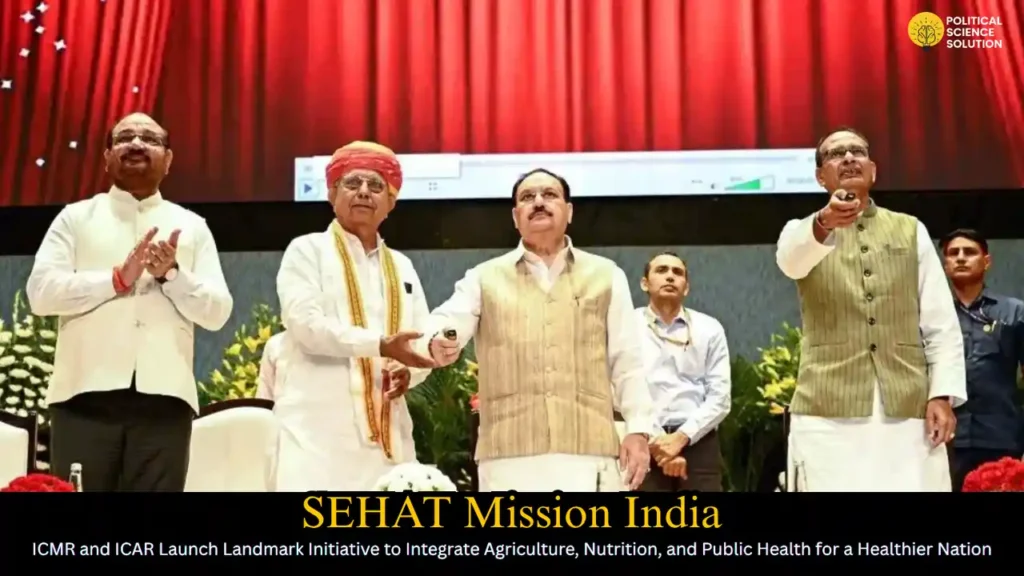
New Delhi: In a pioneering move that promises to reshape India’s approach to public health and food systems, SEHAT Mission India: ICMR and ICAR Launch Landmark Initiative to Integrate Agriculture, Nutrition, and Public Health for a Healthier Nationnion Health and Family Welfare Minister J.P. Nadda unveiled the SEHAT Mission – Science Excellence for Health through Agricultural Transformation. Launched on May 11, 2026, in Delhi, this national mission-mode programme marks a significant convergence between agriculture and healthcare sectors, aiming to convert breakthroughs in farming into measurable improvements in citizen health outcomes.
The initiative is a collaborative effort between the Indian Council of Medical Research (ICMR) and the Indian Council of Agricultural Research (ICAR). It was jointly launched by Nadda and Union Agriculture and Farmers’ Welfare Minister Shivraj Singh Chouhan in the presence of senior policymakers, scientists, and stakeholders. This inter-ministerial partnership underscores a “whole-of-government” strategy to address India’s complex health challenges through evidence-based agricultural innovations.
Understanding the SEHAT Initiative: Bridging Farms and Health
The SEHAT Mission is designed as a structured framework for Healthy Food, Healthy Farms, and a Healthy India. It moves beyond traditional silos where agriculture focused primarily on production and health on treatment. Instead, it positions agricultural research and innovation as direct contributors to nutrition security, preventive healthcare, and disease management.
India faces a unique dual burden of disease: persistent undernutrition alongside rapidly rising cases of overnutrition and non-communicable diseases (NCDs) such as diabetes, hypertension, and cancer. According to officials, this necessitates aligning what is grown in fields with what ends up on plates, validated through rigorous scientific processes. SEHAT seeks to make agriculture a proactive driver of public health rather than just a food supplier.
Union Minister J.P. Nadda described the launch as a “historic step,” highlighting India’s decade-long shift under Prime Minister Narendra Modi from a reactive, curative healthcare model to a proactive, preventive, and holistic one. He emphasized that SEHAT is a direct result of forward-looking policies that prioritize prevention, early detection, and continuum of care. Nadda noted the transition from dependence on imported technologies to indigenous, data-driven innovations tailored to Indian needs.
Key Highlights from the Launch Event
Addressing the gathering, Nadda congratulated ICMR and ICAR for their collaboration, calling it a model of inter-sectoral cooperation. He stressed that financial resources would not constrain efforts to tackle critical health issues, with a focus on outcome-based funding, accountability, and low-cost, high-quality indigenous solutions in diagnostics, therapeutics, and vaccines.
Nadda reiterated Prime Minister Modi’s call to reduce consumption of sugar, salt, and oil, positioning diet and nutrition as central to combating lifestyle diseases. He highlighted ICAR’s role in developing nutritious food systems and ICMR’s critical function in scientifically validating these interventions.
Shivraj Singh Chouhan, Union Minister of Agriculture and Farmers’ Welfare, emphasized the deep connection between agriculture and health. “The foundation of a healthy nation lies in a well-nourished population,” he stated. Drawing from ancient Indian wisdom, Chouhan noted that a healthy body forms the basis of overall well-being and national progress. He described the ICMR-ICAR partnership as “unprecedented and historic” and advocated for promoting organic and sustainable agricultural practices. Chouhan stressed generating scientific evidence on the health benefits of specific crops and aligning production with nutritional needs, adding that “food itself can become medicine with the right approach.”
Dr. Rajiv Bahl, Secretary, Department of Health Research (DHR) and Director General, ICMR, provided a detailed rationale for the initiative. He pointed to India’s dual burden of undernutrition and overnutrition, compounded by rising NCDs. Bahl called for agriculture to evolve beyond mere production into a key driver of nutrition and health outcomes. He outlined how integrated research can foster nutrition-sensitive food systems, improve dietary diversity, address deficiencies, and support disease prevention and management.
Five Priority Areas of the SEHAT Mission
The mission concentrates on five strategic pillars of national importance, each addressing specific gaps at the agriculture-nutrition-health interface:
- Development and Evaluation of Biofortified and Nutrient-Dense Crop Varieties: Focused on tackling malnutrition by creating and scientifically assessing crops rich in essential micronutrients to improve overall nutritional status of the population.
- Strengthening Integrated Farming Systems: Aims to promote dietary diversification, boost farm incomes, and enhance resilience against climate and economic challenges through holistic farming approaches.
- Addressing Occupational Health Risks Among Agricultural Workers: Implements targeted, evidence-based interventions to mitigate health hazards faced by farmers and farm laborers, recognizing their critical role in the food supply chain.
- Advancing Agriculture-Enabled Strategies for NCD Prevention and Management: Promotes functional foods and nutritionally superior crop varieties to help prevent and manage conditions like diabetes, hypertension, and other lifestyle diseases.
- Strengthening One Health Preparedness: Enhances integrated surveillance, diagnostics, and research at the human-animal-environment interface to improve readiness for emerging health threats and zoonotic diseases.
These priorities reflect a comprehensive roadmap that links scientific excellence in agriculture directly to public health gains.
Broader Vision and Expected Outcomes
SEHAT embodies a long-term structural reform. It seeks to generate robust evidence on nutrition and health impacts, develop scalable context-specific models, strengthen inter-sectoral convergence, and create a data-driven policy framework. Officials expect the mission to deliver measurable improvements in population health metrics while supporting farmer livelihoods.
The initiative aligns with national goals in preventive and promotive healthcare. By validating biofortified crops, integrated systems, and functional foods through ICMR’s scientific lens, SEHAT aims to reduce dependence on external solutions and build self-reliant health and food systems.
Additional dignitaries present at the launch included Bhagirath Choudhary, Minister of State for Agriculture and Farmers Welfare; Dr. Mangi Lal Jat, Secretary DARE and DG, ICAR; Ms. Anu Nagar, Additional Secretary, DHR; and Dr. D.K. Yadava, DDG (Crop Science), ICAR. Their participation highlighted the multi-level governmental commitment to the programme.
Why SEHAT Matters for India’s Future
India’s agricultural sector feeds over 1.4 billion people while employing a significant portion of the workforce. However, challenges such as micronutrient deficiencies, farmer distress, occupational health issues, and the NCD epidemic demand innovative solutions. SEHAT addresses these by fostering convergence that benefits both producers and consumers.
Experts view the mission as timely, given global shifts toward sustainable food systems and climate-resilient agriculture. By incorporating One Health principles, SEHAT also prepares India for future pandemics and environmental health challenges.
The programme’s emphasis on evidence generation is particularly noteworthy. Rather than assuming agricultural outputs are inherently healthy, SEHAT mandates rigorous evaluation to confirm real-world health benefits. This scientific temper ensures interventions are effective, scalable, and culturally appropriate for India’s diverse population.
Furthermore, SEHAT supports economic goals by enhancing farm incomes through diversified, high-value integrated systems and promoting sustainable practices that reduce input costs and environmental impact over time.
Implications for Stakeholders
- For Farmers: Access to knowledge on nutrient-dense varieties, integrated farming techniques, and occupational health support.
- For Consumers: Greater availability of affordable, nutritionally superior foods that can serve as preventive “medicine.”
- For Researchers: New collaborative platforms between ICMR and ICAR for cutting-edge studies.
- For Policymakers: A robust evidence base to design more effective nutrition and health programmes.
- For the Nation: Progress toward sustainable development goals related to zero hunger, good health, and responsible consumption.
Conclusion: A New Era of Integrated Development
The launch of the SEHAT Mission represents more than a new government programme — it signals a paradigm shift in how India conceptualizes development. By weaving together science, agriculture, nutrition, and public health, the initiative paves the way for a future where healthy farms naturally produce healthy people.
As India continues its journey toward Viksit Bharat, programmes like SEHAT demonstrate the power of integrated thinking and cross-sectoral collaboration. With strong leadership from ministers Nadda and Chouhan, and technical backing from ICMR and ICAR, the mission is well-positioned to deliver tangible results in the years ahead.
The coming months will see detailed implementation plans, research agendas, and pilot projects under the five priority areas. Stakeholders across agriculture, health, academia, and civil society are expected to actively engage with this transformative initiative.
SEHAT stands as a testament to India’s commitment to evidence-based, preventive, and holistic development — ensuring that the nation’s agricultural transformation translates into healthier citizens and a stronger, more resilient society.
Frequently Asked Questions (FAQs)
Q1: What is the full form of SEHAT Mission and when was it launched?
SEHAT stands for Science Excellence for Health through Agricultural Transformation. It was officially launched on May 11, 2026, in Delhi by Union Health Minister J.P. Nadda and Union Agriculture Minister Shivraj Singh Chouhan. The mission is a joint initiative of the Indian Council of Medical Research (ICMR) and the Indian Council of Agricultural Research (ICAR).
Q2: What are the main objectives of the SEHAT Initiative?
The primary objective of the SEHAT Mission is to create a strong convergence between agriculture, nutrition, and public health. It aims to translate agricultural research and innovations into tangible health benefits for citizens by promoting “Healthy Food, Healthy Farms, and a Healthy India.” The mission focuses on addressing India’s dual burden of undernutrition and non-communicable diseases through evidence-based strategies.
Q3: What are the five priority areas of the SEHAT Mission?
The SEHAT Mission focuses on five key priority areas:
- Development and evaluation of biofortified and nutrient-dense crop varieties to fight malnutrition.
- Strengthening integrated farming systems for dietary diversification, better farm incomes, and resilience.
- Addressing occupational health risks of agricultural workers through targeted interventions.
- Advancing agriculture-based strategies for prevention and management of non-communicable diseases (NCDs) using functional foods and superior crop varieties.
- Strengthening One Health preparedness through integrated surveillance and research at the human-animal-environment interface.
Q4: How will the SEHAT Mission help in tackling non-communicable diseases (NCDs) in India?
The mission promotes the production and consumption of nutrient-rich, biofortified crops and functional foods that can help prevent and manage lifestyle diseases such as diabetes, hypertension, and cancer. It emphasizes reducing intake of sugar, salt, and oil, while encouraging organic and sustainable farming practices. Scientific validation by ICMR ensures these agricultural interventions deliver real health benefits.
Q5: Which ministers and institutions are involved in the SEHAT Mission?
The mission was launched by J.P. Nadda (Union Minister of Health & Family Welfare) and Shivraj Singh Chouhan (Union Minister of Agriculture and Farmers’ Welfare). It is jointly implemented by ICMR and ICAR. Key officials present included Dr. Rajiv Bahl (DG, ICMR), Dr. Mangi Lal Jat (DG, ICAR), and Minister of State Bhagirath Choudhary.