

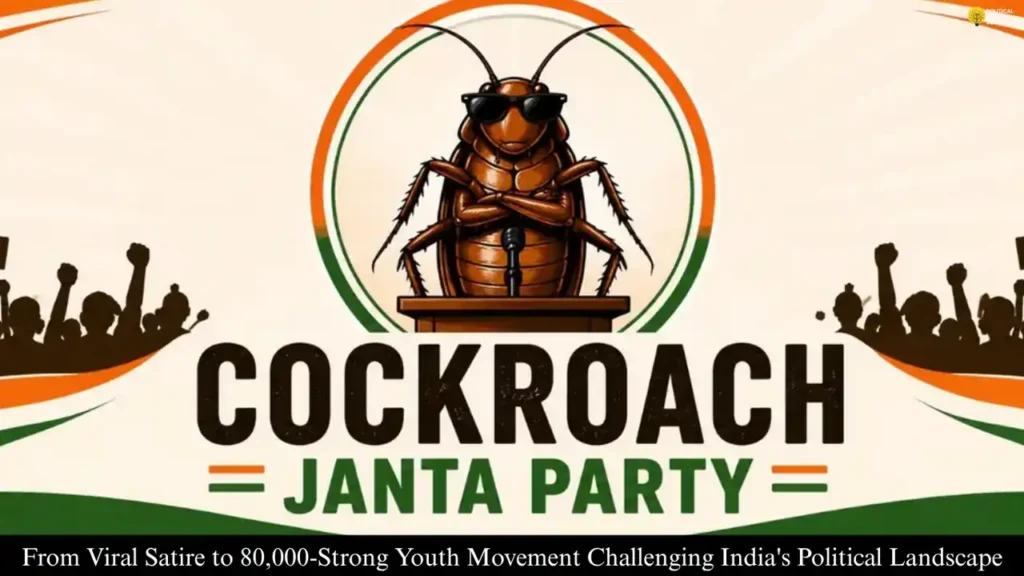
New Delhi: In a remarkable display of digital-age political mobilization, the Cockroach Janta Party (CJP) has rapidly emerged as one of the most talked-about phenomena in Indian social media. What began as a light-hearted satirical response to a controversial courtroom remark by Chief Justice of India Surya Kant has transformed into a full-blown online movement boasting over 80,000 sign-ups within days. Led by 30-year-old Abhijeet Dipke, the initiative has struck a chord with young Indians grappling with unemployment, political disillusionment, and systemic frustrations, positioning itself as the voice of the “lazy, chronically online” generation.
The story of the Cockroach Janta Party highlights how internet humor, youth anger, and calls for institutional reform can converge in unexpected ways. As registrations continue to pour in and prominent figures extend support, questions arise about whether this meme-driven platform could evolve beyond viral sensation into a meaningful force in Indian politics.
The Spark: CJI Surya Kant’s Remark and the Birth of a Satirical Party
The origins of the Cockroach Janta Party trace back to May 16, 2026, when Abhijeet Dipke shared a simple Google Form on X (formerly Twitter). The post invited people to join what he dubbed the “Cockroach Janta Party,” directly referencing Chief Justice of India Surya Kant’s oral observations in court that compared certain individuals to “cockroaches.”
Although the Chief Justice later clarified that his remarks targeted people using fake degrees to enter professions like law and media—and not unemployed youth—the comment had already ignited widespread online debate. Dipke seized the moment with sharp satire, framing the party as a platform for those labeled “unemployed, lazy, chronically online,” and possessing the ability to “rant professionally.”
The eligibility criteria were intentionally tongue-in-cheek, mocking societal stereotypes about Gen Z and millennials. Rather than rejecting the derogatory label, the movement chose to reclaim it, turning “cockroach” into a symbol of resilience. Cockroaches, after all, are known for their survival instincts in the face of adversity.
Within hours of the post going live, thousands signed up. By May 19, the unofficial party had crossed 80,000 registrations. Its dedicated Instagram account gained over 12,000 followers, while the X handle attracted nearly 29,000. A website, cockroachjantaparty.org, was quickly established to host the manifesto and registration details, complete with a cockroach mascot embodying the movement’s irreverent spirit.
Who is Abhijeet Dipke? The Man Behind the Viral Campaign
Abhijeet Dipke, currently based in Boston, United States, brings a unique blend of academic expertise and political communication experience to this unexpected venture. The 30-year-old holds an undergraduate degree in journalism from Pune and completed a Master’s in Public Relations at Boston University, where he focused on narrative building, public messaging, and the impact of digital platforms on political opinion.
His professional background includes volunteering with the Aam Aadmi Party’s (AAP) social media team between 2020 and 2022. During the 2020 Delhi Assembly elections, Dipke contributed to meme-based digital campaigning strategies that helped shape online engagement for the Arvind Kejriwal-led party. After completing his studies, he experimented with new forms of political expression, which ultimately culminated in the launch of the Cockroach Janta Party.
In an exclusive interview with Mint from Boston, Dipke admitted the overwhelming nature of the response. “I have not slept for the last three days. It’s overwhelming. I never imagined a joke would become such a big thing on the internet,” he shared. He described the idea as a “completely random thought” inspired by his long-standing interest in Indian politics and the CJI’s remarks.
Dipke emphasized that the massive sign-ups, primarily from young Gen Z individuals, reflect deep-seated frustration. “The biggest takeaway from the response is that young people in India are frustrated since no political party has done anything for them in the last few years,” he noted. He highlighted how participants identified with the humorous yet pointed take on their struggles.
Manifesto: Serious Demands Beneath the Satire
While the Cockroach Janta Party thrives on irony and memes, its manifesto outlines concrete policy positions that address governance, institutional accountability, and social equity. The platform has articulated several key demands that move the conversation from pure entertainment to substantive critique.
Prominent points include:
- Ensuring absolute independence of the judiciary by prohibiting post-retirement rewards such as Rajya Sabha seats for Chief Justices.
- Implementing strict accountability for voter deletion processes, proposing that the Chief Election Commissioner (CEC) face arrest under UAPA if legitimate votes are deleted, equating such actions to an attack on democratic rights.
- Granting 50 percent reservation for women in Parliament and Cabinet positions without increasing the overall strength of the House, accelerating gender representation.
- Cancelling licenses of media houses owned by major industrialists like Ambani and Adani to foster truly independent media, alongside investigations into the bank accounts of “Godi media” anchors.
- Enforcing rigorous anti-defection laws, barring MLAs or MPs who switch parties from contesting elections or holding public office for 20 years.
These proposals reflect concerns over transparency, representation, judicial integrity, media freedom, and political stability. The manifesto resonates with broader youth anxieties about unemployment, exam pressures, and shrinking opportunities, using satire as a vehicle to amplify these issues.
Growing Support and Political Ripples
The rapid growth of the Cockroach Janta Party has drawn attention from various quarters. Prominent lawyers, academicians, and politicians, including those from the Trinamool Congress (TMC) such as Mahua Moitra and Kirti Azad, have publicly engaged with the trend. Some have teasingly expressed interest in joining, signaling the movement’s cross-aisle appeal as an open platform.
Dipke acknowledged this support without aligning the party exclusively with any opposition group. “We cannot ask people not to support us. It is an open platform. Anyone can come and join us,” he stated.
The movement’s aesthetic—deep-fried memes, anti-establishment humor, and digital swarming—has flourished across social media. It echoes historical examples of political satire in India, such as comedian Jaspal Bhatti’s satirical parties in previous decades, which used absurdity to critique the system.
Future Plans: From Online Joke to Real-World Action?
As the sign-ups surged past 80,000, Dipke conceded that the campaign has moved “beyond a joke.” Speaking about the pressure of hundreds of daily messages, he expressed commitment to not disappointing supporters. He plans to travel to India soon, potentially basing operations in Delhi, to chart the next steps.
Immediate actions include launching a survey to gather suggestions from members and deciding on the movement’s direction. While Dipke remains cautious about its longevity—”I know this can die out in a few days”—he aims to establish it as an independent body that creates a genuine space for youth voices.
He drew parallels to past movements like India Against Corruption (IAC), which channeled public anger and led to the emergence of AAP. However, Dipke stopped short of declaring similar ambitions, focusing instead on peaceful, democratic participation and digital expansion through YouTube and other platforms.
Broader Implications: Youth Frustration Meets Digital Democracy
The Cockroach Janta Party phenomenon underscores a critical reality in contemporary India: the intersection of high youth unemployment, intense competitive pressures, and distrust in traditional political structures. For many young participants, embracing the “cockroach” identity serves as both catharsis and resistance—acknowledging societal dismissal while asserting visibility and resilience.
Critics may view it as a fleeting internet trend that risks trivializing serious issues, but supporters argue it meets people where they are—through humor and relatable language. In an era where digital platforms increasingly shape political discourse, the CJP demonstrates how a single Google Form can galvanize tens of thousands, bypassing conventional organizational barriers.
Questions remain about sustainability. Can an Instagram-fueled satire translate into structured activism? Will it influence policy debates on employment, education, and institutional reforms? Dipke’s background in political communication suggests an understanding of narrative power, yet he operates without a fixed blueprint, taking things “one step at a time.”
The Resilience of the Cockroach
As the Cockroach Janta Party continues to gain traction, it stands as a testament to the power of collective frustration expressed through wit and technology. From its satirical roots in response to a judicial remark, it has evolved into a platform demanding judicial independence, electoral integrity, gender parity, media reform, and political accountability.
Abhijeet Dipke’s creation has given voice to thousands who feel unseen in mainstream politics. Whether it fades as a memorable meme or grows into something more enduring, the movement has already succeeded in spotlighting the aspirations and grievances of India’s young population.
In the words of its founder, the overwhelming response proves that young people are eager for platforms that listen. As registrations climb and discussions intensify, the Cockroach Janta Party reminds observers that in Indian democracy, even the most unlikely symbols can become vehicles for change.
This viral experiment in political satire may just be the beginning of a new chapter in how India’s youth engage with power—resilient, humorous, and impossible to ignore.
FAQs
1. What is the Cockroach Janta Party (CJP)?
The Cockroach Janta Party is a satirical yet rapidly growing youth-oriented political movement launched by Abhijeet Dipke in May 2026. It began as a humorous response to CJI Surya Kant’s “cockroach” remark and has evolved into a platform voicing the frustrations of unemployed and disillusioned young Indians.
2. Who is the founder of Cockroach Janta Party?
Abhijeet Dipke, a 30-year-old Boston University graduate and former AAP social media strategist, founded the Cockroach Janta Party. He created it as a joke on X but was overwhelmed when it crossed 80,000 sign-ups in just three days.
3. What does the Cockroach Janta Party stand for?
The party’s manifesto demands judicial independence, strict anti-defection laws, 50% women’s reservation in Parliament and Cabinet, action against “Godi media,” and severe punishment for voter deletions. It positions itself as the voice of lazy, unemployed, and chronically online youth.
4. How can one join the Cockroach Janta Party?
Anyone can join via the Google Form or the official website cockroachjantaparty.org. The humorous eligibility criteria include being unemployed, lazy, chronically online, and able to rant professionally — all framed in satire.
5. What are the future plans of the Cockroach Janta Party?
Founder Abhijeet Dipke plans to visit India soon, shift base to Delhi, conduct a member survey, and decide the next steps. He aims to transform the viral movement into a structured, independent youth platform for democratic participation.