

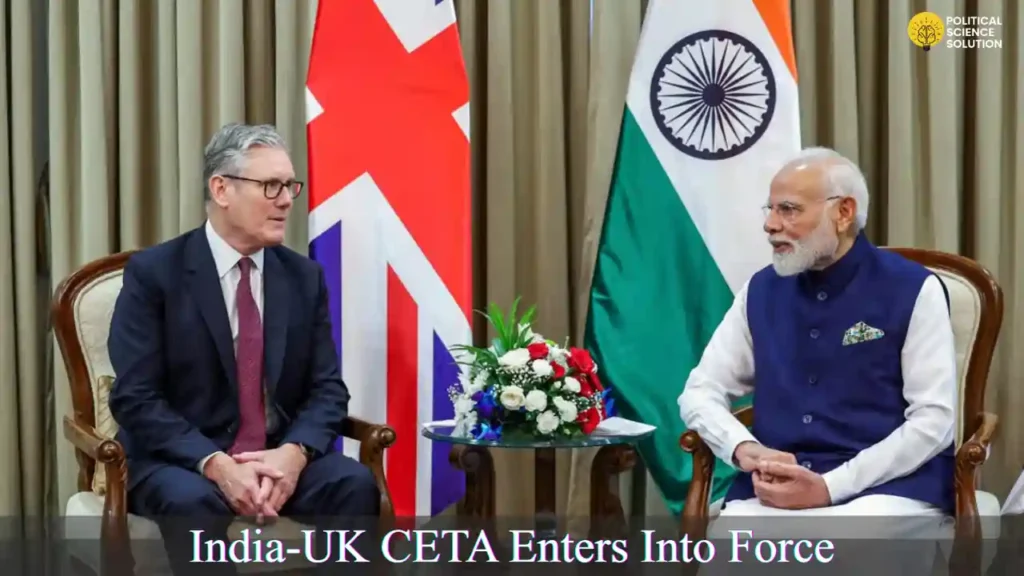
New Delhi: The India-UK Comprehensive Economic and Trade Agreement (CETA) officially came into effect on July 15, 2026, ushering in a new era of deepened economic integration between the world’s two major democracies. This landmark pact, years in the making, promises zero-duty access for nearly 99% of Indian exports to the UK market, significant services liberalization, enhanced professional mobility, and calibrated protections for sensitive Indian sectors. As bilateral merchandise trade already hit USD 25.12 billion in 2025-26 and services trade reached USD 35.44 billion in 2024, experts anticipate accelerated growth, job creation, and investment flows that could push total trade towards USD 120 billion by 2030.
Commerce Secretary Rajesh Agrawal described the agreement as a defining milestone, highlighting its role in fostering a future-oriented partnership that balances export ambitions with domestic priorities. Alongside CETA, the Double Contribution Convention (DCC) on social security also took effect, offering substantial relief to Indian professionals working in the UK.
Strong Foundations: India-UK Bilateral Trade Snapshot
India and the UK boast complementary economies, with India’s 2025 GDP at USD 3.96 trillion and the UK’s at USD 3.84 trillion. In 2025-26, merchandise trade stood at USD 25.12 billion, with Indian exports to the UK at USD 13.44 billion and imports at USD 11.68 billion, yielding a USD 1.76 billion surplus for India. Services trade has been even more dynamic, with India maintaining a robust USD 7.88 billion surplus on the back of USD 21.66 billion in exports versus USD 13.78 billion in imports.
The UK ranks as India’s sixth-largest inward investor, with cumulative equity investments touching USD 35 billion by September 2024. Indian outward investment in the UK reached USD 19 billion by March 2024. Currently, 971 Indian companies operate in the UK, employing over 100,000 people, while 667 British firms in India provide jobs to more than 500,000 Indians. These deep investment links, combined with the large Indian diaspora of 1.864 million (2.6% of the UK’s population per the 2021 Census), create fertile ground for the CETA’s success. The diaspora owns over 65,000 companies in the UK and contributes significantly across sectors like academia, medicine, business, and politics.
Broad-Based Benefits Across Stakeholders
CETA is engineered for inclusive growth. Indian farmers and fisherfolk stand to gain from tariff elimination on key agricultural and marine products, opening premium UK market access. Forest-dependent communities benefit from sustainability-focused provisions promoting responsible resource management.
Labour-intensive manufacturing sectors — textiles, leather, footwear, gems and jewellery, handicrafts, food processing, auto components, plastics, and organic chemicals — are expected to see export surges and employment gains. The agreement emphasizes gender equality, youth participation, and MSME empowerment, with dedicated clauses for women and underrepresented groups in trade and entrepreneurship. It upholds internationally recognized labour rights and fair working conditions.
MSMEs, in particular, will leverage simplified customs, paperless trade, digital systems, Single Window mechanisms, and Authorised Economic Operator (AEO) frameworks. Duty-free access on 99% of Indian exports — including textiles, leather, jewellery, footwear, and food products — will save 4-16% in tariffs, slashing compliance costs and boosting competitiveness.
Skilled professionals benefit from improved mobility, qualification recognition, and services market access. Businesses gain streamlined trade facilitation, digital cooperation, and deeper global value chain integration. The pact also advances digital trade, innovation, and sustainable development goals.
From Negotiations to Implementation: The CETA Journey
The agreement culminates sustained high-level engagement. It builds on the 2021 Migration and Mobility Partnership (MMP) and the 2022 Young Professional Scheme, which issues 3,000 two-year visas annually to 18-30-year-old graduates for work and living opportunities in both countries.
CETA prioritizes people-centric outcomes, extending benefits to every societal segment while positioning both nations for resilient, innovation-driven growth.
Safeguarding Sensitive Sectors with Calibrated Liberalization
India has carefully balanced ambition with protection. It offered tariff concessions on 89.5% of tariff lines (91% of UK export value), with 24.5% receiving immediate duty-free access and the rest phased. Sensitive areas like dairy, cereals, millets, pulses, apples, edible oils, oats, and vegetables are either excluded or face gradual reductions.
High-value and strategic items — gold, jewellery, lab-grown diamonds, essential oils, critical energy fuels, marine vessels, worn clothing, critical polymers, monofilaments, smartphones, and optical fibres — receive safeguards. Sectors aligned with Make in India and PLI schemes see 5-, 7-, or 10-year phase-outs. Alcoholic beverages open gradually, while automobiles follow a quota-based approach: 37,000 passenger vehicle CBUs annually at preferential tariffs. Small and mid-segment ICE vehicles and affordable EVs remain protected, with EV concessions starting only in Year 6. Larger-engine vehicles (above 3000cc petrol/2500cc diesel) receive greater concessions over time.
Sectoral Deep Dive: Where Gains Are Expected to Be Biggest
Textiles and Apparel: The UK imports USD 28.8 billion in textiles; India supplies USD 1.79 billion (6.1% share, fourth-largest supplier). CETA grants zero-duty access on 1,143 lines, leveling the field against Bangladesh, Pakistan, and Cambodia. Ready-made garments, home textiles, carpets, handicrafts, cotton dresses, shirts, linen, artificial fibre products, and bedding items stand to gain significantly.
Agriculture: India’s global agri-exports exceed USD 57 billion, but UK exports are just USD 1.11 billion against the UK’s USD 90+ billion imports. Zero-duty access on 1,437 lines (14.8% of tariff lines) plus waived WTO safeguards will boost grapes, processed foods, bakery items, preserved vegetables, fruits, nuts, sauces, and more. States like Andhra Pradesh, Tamil Nadu, Punjab, Maharashtra, Gujarat, Kerala, and the Northeast are primed for growth, with exports potentially rising over 50% in three years. Traditional knowledge recognition in patents adds further value.
Food Processing: Zero-duty on 985 lines (10.1%) targets India’s USD 14.07 billion global exports against the UK’s USD 50.68 billion imports (India’s share: USD 309.5 million).
Plantation Products: Duty-free instant coffee access strengthens competitiveness against European suppliers.
Leather and Footwear: Exports to UK were USD 494 million in 2024. Duty-free access to the UK’s USD 8.9 billion market could push Indian exports beyond USD 900 million. Clusters in Uttar Pradesh, Tamil Nadu, West Bengal, and Delhi-NCR will benefit, competing better against Vietnam and others. Products include leather shoes, sports footwear, safety shoes, handbags, and purses.
Marine Products: UK’s USD 4.9 billion imports dwarf India’s USD 126 million share. Tariff elimination on shrimp (previously 4.2-8.5%) and other seafood will drive value addition, employment (especially for women in processing), and growth in coastal states like Kerala, Andhra Pradesh, Gujarat, Tamil Nadu, Odisha, and West Bengal.
Engineering Goods: Zero-duty on 1,659 lines (17%) eliminates tariffs up to 18%. Exports could double to over USD 7.5 billion by 2029-30 at 12-20% CAGR. Electrical machinery, auto components, and industrial equipment from clusters in Tamil Nadu, Karnataka, Uttar Pradesh, Maharashtra, Gujarat, and Telangana gain prominently.
Electronics and Software: Zero-duty for eligible electronics plus strong IT/software commitments project 15-20% annual growth in smartphones, optical fibres, inverters, and IT-enabled services.
Pharmaceuticals and Med-Tech: Zero-duty on 56 lines plus medical devices (surgical instruments, diagnostics, ECG, X-ray) position Indian generics and med-tech as alternatives to Chinese supplies.
Chemicals and Plastics: Zero-duty on 1,206 chemical lines and plastics products enhance competitiveness for films, pipes, packaging, and more from hubs in Gujarat, Maharashtra, and others.
Sports Goods and Toys: Duty elimination and standards alignment target 15% growth to USD 186.97 million by 2030 for balls, cricket gear, and non-electronic toys.
Gems and Jewellery: Tariff relaxations could double USD 1.03 billion exports in 2-3 years, benefiting Surat, Jaipur, and other clusters.
Steel: New UK measures prompted quota expansions — India’s country-specific quota now 168,029 tonnes plus 9.45 lakh tonnes under Authorised Use Scheme — protecting and enhancing access.
Oilseeds and Others: Reduced tariffs open consumer bases and strengthen presence.
Services Sector: Ambitious Commitments and Mobility Boost
CETA covers all 12 major services sectors and 137 sub-sectors (over 99% of India’s interests), with India committing in 108. Mutual Recognition Agreements (MRAs) for nursing, accountancy, and architecture are targeted within 12 months. No numerical restrictions or Economic Needs Tests apply for many categories.
Mobility provisions include:
- Business Visitors: 90 days in any 6 months.
- Intra-Corporate Transferees: 3 years (including families and trainees).
- Investors: 1 year.
- Contractual Service Suppliers: 12 months in 24 (1,800 annual quota across 33 sub-sectors).
- Independent Professionals: 12 months in 24 across 16 sub-sectors.
The DCC eliminates dual social security contributions for up to 60 months, saving over USD 600 million annually for 75,000+ professionals and 900 companies. Digitally delivered services, government procurement access (UK’s GBP 90 billion market), and opportunities in education, health, fintech, and GCCs receive major boosts.
Consumer Impact in India and Strategic Depth
Indian consumers can expect phased price reductions on Scotch whisky, gin, premium British cars, luxury motorcycles, cosmetics, chocolates, biscuits, and medical devices. Automotive liberalization uses quotas and safeguards to nurture domestic manufacturing and EVs.
Beyond economics, CETA reinforces the strategic partnership through innovation, clean energy, advanced manufacturing, and people-to-people ties.
Outlook: Towards Viksit Bharat and Deeper Integration
Prime Minister Narendra Modi called the deal a historic milestone supporting farmers, workers, MSMEs, startups, and Viksit Bharat 2047. Industry voices like ASSOCHAM, Grant Thornton, and Vayana foresee nearly doubled trade, job creation, and diversified exports amid global uncertainties.
As CETA and DCC implementations begin, the focus shifts to execution — leveraging digital tools, building capacities, and ensuring benefits reach the grassroots. This agreement not only unlocks immediate commercial gains but also cements a resilient, inclusive, and forward-looking India-UK economic alliance for decades ahead.
FAQs
1. What is the India-UK Comprehensive Economic and Trade Agreement (CETA) and when did it come into effect?
The India-UK CETA is a modern, comprehensive free trade agreement aimed at deepening economic integration through enhanced market access, tariff liberalisation, services commitments, and professional mobility. It came into force on July 15, 2026. Along with CETA, the Double Contribution Convention (DCC) on social security also became effective, eliminating dual contributions for Indian professionals on short-term assignments in the UK for up to 60 months.
2. How does the India-UK CETA benefit Indian exporters and MSMEs?
CETA provides zero-duty access to nearly 99% of India’s exports to the UK, covering almost 100% of trade value. This removes tariffs of up to 70% on processed foods, 21% on marine products, 18% on engineering goods, 16% on leather & footwear, and 12% on textiles. MSMEs gain from simplified customs, paperless trade, digital systems, and duty savings of 4-16% on key products like textiles, jewellery, footwear, and food items. Sectors such as textiles, leather, gems & jewellery, marine products, engineering, agriculture, and chemicals are expected to see major export growth and employment generation.
3. What are the key sectoral gains under the India-UK CETA?
Major gains include:
- Agriculture & Food Processing: Zero-duty access on 1,437 agri lines and 985 food processing lines.
- Textiles: Zero-duty on 1,143 lines.
- Marine Products & Leather/Footwear: Full tariff elimination.
- Engineering & Electronics: Zero-duty on 1,659 lines; projected doubling of engineering exports.
- Gems & Jewellery, Pharmaceuticals, Chemicals & Plastics: Significant tariff relaxations and improved competitiveness.
- Services: Commitments across 137 sub-sectors with strong mobility provisions. Sensitive sectors like dairy, certain vehicles, and strategic industries are protected through exclusions or phased reductions.
4. How will the India-UK CETA benefit Indian professionals and services exports?
The agreement offers ambitious services market access covering over 99% of India’s interests. It includes Mutual Recognition Agreements (MRAs) for nursing, accountancy, and architecture. Mobility provisions allow Business Visitors (90 days), Intra-Corporate Transferees (up to 3 years), Contractual Service Suppliers (1,800 annual quota), and others. The DCC will save over USD 600 million annually by removing dual social security contributions. IT/ITeS, education, healthcare, fintech, and Global Capability Centres (GCCs) are set for strong growth.
5. What will Indian consumers gain and how are domestic industries protected?
Indian consumers can expect gradually cheaper imported British products such as Scotch whisky, gin, premium cars, cosmetics, chocolates, and medical devices due to phased tariff reductions. For domestic industries, India has adopted calibrated liberalisation — protecting dairy, cereals, pulses, apples, edible oils, small/mid-segment vehicles, and PLI-linked sectors through exclusions, quotas (e.g., 37,000 cars annually), and multi-year phase-outs. The deal balances export opportunities with safeguards for national interests while promoting inclusive growth for farmers, women, youth, and MSMEs.