
New Delhi: The 2026 Commonwealth Games ended in Glasgow, Scotland, with the official transfer of the Games flag and baton to India. Ahmedabad in Gujarat will stage the 2030 centenary edition, making India the first Asian country to host the event more than once following the 2010 Games in Delhi. The moment also triggered sharp political exchanges in India over the choice of host state.
Glasgow Closes and Passes the Baton to India
Prince Edward, Duke of Edinburgh, representing King Charles III, formally declared the Glasgow Games closed at the OVO Hydro. He thanked athletes, officials, volunteers and organisers for upholding Commonwealth values and issued an open invitation to competitors from every member country and territory to gather in Ahmedabad four years later for the 24th edition. Boxer Jaismine Lamboria, who won gold in the women’s 57 kg category, carried the Indian flag during the ceremony.
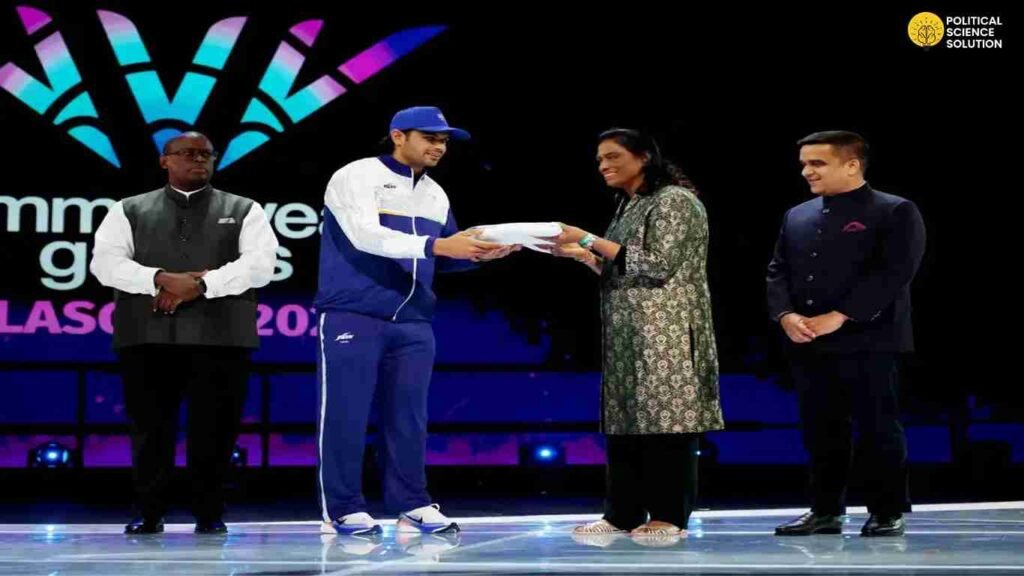
The flag handover followed a carefully staged procession. Bearers holding the Scottish and Indian flags lowered the folded Commonwealth Games flag. Glasgow’s Lord Provost Jacqueline McLaren then passed it in sequence to Commonwealth Games Scotland vice-chair Susan Jackson, Scottish netball player Emily Nicholl, Commonwealth Sport president Dr Donald Rukare, Olympic champion Neeraj Chopra, Indian Olympic Association president P.T. Usha and Gujarat Deputy Chief Minister Harsh Sanghavi. The transfer marked the formal shift of responsibility from Scotland to India.
Scotland’s wheelchair racer Melanie Woods received the David Dixon Award for outstanding performance, fair play and overall contribution to her team.
Ahmedabad Named Host for the Centenary Games
India will become only the second nation after Australia to host the Commonwealth Games twice. The 2030 edition carries special significance as the centenary celebration of a competition that began in 1930. Organisers presented Ahmedabad as a city where centuries-old heritage meets modern urban ambition, positioning Gujarat as a natural venue for an event that blends elite sport with cultural exchange.
Political Debate Erupts Over Gujarat’s Selection
Congress MP Deepender Hooda from Haryana questioned the decision almost immediately. He posted that “Haryana gets medals, Gujarat gets the Games” and demanded that Haryana be named host or co-host for 2030. Hooda led a protest outside Parliament with other Congress MPs from the state and released a state-wise medal tally comparing Haryana’s haul with Gujarat’s zero medals.
India finished the Glasgow campaign with 39 medals, including 13 golds. Haryana athletes contributed seven golds, two silvers and one bronze, accounting for 11 of the country’s total medals. Haryana Chief Minister Nayab Singh Saini described the performance as proof that the state remains one of India’s strongest sporting centres.
Babita Phogat Counters the Criticism
Olympian and three-time Commonwealth Games medallist Babita Phogat, now a BJP leader, responded directly on social media. She asked why Hooda had remained silent when the 2010 Games were staged in Delhi and noted that during his ten years as president of the Haryana Wrestling Association he had failed to organise even a single national-level event in the state. Phogat stressed that major international multi-sport events are hosted by countries, not individual states. She also criticised Leader of the Opposition Rahul Gandhi for not publicly acknowledging India’s fourth-place finish at Glasgow while the Haryana protest unfolded.
India’s Cultural Showcase at the Closing Ceremony
After the formal handover, India presented a three-act cultural programme built around the ancient philosophy of Vasudhaiva Kutumbakam — the world is one family — a message chosen to echo Commonwealth ideals of unity and friendship.
The first act commemorated 150 years of the national song Vande Mataram. Actor Manushi Chhillar led a large choreography set against immersive digital visuals that portrayed India’s linguistic, cultural and artistic diversity. Composer Shankar Mahadevan supplied a score that fused orchestral grandeur with Indian musical traditions. A specially produced film then introduced Ahmedabad to the global audience, tracing sport in India from ancient practices of discipline and physical excellence to the aspirations of a young nation and highlighting Gujarat as a meeting point of heritage and innovation.
The second act, titled “The Cultural Jugalbandi,” featured a musical conversation between Indian sitar virtuoso Rishab Sharma and Scottish musician Ross Ainslie on pipes and whistles. The performance moved fluidly between meditative passages and energetic crescendos, illustrating how music can cross geographic and linguistic boundaries while respecting distinct cultural identities.
The finale brought Shankar Mahadevan back to the stage with his sons Siddharth and Shivam. Their set included recognisable Indian songs such as “Suno gaur se duniya walon,” “Bhaag Milkha,” “Ae watan watan” and “Lehara Do.” Gujarati playback singer Bhoomi Trivedi added a dedicated tribute to the host state, ensuring Gujarat remained central to the invitation extended to the Commonwealth. The Indian sequence followed Scotland’s own farewell of music, poetry and dance.
Understanding the Commonwealth Games
The Commonwealth Games is an international multi-sport event held every four years. First staged in Canada in 1930 under the name British Empire Games, it brings together athletes from countries that were formerly part of the British Empire, along with overseas territories and island states. Seventy-two Commonwealth Games Associations currently participate. India made its debut at the second edition in 1934.
Core sports include athletics and para athletics, swimming and para swimming, table tennis and para table tennis, bowls and para bowls, weightlifting and para powerlifting, artistic gymnastics, netball and boxing. Hosts may propose up to two additional new or traditional sports for inclusion.
The Wider Commonwealth Family
The Commonwealth is a voluntary association of 56 independent and equal countries spanning Africa, Asia, the Americas, Europe and the Pacific. The London Declaration of 1949 established the modern framework by confirming that republics and countries with other systems of government could remain members. The most recent nations to join were Gabon and Togo in 2022.
Looking Ahead to 2030
With the baton now in Indian hands, planning for the 2030 centenary Games in Ahmedabad begins in earnest. The city will welcome athletes, officials and visitors from across the Commonwealth for an edition that combines high-level competition with a celebration of shared values and cultural exchange. India’s return as host sixteen years after Delhi underlines its growing role on the global sporting stage, while the domestic discussion that followed the medal table and host selection reflects the strong public interest that surrounds major multi-sport events in the country.
FAQs
1. Which city will host the 2030 Commonwealth Games and why is it significant?
Ahmedabad in Gujarat will host the 2030 Commonwealth Games. This marks the centenary edition of the competition and makes India the first Asian nation to stage the Games more than once, following the 2010 edition held in Delhi. India becomes only the second country after Australia to host the event twice. The formal handover of the Games flag and baton took place at the closing ceremony of the 2026 Glasgow Games.
2. What sparked the political controversy after Gujarat was named host?
Congress MP Deepender Hooda from Haryana questioned the decision, stating that Haryana produces the majority of India’s medals while Gujarat was awarded the Games. He demanded that Haryana be made host or co-host and led a protest outside Parliament. India won 39 medals including 13 golds at Glasgow 2026; Haryana athletes accounted for seven golds, two silvers and one bronze (11 medals total), while Gujarat recorded none. Olympian Babita Phogat responded by asking why similar concerns were not raised when the 2010 Games were held in Delhi and stressed that international multi-sport events are hosted by countries, not individual states.
3. How was the handover from Glasgow to India conducted?
At the OVO Hydro closing ceremony, Prince Edward, Duke of Edinburgh, declared the 2026 Games closed and invited athletes to Ahmedabad in 2030. The Commonwealth Games flag was lowered and passed in sequence from Glasgow’s Lord Provost Jacqueline McLaren to Commonwealth Games Scotland vice-chair Susan Jackson, Scottish netball player Emily Nicholl, Commonwealth Sport president Dr Donald Rukare, Neeraj Chopra, Indian Olympic Association president P.T. Usha and Gujarat Deputy Chief Minister Harsh Sanghavi. Boxer Jaismine Lamboria carried India’s flag after winning gold in the women’s 57 kg category. Scotland’s Melanie Woods received the David Dixon Award.
4. What cultural elements did India present during the closing ceremony?
India’s three-act presentation centred on the philosophy of Vasudhaiva Kutumbakam (“the world is one family”). The first act marked 150 years of Vande Mataram with choreography led by Manushi Chhillar and music by Shankar Mahadevan, accompanied by a film introducing Ahmedabad. The second act featured a “Cultural Jugalbandi” between sitarist Rishab Sharma and Scottish musician Ross Ainslie. The finale brought Shankar Mahadevan on stage with his sons Siddharth and Shivam, joined by Gujarati singer Bhoomi Trivedi for a tribute to the host state.
5. What is the basic structure and history of the Commonwealth Games?
The Commonwealth Games is a multi-sport event held every four years among nations formerly linked to the British Empire, plus overseas territories and island states. First held in Canada in 1930 as the British Empire Games, it now involves 72 Commonwealth Games Associations. India debuted in 1934. Core sports include athletics and para athletics, swimming and para swimming, table tennis and para table tennis, bowls and para bowls, weightlifting and para powerlifting, artistic gymnastics, netball and boxing; hosts may add up to two extra sports. The wider Commonwealth comprises 56 independent countries; the London Declaration of 1949 allowed republics to remain members, with Gabon and Togo joining most recently in 2022.