

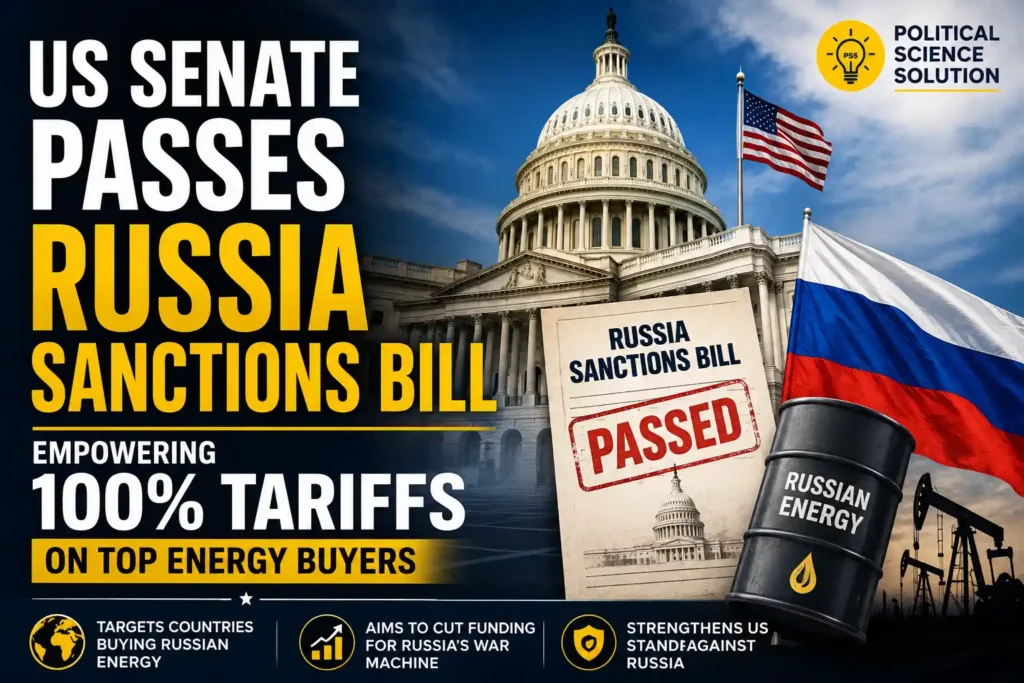
New Delhi: The United States Senate voted 86-11 on August 7 to approve a sweeping bipartisan package that gives the president authority to impose tariffs reaching 100 percent on goods from the five largest global buyers of Russian crude oil or natural gas. Officially named the Lindsey O. Graham Sanctioning Russia and Iran Act of 2026, the legislation now moves to the House of Representatives for further consideration when lawmakers return on August 31.
Tribute to Late Senator and Bipartisan Backing
Republican Lindsey Graham of South Carolina, who died on July 11, had long pushed for stronger measures against Moscow’s energy earnings that help fund the war in Ukraine. His sister Darline Graham, who took his Senate seat, stated that the bill strikes Russian President Vladimir Putin in a vulnerable area. Democrat Richard Blumenthal of Connecticut, who worked alongside Graham for more than a year, declared during floor debate that Ukrainian President Volodymyr Zelensky was observing events from Kyiv while Putin watched from Moscow. Blumenthal added that he believed Graham might also be watching and emphasized that Ukraine does not stand alone while asserting that Putin will not succeed in conquering the country.
Senate Foreign Relations Committee Chairman Jim Risch of Idaho described the package as a way to interrupt the cash flow sustaining Russia’s military effort. The measure advanced after senators used a previously passed House tax bill as the legislative vehicle, amending it to include the full sanctions text.
Core Tariff Authority and Qualification Rules
Section 113 of the approved text requires the president to raise duties on imports from qualifying nations to levels as high as 100 percent within 30 days of the law taking effect. These duties would apply in addition to any tariffs already in place. A country qualifies when it knowingly begins new purchases of Russian crude oil or natural gas starting 30 days after enactment and ranks among the five largest importers of either commodity during the prior 12 months. The same ranking system covers nations that help facilitate evasion of existing American sanctions on Russian oil.
The United States Trade Representative must identify the five largest importers of Russian crude and the five largest importers of Russian natural gas within 180 days after the first set of duties and then repeat the process every 180 days, applying the corresponding tariffs each time. At least ten days before any duty is imposed or altered, the president or trade representative must deliver a written explanation to Congress detailing the chosen rate and the method used to confirm that a country meets the criteria.
Nations Potentially Affected and Existing Exceptions
Current rankings place India and China among the five largest purchasers, along with Azerbaijan, Hungary and Slovakia. The legislation never lists any specific country by name. Officials must independently verify that a nation satisfies the statutory tests before any tariff applies. Indian refiners brought in a record 2.64 million barrels per day of Russian crude in June, representing a 37.4 percent increase from May and about half of the country’s total oil imports. Those volumes rose after a temporary United States sanctions waiver allowed refiners to cover a Gulf supply gap created by the Strait of Hormuz blockade. Purchases from non-sanctioned Russian entities continued even after the waiver ended. The bill’s standard focuses solely on the Russian origin of the oil rather than the sanction status of the particular seller.
Exceptions are built into the text. Nations that import less than 15 percent of their natural gas from Russia and that are actively reducing those volumes can avoid the duties. The president may also waive any tariff or restriction after certifying to Congress that the action serves the national interest. A separate directive requires the president to increase tariffs on goods from Russia itself to as high as 500 percent, subject to the same exceptions and waiver authority. Most elements of the package, including the tariff provisions, expire five years after the law is enacted.
Additional Sanctions Targeting Russian Entities and Infrastructure
Beyond the secondary tariffs, the bill expands existing sanctions to cover older oil tankers that have been reflagged and used by Russia to bypass current American restrictions. It applies sanctions to Putin, senior Russian political and military leaders, major Russian financial institutions, and individuals or companies linked to designated Russian energy projects. Further restrictions limit United States investment in and exports involving Russia’s energy sector.
Parallel Extension of Iran Sanctions
In addition to the Russia-focused measures, the legislation extends the expiration date of the Iran Sanctions Act of 1996 until 2031. That statute imposes penalties on companies that invest in Iran’s energy sector, and the extension keeps those tools available for another five years.
Current Trade Measures Already Affecting India
India currently faces a separate 10 percent Section 301 tariff on certain products. That duty took effect on July 24 as part of an action covering 60 economies over shortcomings in enforcing bans on goods made with forced labor. India received the 10 percent rate after putting its own forced-labor import prohibition in place. In February, President Donald Trump had removed an additional 25 percent tariff on Indian imports following New Delhi’s commitment to stop buying Russian oil. The related executive order instructed agencies to monitor India’s purchases and to consider reinstating the higher duty if imports of Russian oil resumed. The new Senate bill operates independently of those earlier steps.
Failed Effort to Remove Tariff Language
Senator Rand Paul of Kentucky offered an amendment that would have deleted the Russian-energy tariff provisions while leaving the rest of the sanctions intact. The amendment was defeated by a 32-64 vote. Paul contended that the proposed duties would increase costs for American consumers and that Congress should not transfer its constitutional tariff responsibilities so readily to the executive branch.
Path Ahead in the House
The House of Representatives must now decide whether to accept the Senate amendment or negotiate a revised version. Only after House passage and a presidential signature would the new authorities become law. Supporters argue that the package supplies a flexible instrument capable of pressuring major energy buyers while preserving presidential discretion through waivers and periodic reviews. The combination of written justifications, six-month reassessment cycles, explicit exceptions, and national-interest waivers was designed to make the tools practical rather than purely symbolic.
The five-year sunset clause ensures that future Congresses will have the opportunity to reassess the measures. Implementation decisions, if the bill becomes law, will determine whether secondary tariffs alter the economics of Russian energy sales and how they interact with existing trade relationships involving major Asian and European partners. The Senate’s decisive margin and the personal dedication to Graham provide political momentum as the legislation awaits House action after the August recess.
FAQs
1. What does the Lindsey O. Graham Sanctioning Russia and Iran Act of 2026 actually authorize?
The legislation allows the president to impose tariffs of up to 100 percent on goods from any country that ranks among the five largest importers of Russian crude oil or natural gas and that makes new purchases of those products beginning 30 days after the law takes effect. It also directs tariffs as high as 500 percent on imports from Russia itself, expands sanctions to cover reflagged tankers, Russian leaders, financial institutions and energy projects, and extends the Iran Sanctions Act of 1996 through 2031.
2. Will India automatically face 100 percent tariffs if the bill becomes law?
No. The bill never names India or any other specific country. Federal officials must first determine that a nation meets the statutory tests—ranking among the top five buyers over the prior 12 months and making new Russian energy purchases after the 30-day trigger—before any tariff can be applied. Exceptions exist for countries importing less than 15 percent of their natural gas from Russia while reducing those volumes, and the president may waive duties after certifying a national-interest justification to Congress.
3. How did the Senate vote and what happens next?
The Senate approved the measure 86-11 on August 7, 2026. Lawmakers attached it to a House-passed tax bill. The House of Representatives must now accept the Senate amendment or negotiate changes when it reconvenes on August 31. Only after House approval and a presidential signature would the authorities take effect. Most provisions, including the tariff mechanisms, expire five years after enactment.
4. What other sanctions and restrictions does the bill contain?
Beyond the secondary tariffs, the package targets Vladimir Putin, senior Russian political and military officials, major Russian financial institutions, and entities linked to specified energy projects. It restricts U.S. investment and exports involving Russia’s energy sector and closes loopholes by sanctioning older, reflagged oil tankers used to evade existing restrictions. A parallel provision keeps Iran energy-sector sanctions tools available until 2031.
5. How do existing U.S. tariffs on India relate to this new legislation?
India already faces a separate 10 percent Section 301 tariff on certain goods that took effect July 24, 2026, as part of an action addressing forced-labor import enforcement. In February 2026 the administration had removed an earlier additional 25 percent tariff after India committed to halt Russian oil purchases, while directing agencies to monitor compliance. The new Senate bill operates independently of those prior measures and would require fresh determinations based on its own top-five importer criteria.