

New Delhi: Colombia entered a new political chapter on Friday, August 7, 2026, when Abelardo de la Espriella took the presidential oath in the southwestern city of Cali. The 48-year-old right-wing lawyer and businessman, widely known among supporters as “El Tigre,” replaced leftist leader Gustavo Petro after winning a close runoff election. His decision to hold the ceremony outside Bogotá marked a deliberate departure from long-standing tradition and signaled an immediate emphasis on confronting illegal armed groups that have long operated in the region.
The event, attended by international dignitaries and staged under heavy security, reflected both the new president’s outsider profile and the broader rightward political movement taking hold across Latin America. De la Espriella campaigned on promises of aggressive action against narco-terrorism, deep cuts in public spending, and a revival of the country’s oil and gas sector. Those commitments now form the core of his early agenda.
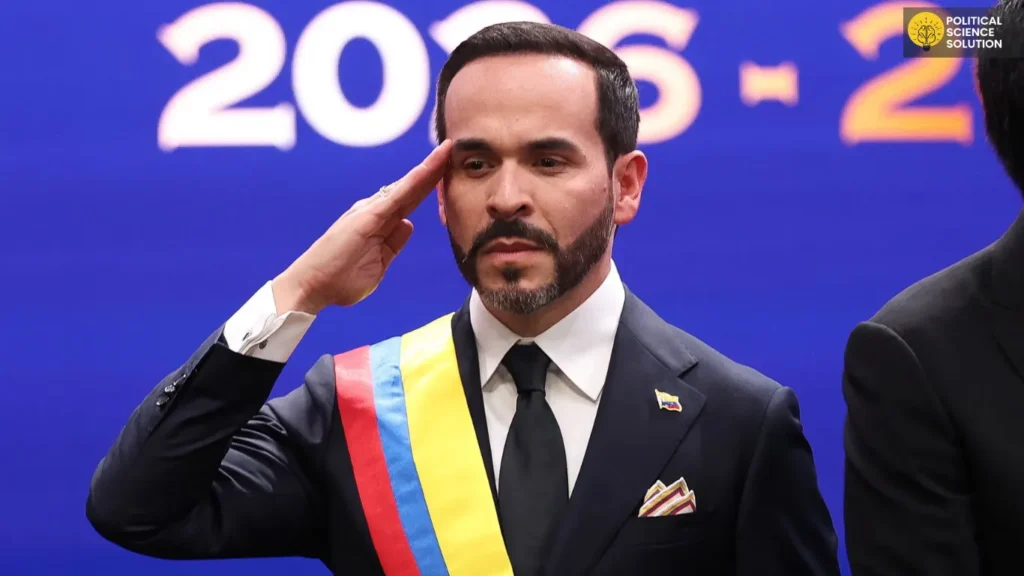
Inauguration Ceremony Signals Break from Past Approach
De la Espriella received the presidential sash from Senate President Honorio Henriquez inside a university auditorium before members of Congress. The choice of Cali, a city that has endured years of conflict involving armed factions, was intentional. Officials lined nearby roads with soldiers and armored vehicles. In the days leading up to the event, police established multiple checkpoints and inspected vehicles for explosives. The heightened security measures underscored the challenges that have defined the southwest for decades.
After the formal swearing-in, the new president traveled to a local military battalion. There he addressed troops directly, presenting the visit as a show of support for the armed forces and a clear message to illegal groups active in the area. He stated that the option of dialogue had been fully exhausted and pledged to relentlessly defeat narco-terrorism. “There will be no room for manoeuvres that undermine the stability of the nation,” he told the audience. He later reinforced the point by declaring that criminals would find no safe place within Colombian territory and that democracy would be defended by reason or by force.
The groups operating in the southwest include dissident factions of the former FARC movement that rejected the peace agreement signed roughly ten years earlier, the Clan del Golfo cartel, and the National Liberation Army. Competition among them over drug trafficking and illegal mining continues to drive violence and displacement in the region. De la Espriella’s early statements rejected the negotiation-focused strategy pursued by the outgoing administration and instead framed the path forward as one of decisive military pressure.
Security Promises and Rejection of Negotiated Peace
Throughout the campaign and in his first official remarks, de la Espriella positioned security as the central priority. He argued that previous efforts at dialogue had failed to curb the expansion of armed organizations or reduce the scale of illegal economies. His government, he said, would treat remaining holdouts as military targets if they refused to surrender. The approach draws comparisons to recent crackdowns in other Latin American countries facing similar challenges with organized crime.
Heavy security surrounded the entire inauguration process. Authorities screened for potential threats in the days before the ceremony, reflecting both the volatile local environment and the political tensions surrounding the transfer of power. The new president’s decision to speak first to soldiers rather than remaining solely in civilian settings reinforced the message that the armed forces would play a central role in the coming period.
Economic Agenda Centers on Spending Cuts and Energy Revival
Beyond security, de la Espriella outlined an economic platform aimed at attracting investment and reversing what he described as stagnation in key industries. Speaking to business leaders, he promised that his administration would act as a partner for those willing to invest in Colombia. He called for responsible and sustainable fracking and rejected the idea that the country should accept limited oil reserves or declining gas supplies. Strengthening the state oil company Ecopetrol formed part of that plan.
On public finances, he has committed to reducing government spending by as much as 40 percent. The combination of fiscal restraint and energy expansion is intended to support broader growth, though analysts have noted that translating campaign language into concrete policy remains a significant test. One economist observed that the new president’s early remarks contained strong principles and a clear distance from the previous progressive government, yet lacked the detailed roadmap needed to deliver on ambitious goals of national transformation.
International Realignment and U.S. Support
Foreign policy under the new government is expected to shift markedly. De la Espriella has pledged to join the Shield of the Americas, a regional security partnership focused on drug trafficking that emerged from a summit hosted by the Trump administration earlier in the year. He also announced plans to restore diplomatic relations with Israel while ending ties with Cuba and Nicaragua, which he has described as tyrannies. These moves reverse positions taken by the Petro administration, which had been openly critical of certain U.S. policies and had severed relations with Israel over the conflict in Gaza.
U.S. President Donald Trump endorsed de la Espriella during the campaign. On the day of the inauguration, the U.S. State Department announced an intended $1 billion security assistance package for the new Colombian government, subject to congressional approval. Officials described the funding as a cornerstone of renewed partnership aimed at shared objectives on organized crime and related issues. The same statement welcomed Colombia’s alignment with the regional anti-trafficking coalition and noted opportunities for expanded trade and economic cooperation.
Guests at the Cali ceremony included Spain’s King Felipe VI, acting U.S. Attorney General Todd Blanche, FIFA President Gianni Infantino, Argentina’s Javier Milei, Chile’s José Antonio Kast, and Ecuador’s Daniel Noboa. The presence of these figures highlighted the international interest in Colombia’s political turn and the emerging network of conservative governments across the region.
Regional Context and Rightward Political Trend
De la Espriella’s victory continues a series of conservative electoral successes in Latin America since early 2025. Leaders such as Peru’s Keiko Fujimori, Chile’s José Antonio Kast, and Argentina’s Javier Milei have taken office amid widespread concerns over crime, economic pressure, and migration. Analysts have described the pattern as consolidating a bloc of right-leaning governments at a time when left-wing administrations hold fewer positions of power. Brazil’s president, for example, faces a more limited set of regional allies as a result.
The new Colombian leader has expressed admiration for Milei’s approach and has positioned himself as an outsider who rejected traditional political networks. His rise adds another voice to the group of governments seeking closer coordination with the United States on security matters.
Opposition Response and Public Protests
Gustavo Petro did not attend the inauguration. He had initially challenged the election outcome, claiming that tallies had been manipulated, though international observers and Colombia’s electoral authorities rejected those allegations. On the day power changed hands, Petro stated that he would respect the popular will. At the same time, observers expect him to remain a vocal and determined opponent. He has previously urged social movements in the southwest to organize self-defense groups and has called on supporters to prepare for collective action if authorities move against him after he leaves office.
Protests took place in Cali, Bogotá, and Barranquilla on inauguration day. In Cali’s Puerto Resistencia neighborhood, a site of major demonstrations in 2021, one young resident said local people were defending their dignity and making clear that the new president lacked support in the area. Another resident from southern Cali noted the deep divisions within the city and expressed hope that any demonstrations would stay peaceful. The close margin of the runoff election and the polarized atmosphere underline the difficulty of governing a country split along ideological lines.
Political analysts have pointed out that the combination of a hard-line security posture from the new government and continued mobilization by the outgoing president’s supporters raises the possibility of tension during future protests. The southwest in particular remains a focal point of both security operations and social resistance.
Background of the New President
Abelardo de la Espriella entered national politics without prior elected experience. He built his career and wealth as a lawyer and businessman, largely financing his own presidential campaign. He has held U.S. citizenship since 2023 after living and working for years in Miami. Earlier in his legal practice he represented clients linked to paramilitary and drug-trafficking networks, a chapter that now stands in contrast to his stated determination to confront such organizations.
He announced his candidacy shortly after another conservative contender was killed and conducted much of his campaign under tight personal security, frequently appearing behind protective barriers and wearing a bulletproof vest. Supporters adopted the “El Tigre” nickname as a symbol of the forceful style he promised to bring to office. His outsider status and direct communication style helped distinguish him from more established political figures.
Looking Ahead
The new administration begins with clear priorities: confronting armed groups through sustained pressure, reducing public expenditure, expanding domestic energy production, and realigning Colombia’s international relationships. The $1 billion U.S. security package, once approved, is expected to support the first of those goals. At the same time, the government faces a polarized electorate, an active opposition, and the practical challenge of turning broad campaign commitments into workable policy.
De la Espriella’s decision to start his presidency in Cali rather than Bogotá, his immediate outreach to the military, and his explicit rejection of further dialogue with illegal armed organizations have set a distinctive tone. Whether that approach produces lasting improvements in security and economic performance will depend on execution in the months ahead and on the ability to navigate Colombia’s deep political divisions. The inauguration has already positioned the country within a wider regional shift toward conservative governance and closer coordination with the United States on shared security concerns.
FAQs
1. Who is Abelardo de la Espriella and what is his background?
Abelardo de la Espriella is a 48-year-old Colombian lawyer and businessman who took office as president on August 7, 2026. Known to supporters as “El Tigre,” he had never held elected office before. He built his career and wealth in the private sector, largely self-financed his presidential campaign as an outsider, and has held U.S. citizenship since 2023 after years living and working in Miami. Earlier in his legal practice he represented clients linked to paramilitary networks, a background that now contrasts with his tough security stance.
2. Why was the presidential inauguration held in Cali instead of Bogotá?
De la Espriella deliberately broke with tradition by staging the ceremony in Cali, a city in Colombia’s southwest that has long faced violence from illegal armed groups. The location was chosen to signal his priority of confronting those groups and to reject the negotiation-focused approach of the previous government. Heavy security, including soldiers, armored vehicles, and vehicle checkpoints, surrounded the event.
3. What are the main policy promises of the new president?
He has pledged an all-out campaign against narco-terrorism and armed groups, declaring that dialogue is exhausted and that remaining factions will face military pressure. On the economy he has promised to cut government spending by as much as 40 percent, promote responsible fracking, reverse the decline in oil and gas reserves, and strengthen the state oil company Ecopetrol. He also plans to join the U.S.-backed Shield of the Americas anti-drug coalition, restore ties with Israel, and end relations with Cuba and Nicaragua.
4. How has the United States responded to his election?
U.S. President Donald Trump endorsed de la Espriella during the campaign. On inauguration day the U.S. State Department announced plans for a $1 billion security assistance package, subject to congressional approval, to support shared goals on organized crime and related issues. The statement also welcomed Colombia’s alignment with the Shield of the Americas and noted opportunities for deeper trade and economic ties.
5. How does this fit into wider political changes in Latin America?
De la Espriella’s victory continues a series of conservative wins across the region since early 2025, including those of leaders in Peru, Chile, and Argentina. Analysts describe it as strengthening a bloc of right-leaning governments focused on security, crime, and closer coordination with the United States, while reducing the number of left-wing administrations in power.