

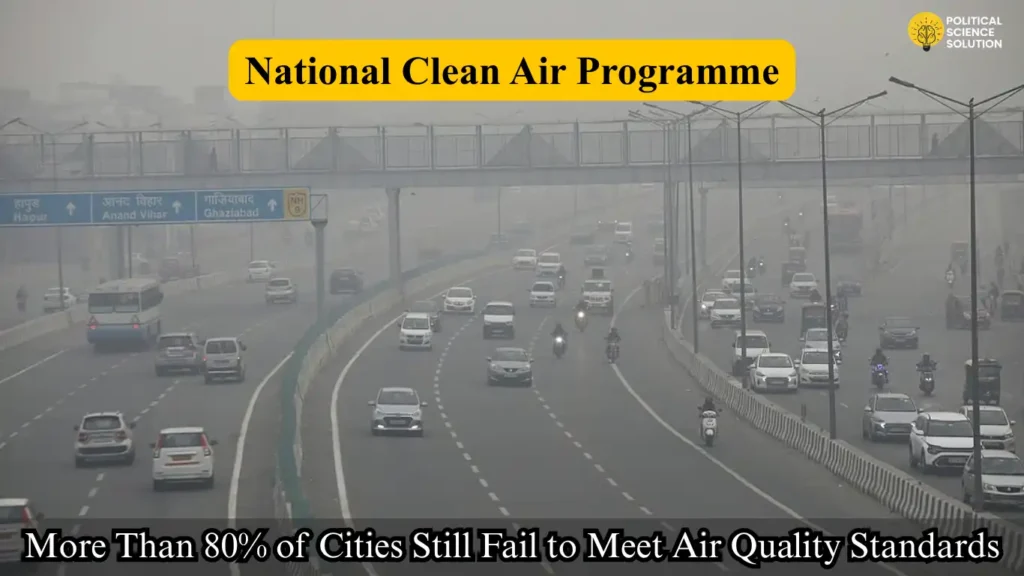
New Delhi: Official data presented in Parliament has revealed that more than 80 percent of the cities covered under India’s National Clean Air Programme continue to exceed national air quality limits. Despite significant spending and years of planned action, most of these cities still record levels of particulate pollution above the safe standards set by the government. The information was provided by the Ministry of Environment, Forest and Climate Change in the Lok Sabha on 10 August 2026 in reply to a question on the programme’s progress and funding.
Government Data Shows Widespread Shortfall in Results
According to the ministry’s reply, 83 percent of the 130 cities under the National Clean Air Programme still have poor air quality. Only 14 cities – less than 10 percent of the total – managed to meet the National Ambient Air Quality Standards for PM10 in 2025-26. Just 26 cities succeeded in cutting their particulate matter levels by the targeted 40 percent.
The data further shows that 108 cities have exceeded the annual PM10 limit for three consecutive years. Maharashtra has the highest number of such cities at 19, followed by Uttar Pradesh with 16. In Maharashtra, every one of the 19 programme cities, including Mumbai, has stayed above the national limit despite more than Rs 800 crore spent on air pollution control measures.
Similar patterns appear in other states. All three cities from Bihar, all four from Gujarat and all seven from Odisha covered by the programme have failed to meet the standards. In Andhra Pradesh, which has 13 cities under the scheme, eight continue to breach the limits. In Uttar Pradesh, 16 out of 17 cities remain above the safe level.
A group of major cities has recorded continuous exceedances. Delhi, Kolkata, Surat, Ahmedabad, Pune, Guwahati, Mumbai, Bhubaneswar and Amritsar all stayed above the National Ambient Air Quality Standards for PM10 in 2023, 2024, 2025 and the first seven months of 2026.
Since 2023 alone, the government has spent Rs 6,822 crore under the National Clean Air Programme. Total spending since the programme began in 2019 has crossed Rs 16,423 crore. These figures underline the gap between the money allocated and the results achieved so far.
How the National Clean Air Programme Was Designed and What Support Measures Exist
The National Clean Air Programme was launched in 2019 by the Ministry of Environment, Forest and Climate Change as a national strategy to improve air quality. It covers 130 cities across 24 states and union territories – 122 non-attainment cities that had already failed to meet national standards, plus eight additional million-plus cities.
The programme relies on city-specific Clean Air Action Plans, performance-linked funding, coordination between different ministries, and a public participation approach known as Jan Andolan. Its main target is to achieve up to a 40 percent reduction in particulate matter (PM10 and PM2.5) concentrations or to bring levels within the National Ambient Air Quality Standards by 2025-26.
The National Ambient Air Quality Standards, notified by the Central Pollution Control Board in 2009, set annual limits of 60 micrograms per cubic metre for PM10 and 40 micrograms per cubic metre for PM2.5. These standards cover 12 pollutants in total. To monitor progress, the government launched the PRANA portal – Portal for Regulation of Air-pollution in Non-Attainment cities.
PM10 consists of particles 10 micrometres or smaller that come from road dust, construction activity, vehicle exhaust, industrial emissions and sometimes pollen. The finer PM2.5 particles are more harmful because they can travel deeper into the lungs.
Alongside the core programme, the government has tried to link other schemes for better results. These include the Swachh Bharat Mission-Urban, AMRUT, PM e-Bus Sewa, PM E-DRIVE and Nagar Van Yojana. For days of very high pollution, emergency measures such as the Graded Response Action Plan in Delhi-NCR and local emergency systems for hotspots are used. Technology support includes the PRANA portal, the shift to cleaner BS-VI vehicle emission norms, and sensor-enabled smart poles that provide real-time pollution data.
The ministry has described the programme as aiming for long-term air quality management through better infrastructure, local plans and stronger institutions. Yet the latest numbers show that most cities have not yet reached either the reduction target or the absolute safe limits.
The continuing high levels of particulate pollution mean that large numbers of people in these cities are still breathing air that does not meet national health standards. With the original 2025-26 deadline approaching, the data highlights the need for faster and more effective action on the ground if the programme’s goals are to be met.
Frequently Asked Questions
1. When was the National Clean Air Programme launched and what is its main goal?
The National Clean Air Programme was launched in 2019 by the Ministry of Environment, Forest and Climate Change. Its main goal is to reduce particulate matter (PM10 and PM2.5) by up to 40 percent or bring pollution levels within the National Ambient Air Quality Standards in 130 cities by 2025-26.
2. What do the latest government figures say about the success of NCAP?
Government data shows that 83 percent of the 130 cities under the programme still have poor air quality. Only 26 cities achieved the 40 percent reduction target, and just 14 cities met the national PM10 standard in 2025-26. A total of 108 cities have exceeded the PM10 limit for three straight years.
3. Which states have the highest number of cities failing under NCAP?
Maharashtra has the most with all 19 of its NCAP cities failing to meet standards. Uttar Pradesh has 16 out of 17 cities above the limit. Andhra Pradesh has 8 out of 13 failing cities, while all NCAP cities in Bihar, Gujarat and Odisha have also not met the required standards.
4. How much has the government spent on the National Clean Air Programme so far?
More than Rs 16,423 crore has been spent since the programme began in 2019. Of this, Rs 6,822 crore was spent from 2023 onwards. In Maharashtra alone, over Rs 800 crore has been used, yet none of its 19 cities have come within the safe limits.
5. What other measures is the government taking along with NCAP to control air pollution?
The government is combining NCAP with other schemes like Swachh Bharat Mission-Urban, AMRUT, PM e-Bus Sewa, PM E-DRIVE and Nagar Van Yojana. It is also using emergency response systems such as GRAP in Delhi-NCR, enforcing cleaner BS-VI vehicle norms, and tracking progress through the PRANA portal and sensor-based smart poles.