

New Delhi: The Monsoon Session of the Indian Parliament in 2026 has concluded as one of the least productive in recent decades. Both the Lok Sabha and Rajya Sabha operated far below their scheduled capacity amid repeated disruptions and adjournments. According to data compiled by PRS Legislative Research, the Lok Sabha functioned for only 15 percent of its scheduled time while the Rajya Sabha worked for 33 percent. In absolute terms, the Lok Sabha sat for just 17.5 hours and the Rajya Sabha for 37.4 hours during the session that began on July 20 and ended around August 10-13, 2026.
These figures mark the 2026 Monsoon Session as among the poorest performers over the past ten years and highlight deeper institutional challenges that continue to affect the functioning of India’s highest legislative body.
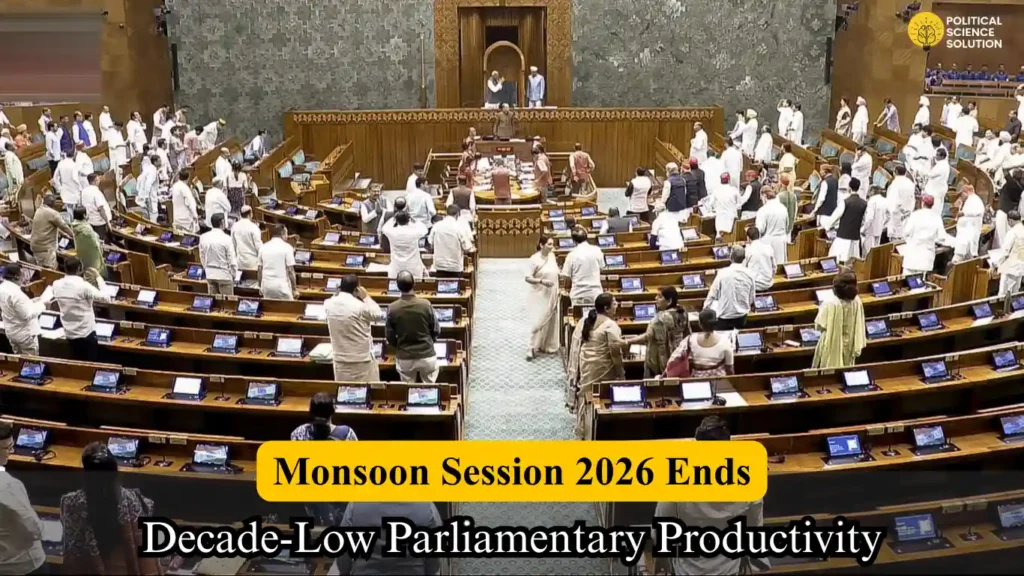
Sharp Decline Compared With Earlier Monsoon Sessions
A comparison with previous Monsoon Sessions reveals the extent of the drop. The Lok Sabha had functioned for more than 37 hours during the 2025 Monsoon Session and exceeded 44 hours in both 2022 and 2023. The contrast becomes even sharper when measured against earlier years: the House worked for more than 120 hours in 2016 and over 112 hours in 2018.
The Rajya Sabha also recorded lower-than-usual hours. It functioned for 41.9 hours in 2025 and 55 hours in 2023, against only 37.4 hours in 2026. While several sessions in the last decade suffered from disruptions, the latest one stands out for the significant volume of scheduled time that was lost.
Legislative Business and Growing Backlog
The session began with 30 pending bills. During its course, 13 bills were introduced and 12 were passed. Despite this activity, the overall legislative backlog did not improve. Parliament ended the Monsoon Session with 31 bills still pending, one more than at the start.
Detailed debate took place on only one of the twelve bills that cleared Parliament—the Public Examination (Prevention of Unfair Means) Amendment Bill, 2026, also known as the anti-paper leak legislation. Of the eleven bills passed by the Lok Sabha in the broader period under review, nine moved forward without any Member of Parliament other than the concerned Minister speaking on them.
Oral questions were equally scarce. Only two questions received oral answers in the Lok Sabha across the entire session, while the Rajya Sabha managed sixteen. These numbers reflect how limited the opportunities for detailed scrutiny and government accountability remained.
Opposition Unity and Key Referrals
Despite the overall low productivity, the Opposition maintained a united front. It pushed back strongly against several measures, most notably the Foreign Contribution (Regulation) Amendment Bill, 2026. Sustained pressure led to the bill being referred to a Joint Parliamentary Committee rather than being passed without deeper examination. This outcome showed that coordinated action can still influence the legislative process even in a disrupted session.
High Financial Cost of Lost Time
The monetary cost of the disruptions has also come under focus. Estimates place the expenditure of running the Lok Sabha at around Rs 2.5 lakh per minute. With large portions of scheduled business hours lost to repeated adjournments, the value of wasted parliamentary time runs into thousands of crores. For this particular Monsoon Session the loss has been calculated at approximately Rs 175 crore. Such figures underline the opportunity cost of time that could have been used for legislative scrutiny, financial oversight and executive accountability.
Structural Reasons Behind Declining Productivity
Several interconnected factors explain the persistent fall in parliamentary productivity. Rising political polarization has reduced the space for consensus-building. Issues such as the NEET paper leak controversy illustrate how specific disputes quickly escalate into prolonged confrontations that have become standard parliamentary strategies rather than exceptions.
Parliamentary committees have also been marginalized. During the 18th Lok Sabha up to the 2026 Monsoon Session, only 21 percent of bills were referred to committees. This limited referral rate restricts the detailed examination that committees are designed to provide.
Executive practices have contributed further. Frequent use of the ordinance route and the classification of certain measures as Money Bills have restricted the Rajya Sabha’s scope for full scrutiny. At the same time, Indian Members of Parliament lack access to independent research platforms comparable to the US Congressional Research Service. The absence of such logistical and analytical support constrains the quality of preparation that legislators can bring to debates and committee work.
The broader political environment adds another dimension. Data from the Association for Democratic Reforms showed that 46 percent of candidates in the 2024 Lok Sabha elections had pending criminal cases. Analysts argue that high levels of criminalization can affect the tone of proceedings, the incentives for disruption and the seriousness with which institutional processes are treated.
Wider Impact on Governance and Accountability
The consequences of sustained low productivity extend well beyond sitting hours. Legislation passed with minimal debate risks remaining poorly drafted, ambiguous in language and difficult to implement effectively.
Financial accountability has already shown clear signs of strain. In 2023 only 11 percent of budget expenditure underwent detailed scrutiny, while more than 75 percent of Demands for Grants were passed without discussion. When Parliament leaves gaps in law-making or oversight, the judiciary sometimes steps in to fill the vacuum, as seen historically with the formulation of the Vishaka Guidelines.
Reduced time for Question Hour and Zero Hour further weakens the regular mechanisms through which the executive is held accountable for its actions and policies. Collectively these trends point to an erosion of the core functions that Parliament is expected to perform in a parliamentary democracy.
What the Numbers Reveal About Institutional Health
Taken together, the 2026 Monsoon Session illustrates a pattern that has been building over several years. Productivity metrics have trended downward even as the volume and complexity of legislative and financial business have grown. The combination of polarization, limited committee referral, executive procedural choices, inadequate research support for legislators and the background of criminalization has created an environment in which disruption frequently outweighs deliberation.
Yet the session was not entirely without legislative output. Twelve bills did clear Parliament and one received a relatively fuller examination. The successful referral of the FCRA amendment to a Joint Parliamentary Committee demonstrated that Opposition coordination can still shape outcomes on specific measures. These limited successes, however, do not offset the overall picture of time lost, questions unanswered and scrutiny deferred.
Looking Ahead: The Need for Institutional Correction
Restoring meaningful productivity will require attention to both immediate procedural practices and longer-term institutional reforms. Greater willingness to refer bills to committees, clearer norms around the use of ordinances and Money Bill provisions, investment in independent research capacity for Members of Parliament, and efforts to reduce the influence of criminal cases on the political class form part of the conversation that the latest session has again brought into focus.
Without progress on these fronts, future sessions risk repeating the same cycle of low functioning hours, limited debate and accumulating legislative and accountability deficits. The data from PRS Legislative Research, the comparative historical figures, the specific bill outcomes, the oral question tallies, the cost estimates and the structural diagnoses all point to the same conclusion: the 2026 Monsoon Session ranked among the least productive in a decade and exposed ongoing weaknesses in the functioning of India’s parliamentary institutions. Addressing those weaknesses remains essential if Parliament is to fulfill its constitutional roles of legislation, financial control and executive oversight with the seriousness and thoroughness that a complex democracy demands.
FAQs
1. How productive was the 2026 Monsoon Session of Parliament?
The 2026 Monsoon Session was one of the least productive in a decade. According to PRS Legislative Research, the Lok Sabha functioned for only 15% of its scheduled time (just 17.5 hours), while the Rajya Sabha worked for 33% (37.4 hours). The session ran from July 20 to around August 10–13, 2026, and recorded the lowest productivity levels seen in ten years.
2. How does this session compare with previous Monsoon Sessions?
It marks a sharp decline. The Lok Sabha had worked more than 37 hours in the 2025 Monsoon Session and over 44 hours in both 2022 and 2023. In 2016 it functioned for more than 120 hours and in 2018 for over 112 hours. The Rajya Sabha also underperformed, logging 41.9 hours in 2025 and 55 hours in 2023 compared with only 37.4 hours in 2026.
3. What were the main reasons for the low productivity?
Key factors include rising political polarization (seen in issues such as the NEET paper leak), marginalization of parliamentary committees (only 21% of bills referred during the 18th Lok Sabha up to this session), frequent use of ordinances and the Money Bill route, lack of independent research support for MPs, and high criminalization of politics (46% of 2024 Lok Sabha candidates had pending criminal cases, as per ADR).
4. What was the legislative output and what did it cost?
The session began with 30 pending bills. Thirteen bills were introduced and twelve were passed, yet the backlog rose to 31. Detailed debate occurred on only one bill—the Public Examination (Prevention of Unfair Means) Amendment Bill, 2026. Only two questions were answered orally in the Lok Sabha and 16 in the Rajya Sabha. The estimated cost of lost Lok Sabha time stood at around Rs 175 crore, based on a running cost of approximately Rs 2.5 lakh per minute.
5. What are the broader impacts of such low parliamentary productivity?
It leads to hasty and poorly drafted legislation, weak financial scrutiny (in 2023 only 11% of budget expenditure was examined in detail and over 75% of Demands for Grants passed without discussion), reduced executive accountability through curtailed Question Hour and Zero Hour, and greater scope for judicial intervention to fill legislative gaps (as seen earlier with the Vishaka Guidelines).