

New Delhi: Veteran Bangladesh Nationalist Party figure Mirza Fakhrul Islam Alamgir has formally entered office as the 23rd President of the People’s Republic of Bangladesh. The 78-year-old leader completed the constitutional process with a swearing-in ceremony held at the Darbar Hall inside Bangabhaban, the official residence of the head of state. The Speaker of the Jatiya Sangsad administered the oath, bringing to a close the first multi-candidate presidential contest Bangladesh has witnessed in 35 years.
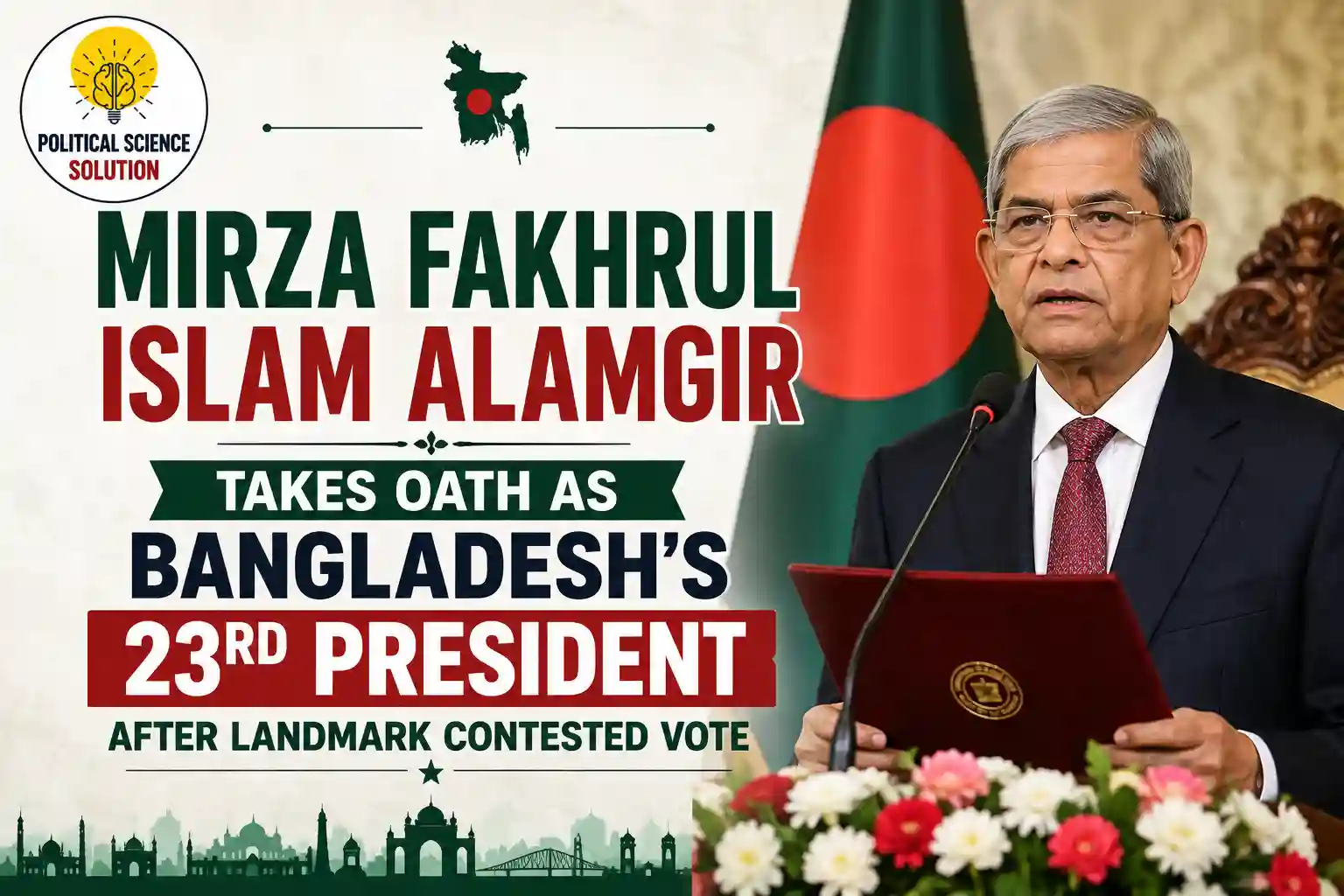
Swearing-In Ceremony at Bangabhaban
The formal investiture took place in the presence of Prime Minister Tarique Rahman, senior constitutional authorities, foreign representatives, and ranking civil and military officers. The gathering reflected the full institutional weight of the occasion. Earlier that same day, Alamgir travelled to the Sher-e-Bangla Nagar area of Dhaka to pay respects at the resting places of BNP founder President Ziaur Rahman and former Prime Minister Begum Khaleda Zia. The visit underscored personal and party continuity at a moment of national transition.
Results of the Parliamentary Presidential Election
Members of the Jatiya Sangsad elected Alamgir by a clear margin of 255 votes to 88. His sole opponent was Oli Ahmad, an 84-year-old retired army colonel and chairman of the Liberal Democratic Party. Ahmad stood as the candidate of an 11-party opposition coalition headed by Jamaat-e-Islami and backed by the National Citizen Party. Chief Election Commissioner ASM Nasir Uddin oversaw the process and announced the outcome. Although the parliament contains 350 seats, voting occurred among 349 members because one constituency election remained suspended. Of those 349, 343 participated.
The contest itself marked a departure from recent practice. For more than three decades, presidential elections had been uncontested after opposition parties chose not to nominate candidates. Alamgir’s selection by the BNP the previous week required him to step down as party Secretary General and as a member of the National Standing Committee before the ballot.
Background to the Presidential Vacancy
The election became necessary after President Mohammed Shahabuddin resigned last month on medical grounds, more than two years short of completing his five-year term. Shahabuddin had been elected unopposed in 2023 as the nominee of the Awami League government then led by Sheikh Hasina. He remained in office through Hasina’s departure in August 2024, the subsequent interim administration under Muhammad Yunus, and the BNP’s return to power after the February 12 general elections. Bangladesh’s Constitution requires a new president to be chosen within 90 days of any vacancy. The BNP’s two-thirds parliamentary majority following those February polls provided the decisive numbers for Alamgir’s victory.
Political Journey of Mirza Fakhrul Islam Alamgir
Alamgir’s public life stretches across more than five decades. He first engaged in politics as a student of economics at Dhaka University and became a prominent organiser during the 1969 mass uprising against Pakistani military rule. He entered the BNP in the early 1990s and steadily rose through its hierarchy. During Sheikh Hasina’s long period in office he emerged as one of the party’s most recognisable national faces and faced repeated detention that the BNP consistently described as politically driven.
In the years when Begum Khaleda Zia was incarcerated and Tarique Rahman lived in exile in London, Alamgir managed the party’s organisational work on the ground while coordinating with the leadership abroad. After the BNP formed the government in February he served as Local Government Minister. Earlier ministerial assignments included Agriculture, Aviation and Tourism. Before the parliamentary vote he publicly described his aspiration for “a happy, prosperous and welfare-oriented state where marginalised communities, hard-working people and daily wage earners can afford meals twice a day,” according to the state news agency BSS.
International Reactions and Congratulatory Messages
Messages of goodwill arrived promptly from key partners. Indian President Droupadi Murmu conveyed formal congratulations, writing: “I extend to you my warm congratulations on your assumption of office as the President of the People’s Republic of Bangladesh. I am confident that your long experience of public life and political leadership heralds a successful tenure in service of the people of Bangladesh.” She recalled the “unique relationship” between the two countries “rooted in a shared history of sacrifices, close cultural ties and warm bonds of friendship” and noted expanding cooperation in energy, technology, connectivity, youth affairs, health and education. “I look forward to working with you to further strengthen the partnership between our two neighbouring countries,” she added, extending personal wishes for Alamgir’s health and for the continued progress of the Bangladeshi people.
The United Kingdom issued a statement congratulating Alamgir and affirming readiness to deepen the established partnership between Dhaka and London. China, through Foreign Ministry spokesperson Lin Jian, welcomed the election and restated its intention to advance a “China-Bangladesh community with a shared future in the new era.”
Stance on Bilateral Relations with India
Alamgir has previously articulated firm positions on sovereignty and bilateral files. In December 2024, speaking at a BNP gathering in London, he criticised incidents involving Bangladesh’s Assistant High Commission in Agartala and demonstrations outside Bangladeshi missions, while asserting that India had supported Hasina after her government’s fall. On the 1996 Indo-Bangladesh Ganges Water Sharing Treaty, which is scheduled to expire in December, he stated in May that relations with India would hinge on implementation that meets the requirements of the Bangladeshi population. “We want to send a clear message to the Indian government that a treaty must be implemented immediately through discussions according to the expectations and needs of Bangladesh’s people,” he declared at the time.
Domestic Political Context and Opposition Response
Within Bangladesh, Jamaat-e-Islami Ameer and Leader of the Opposition Dr Shafiqur Rahman offered formal congratulations. He described the presidency as “a symbol of national unity” with a significant responsibility to advance democracy, secure the rights of citizens and justice, and safeguard independence and sovereignty. The Awami League remains barred from political activity following the 2024 upheaval. Sheikh Hasina continues to reside in India and has spoken of returning in December; Alamgir’s elevation removes a presidential figure closely identified with the previous administration.
Looking Ahead for the New Presidency
Although the office is largely ceremonial, the president serves as head of state and commander-in-chief of the armed forces and retains residual constitutional authority. Alamgir’s long record as organiser, parliamentarian and minister equips him with institutional familiarity at a moment when Bangladesh continues to navigate economic recovery, employment pressures and the management of sensitive external relationships. The orderly completion of the election and the subsequent oath-taking provide a formal marker of constitutional continuity under the current parliamentary majority.
The sequence of events—parliamentary ballot, ceremonial investiture, international acknowledgments and domestic political responses—demonstrates adherence to the prescribed process for filling a mid-term vacancy. As Alamgir begins his tenure, attention will centre on how the office contributes to national cohesion while the elected government advances its legislative programme. His stated emphasis on welfare for ordinary citizens and respect for democratic norms will form the public benchmark against which the coming years are measured.
FAQs
1. Who is Mirza Fakhrul Islam Alamgir and how did he become Bangladesh’s 23rd President?
Mirza Fakhrul Islam Alamgir is a 78-year-old veteran leader of the Bangladesh Nationalist Party (BNP). He was elected by Members of Parliament in a vote held at the Jatiya Sangsad and formally sworn in as President at the Darbar Hall of Bangabhaban. The Speaker of Parliament administered the oath. He secured the post after the BNP nominated him, prompting his resignation as party Secretary General and National Standing Committee member. This marked the first contested presidential election in Bangladesh in 35 years.
2. What were the results of the presidential election and who was the opposing candidate?
Alamgir received 255 votes while his challenger, retired army officer Oli Ahmad (backed by an 11-party opposition alliance led by Jamaat-e-Islami and supported by the National Citizen Party), obtained 88 votes. Of the 349 eligible MPs (one constituency election having been suspended), 343 cast ballots under the supervision of Chief Election Commissioner ASM Nasir Uddin. The Chief Election Commissioner declared Alamgir the winner.
3. Why was a new presidential election necessary at this time?
The election followed the resignation of previous President Mohammed Shahabuddin last month on health grounds, more than two years before the end of his five-year term. Shahabuddin had been elected unopposed in 2023 as an Awami League nominee and remained in office through the 2024 political changes, the interim administration, and the BNP’s return to power after the February 12 general elections. The Constitution requires a new president to be elected within 90 days of a vacancy. The BNP’s two-thirds parliamentary majority ensured Alamgir’s clear victory.
4. What is Mirza Fakhrul Islam Alamgir’s political background and previous roles?
Alamgir entered politics as a student of economics at Dhaka University and played a prominent role in the 1969 uprising against Pakistani military rule. He joined the BNP in the early 1990s and became one of its most visible national leaders. He faced repeated arrests during Sheikh Hasina’s tenure, which the party described as politically motivated. In the absence of Begum Khaleda Zia (who was jailed) and while Tarique Rahman was in exile, Alamgir managed the party’s ground-level affairs. After the BNP’s February victory he served as Local Government Minister and had earlier held portfolios including Agriculture, Aviation and Tourism. Before the presidential vote he spoke of aspiring to build a welfare-oriented state focused on ordinary citizens.
5. How have India and other countries responded, and what are Alamgir’s known positions on bilateral ties?
Indian President Droupadi Murmu sent a congratulatory message praising Alamgir’s experience and expressing confidence in stronger India-Bangladesh partnership across energy, technology, connectivity, health, education and other areas. The United Kingdom and China also issued formal congratulations, with China reaffirming its commitment to advancing bilateral relations. Domestically, Jamaat-e-Islami Ameer Dr Shafiqur Rahman welcomed the new president as a symbol of national unity. Alamgir has previously called for respect for Bangladesh’s sovereignty, criticised certain incidents involving Bangladeshi diplomatic missions, and stated that relations with India would depend on timely implementation of the Ganges Water Sharing Treaty according to the needs of the Bangladeshi people.