

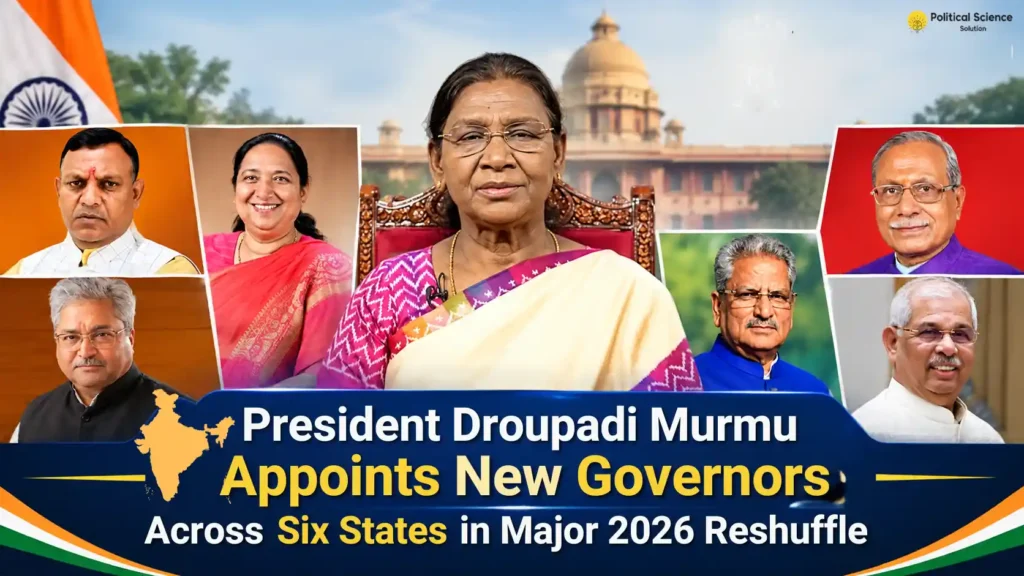
New Delhi: In a significant administrative reshuffle affecting the highest constitutional offices in multiple states, President Droupadi Murmu has formally appointed Governors for six Indian states. The appointments, announced through an official communique from Rashtrapati Bhavan on Monday, involve both transfers of sitting Governors and the elevation of four new individuals to the gubernatorial positions. These changes cover Keralam, Tamil Nadu, Sikkim, Odisha, Karnataka, and Uttarakhand, and will come into force on the dates the appointees assume charge of their respective offices.
The reshuffle transfers Om Prakash Mathur, previously the Governor of Sikkim, to the post of Governor of Keralam. In turn, Rajendra Vishwanath Arlekar, who had been serving as Governor of Keralam, has been appointed Governor of Tamil Nadu. Fresh appointments include Braj Mohan Ram as Governor of Odisha, Dr. Sudha Yadav as Governor of Karnataka, Dr. Dhal Singh Bisen as Governor of Uttarakhand, and Dushyant Gautam as Governor of Sikkim.
This marks one of the more extensive gubernatorial exercises of the year, following an earlier major reshuffle of Governors and Lieutenant Governors carried out by the President in March 2026. That earlier exercise had covered Delhi, Ladakh, Telangana, Maharashtra, Bihar, West Bengal, Tamil Nadu, Himachal Pradesh, and Nagaland. The latest set of decisions continues the process of realigning state constitutional heads.
Details of the Transfers and New Appointments
Rajendra Vishwanath Arlekar’s move from Keralam to Tamil Nadu ends a period in which the Tamil Nadu gubernatorial office had been managed under dual-charge arrangements. Officials familiar with the matter have noted that the placement of an experienced administrator is intended to provide continuity and stability in a state that has witnessed repeated differences between the elected government and the Raj Bhavan in recent years. Arlekar’s prior tenure in Keralam had already exposed him to the complexities of Centre-state relations in a politically assertive southern state.
Om Prakash Mathur’s transfer from Sikkim to Keralam fills the vacancy created by Arlekar’s elevation. Mathur brings with him the experience of administering a smaller Himalayan state and will now take charge of a larger southern state with its own distinct political and administrative culture.
Among the four new appointees, Braj Mohan Ram, a senior Bharatiya Janata Party leader from Jharkhand, has been named Governor of Odisha. He succeeds the incumbent Hari Babu Kambhampati. Ram has a long record in electoral politics. He represented the Palamu parliamentary constituency in Jharkhand three times in the Lok Sabha, with his first election coming in 1996. Earlier, when Jharkhand was still part of Bihar, he had also served as a member of the state legislative assembly. His selection is viewed as recognition of his organisational work and parliamentary experience.
Dr. Sudha Yadav has been appointed Governor of Karnataka, succeeding Thaawarchand Gehlot. Yadav is a former Lok Sabha member who represented the Mahendragarh constituency in Haryana between 1994 and 2004. She currently serves as a member of the BJP’s parliamentary board. Her elevation is seen as part of a broader effort to place experienced women leaders in constitutional roles.
Dr. Dhal Singh Bisen takes over as Governor of Uttarakhand, succeeding Lieutenant General Gurmit Singh (retired). Bisen has a substantial legislative background, having been elected as a Member of the Legislative Assembly for four terms and later serving as a cabinet minister in the state government. His appointment adds another leader with long grassroots experience to the gubernatorial ranks.
Dushyant Gautam has been named the new Governor of Sikkim, filling the post vacated by Om Prakash Mathur. Gautam is a former national general secretary of the Bharatiya Janata Party. In 2020 he was elected unopposed to the Rajya Sabha from Haryana. More recently he contested the 2025 Delhi Assembly elections but did not succeed. His organisational experience at the national level is expected to serve him in the smaller but strategically important Himalayan state.
Social Composition of the New Appointments
Observers have noted that the four fresh appointments reflect a deliberate social balance. Sudha Yadav and Dhal Singh Bisen belong to Other Backward Classes communities, while Braj Mohan Ram and Dushyant Gautam are Dalit leaders. Both Yadav and Bisen have held elected office for extended periods, and both Ram and Gautam have contested multiple elections and held organisational responsibilities within the party structure. The composition has been described in political circles as consistent with the ruling party’s long-term social engineering approach of broadening representation across different social groups in constitutional and organisational posts.
Official Communication and Effective Dates
The Rashtrapati Bhavan communique has made it clear that all six appointments will take effect only from the dates on which the concerned individuals formally assume charge of their offices. Until that formal assumption occurs, the existing arrangements in each state will continue. No specific dates for the swearing-in ceremonies have been announced yet; these are expected to be finalised by the respective state governments in consultation with the new appointees and the Centre.
Broader Context of Gubernatorial Appointments
Governors in India are appointed by the President under Article 155 of the Constitution and hold office during the pleasure of the President. While the office is largely ceremonial, Governors play important roles in situations involving hung assemblies, passage of bills, and the maintenance of constitutional machinery under Article 356. In recent years several states have witnessed public differences between Governors and elected governments, particularly over the delay or withholding of assent to bills and the timing of assembly sessions. The placement of experienced hands such as Arlekar in Tamil Nadu is therefore being watched closely by political observers.
The March 2026 reshuffle had already signalled the Centre’s willingness to carry out wide-ranging changes. The latest round reinforces that pattern. By combining transfers of sitting Governors with the induction of new faces drawn from different social backgrounds and regions, the exercise seeks both administrative continuity and political signalling.
Profiles of the Incoming Governors
Rajendra Vishwanath Arlekar arrives in Tamil Nadu with prior experience of managing Centre-state relations in Keralam. His tenure there involved navigating a political environment dominated by parties other than the one at the Centre.
Om Prakash Mathur moves from the quieter administrative setting of Sikkim to the more complex landscape of Keralam. His previous role required balancing the interests of a small state with significant strategic and environmental concerns.
Braj Mohan Ram’s parliamentary record spanning three Lok Sabha terms from Palamu and earlier assembly experience from the Bihar period gives him familiarity with both national and state-level legislative processes. His appointment to Odisha places a leader with roots in the eastern region in charge of another eastern state.
Sudha Yadav’s decade-long stint in the Lok Sabha from Haryana and her current position on the BJP parliamentary board mark her as a leader with both electoral and organisational credentials. Her appointment to Karnataka, a state with a strong regional political identity, will test her ability to function as a constitutional bridge.
Dhal Singh Bisen brings four terms as an MLA and cabinet-level administrative experience. Uttarakhand’s unique challenges—ranging from disaster management in the Himalayas to the politics of migration and hill development—will require the kind of local administrative familiarity he possesses.
Dushyant Gautam’s background as a national general secretary and his unopposed election to the Rajya Sabha position him as a party organiser of long standing. Sikkim’s distinct demographic composition and its location along international borders will demand careful handling of both internal administration and external sensitivities.
Political Reactions and Expectations
While formal reactions from the state governments concerned are still emerging, the appointments have already generated discussion in political circles. Parties in Tamil Nadu and Karnataka, both of which have histories of friction with Raj Bhavan, are expected to watch the new incumbents’ early decisions closely. In Odisha and Uttarakhand the changeovers are seen as more routine transitions. In Keralam and Sikkim the focus will be on how quickly the new Governors establish working equations with the elected administrations.
The emphasis on social representation has also drawn comment. Leaders from OBC and Dalit communities within the broader political spectrum have noted that the elevation of Yadav, Bisen, Ram and Gautam adds to the visible presence of these groups in high constitutional offices. At the same time, opposition parties are likely to scrutinise whether the new Governors maintain the neutrality expected of the office or become more assertive in their dealings with state governments.
Looking Ahead
The six appointments together represent a carefully calibrated exercise. Transfers of Arlekar and Mathur provide continuity of experience, while the induction of four new faces introduces both social diversity and fresh organisational energy. The fact that the appointments take effect only upon assumption of charge allows for orderly transitions and gives the new incumbents time to prepare for their responsibilities.
As the formal swearing-in ceremonies are scheduled in the coming days and weeks, attention will shift to the early interactions between the new Governors and the respective Chief Ministers. In states where Centre-state relations have been strained, the tone set by the new constitutional heads will be watched with particular interest. For the remaining states the changeovers are expected to be smoother, focusing primarily on administrative continuity.
President Murmu’s exercise of the constitutional power of appointment has once again underlined the central role of the Rashtrapati Bhavan in the architecture of India’s federal system. The latest reshuffle adds another chapter to the ongoing process of staffing the Raj Bhavans with individuals who combine political experience, organisational background and social representation. How these new Governors discharge their constitutional duties will shape Centre-state dynamics in six important states for the remainder of their tenures.
FAQs
1. Who has been appointed as the new Governors in the six states by President Droupadi Murmu?
President Droupadi Murmu has appointed Om Prakash Mathur as the Governor of Keralam (previously Governor of Sikkim), Rajendra Vishwanath Arlekar as the Governor of Tamil Nadu (previously Governor of Keralam), Braj Mohan Ram as the Governor of Odisha, Dr. Sudha Yadav as the Governor of Karnataka, Dr. Dhal Singh Bisen as the Governor of Uttarakhand, and Dushyant Gautam as the Governor of Sikkim.
2. When will these new Governor appointments take effect?
The appointments will take effect from the dates on which the respective individuals formally assume charge of their offices. Until then, the existing arrangements in each state will continue.
3. Who are the four newly appointed Governors and what is notable about their backgrounds?
The four new Governors are Braj Mohan Ram (Odisha), Dr. Sudha Yadav (Karnataka), Dr. Dhal Singh Bisen (Uttarakhand), and Dushyant Gautam (Sikkim). Sudha Yadav and Dhal Singh Bisen are OBC leaders, while Braj Mohan Ram and Dushyant Gautam are Dalit leaders. This composition has been described as aligned with the BJP’s social engineering approach.
4. Which previous Governors are being replaced in these states?
Braj Mohan Ram succeeds Hari Babu Kambhampati in Odisha, Dr. Sudha Yadav succeeds Thaawarchand Gehlot in Karnataka, and Dr. Dhal Singh Bisen succeeds Lt Gen Gurmit Singh (retd) in Uttarakhand. In Tamil Nadu, Rajendra Vishwanath Arlekar’s appointment ends a period of dual-charge management.
5. What prior experience do the new and transferred Governors bring to their roles?
Rajendra Vishwanath Arlekar brings experience from Keralam; Om Prakash Mathur from Sikkim; Braj Mohan Ram has served three terms as Lok Sabha MP from Palamu and earlier as an MLA; Dr. Sudha Yadav represented Mahendragarh in the Lok Sabha (1994–2004) and is a BJP parliamentary board member; Dr. Dhal Singh Bisen was an MLA for four terms and a cabinet minister; and Dushyant Gautam is a former BJP national general secretary who was elected unopposed to the Rajya Sabha from Haryana in 2020.