

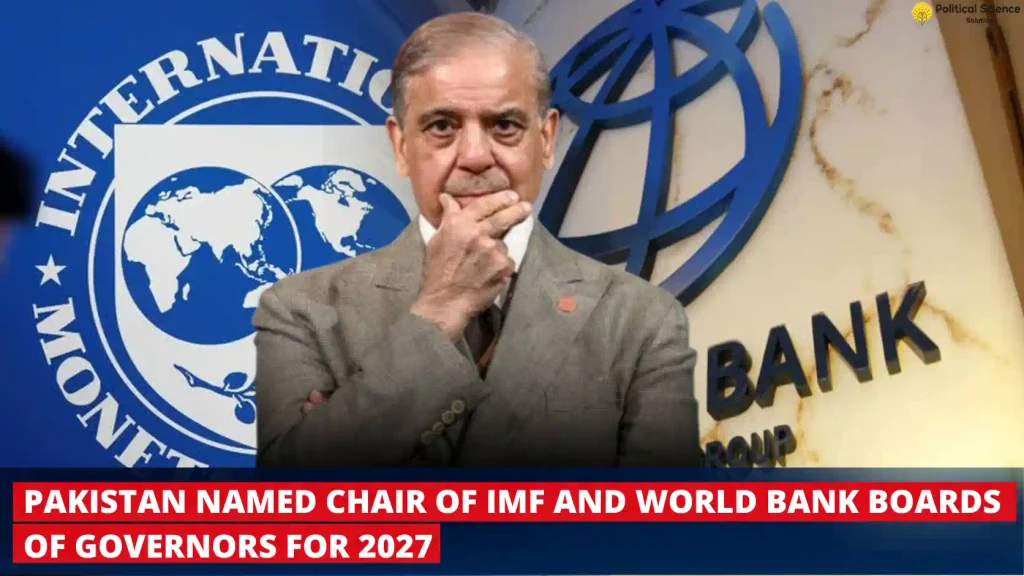
New Delhi: Pakistan has been selected to chair the Boards of Governors of the International Monetary Fund and the World Bank Group in 2027, the first time the country will hold the position since 1953. The announcement came during the plenary session of the 2026 World Bank Group-IMF Annual Meetings held in Bangkok. Pakistan’s Minister for Economic Affairs Ahad Khan Cheema, who also serves as the country’s governor to the World Bank, was formally named the incoming chair.
The Ministry of Economic Affairs described the development as a “historic milestone” for Islamabad. Officials stated that the role would enable Pakistan to play a more active part in global economic and development discussions while fostering cooperation and dialogue among member nations. The 2026 annual meetings, which ran from October 12 to 18, drew more than 15,000 participants from 191 countries.
This appointment returns Pakistan to a position it last occupied 74 years earlier. In 1953, then Finance and Economic Affairs Minister Mohamad Ali chaired the eighth annual meetings of the IMF and the International Bank for Reconstruction and Development in Washington. Other South Asian countries have also held the chairmanship in the past: India in 1950 in Paris under Finance Minister Chintaman D. Deshmukh, Sri Lanka (then Ceylon) in 1968, and Nepal in 1999.
Selection Process and Eligibility Rules
The bylaws of both institutions govern the selection. Section 6(a) of the World Bank’s bylaws states that at each annual meeting the Board of Governors shall select a Governor to act as Chair. The appointment continues until the conclusion of the following annual meeting. Section 7 of the IMF’s bylaws provides for the selection of a chair and at least two vice chairs at each regular meeting, with terms lasting until the next regular meeting.
These rules establish a rotating system that includes developing economies and is not reserved for major shareholders. Member countries appoint governors, typically finance ministers, central bank governors, or senior officials of equivalent rank. The chairmanship itself is not legally restricted to finance ministers; any appointed governor is eligible.
In Pakistan’s case, the Economic Affairs Division handles matters relating to the World Bank and other multilateral development institutions under the Rules of Business, while the Finance Division deals with the IMF. Ahad Khan Cheema’s role as Pakistan’s governor to the World Bank made him eligible. Pakistan is represented on the IMF Board of Governors by the governor of the State Bank of Pakistan. Finance Minister Muhammad Aurangzeb does not sit on either Board of Governors but continues to lead the country’s economic and financial discussions at the annual meetings alongside the central bank governor.
Powers and Limitations of the Chairmanship
The chair’s responsibilities are primarily procedural and diplomatic. Under Section 5(d) of the World Bank’s bylaws, the chair, jointly with the bank’s president, is responsible for arrangements concerning meetings of the Board of Governors. The official Rules of Conduct for Annual Meetings, approved in March 2023, state that the Chair of the Boards of Governors will establish the order of speaking at each session. The chair may also communicate information about the proceedings to the press alongside the World Bank president and the IMF managing director.
Importantly, the position confers no executive authority over either institution. Although the Boards of Governors are the highest governing bodies, most operational responsibilities are delegated to the respective Executive Boards. The chairmanship does not grant Pakistan additional voting rights, preferential access to financing, or any authority to approve IMF programmes or World Bank loans.
Pakistan will preside over the 2027 annual meetings, scheduled for October 4-9 in Washington. The significance for Islamabad lies mainly in greater international representation and opportunities to engage with senior economic policymakers. It provides a platform to contribute to discussions on global economic and development issues, particularly the financing needs of developing countries and the mobilisation of private capital.
Fact-Check of “Historic Milestone” Claim
Former IMF Executive Director Krishnamurthy V. Subramanian publicly fact-checked Pakistan’s characterisation of the appointment. In posts on X, he stated that the claim of Pakistan “heading back to the top table of global finance after 74 years” misrepresents the nature of the role. “Pakistan will chair the IMF-World Bank Annual Plenary in 2027. This chair is purely ceremonial & rotates annually: Paraguay this year, Cabo Verde in 2025. It’s protocol, not power,” he wrote.
Subramanian further argued that comparing India’s G20 and BRICS presidencies with Pakistan’s rotating chairmanship constitutes a false equivalence. India’s G20 presidency set the agenda for a major forum of global economic cooperation, and its BRICS presidency drove an emerging-economies platform, whereas Pakistan’s role is to preside over an annual meeting.
Pakistan’s Ongoing IMF Engagement and Pending Disbursement
The announcement coincides with Pakistan’s continued reliance on IMF support. The country is engaged under a $7 billion Extended Fund Facility intended to ease balance-of-payments needs and advance economic reforms, and a $1.4 billion Resilience and Sustainability Facility that supports efforts to mitigate climate-related threats and strengthen resilience.
IMF staff and Pakistani authorities have reached agreement on the latest reviews of these two programmes. This paves the way for a potential disbursement of approximately $1.2 billion, subject to approval by the IMF Executive Board. Pakistan is borrowing under the EFF to address balance-of-payments pressures and support reforms, while the RSF provides longer-term financing focused on climate risks.
Broader Context from Recent IMF Assessments
In related developments reported around the same period, the IMF projected that the Indian economy would grow at 7 per cent in both 2026-27 and 2027-28, retaining its status as the world’s fastest-growing major economy. The Fund’s latest projections suggested that India’s high growth trajectory might continue even after the fading of policy-induced cyclical support from income tax cuts and Goods and Services Tax rationalisation. This performance stands out at a time when many countries in similar cohorts—energy importers and those outside the technology boom—face weaker growth and macroeconomic challenges.
Prime Minister Narendra Modi referenced the figures at the Bloomberg New Economy Forum in New Delhi, noting that India’s April-June quarter growth stood at 7.8 per cent and rested on a strong foundation. He described India as offering “the assurance of reliability and stability” in a world filled with uncertainty. The IMF observations were also cited as addressing earlier questions about the statistical integrity of India’s June quarter GDP numbers.
Diplomatic Visibility Versus Structural Influence
The chairmanship enhances Pakistan’s diplomatic visibility within the international financial architecture without altering its voting power or giving it influence over lending decisions. For a country navigating repeated IMF programmes and structural economic challenges, the role offers a formal platform at the 2027 meetings but remains distinct from the agenda-setting authority associated with presidencies of bodies such as the G20 or BRICS.
The selection process itself underscores the rotational and inclusive character of the Boards of Governors. By design, the chairmanship circulates among the membership rather than concentrating in the hands of the largest shareholders. Pakistan’s return after more than seven decades fits within this established pattern, following earlier turns by India, Sri Lanka and Nepal in the South Asian region.
As the 2027 meetings approach, attention will focus on how the chair manages procedural responsibilities and facilitates dialogue among the 191 member countries. The appointment does not change the fundamental distribution of decision-making power inside the IMF or the World Bank Group, nor does it alter the terms of Pakistan’s existing financing arrangements. Those arrangements remain subject to the standard review and approval processes of the Executive Board.
Overall, Pakistan’s designation as chair of the IMF and World Bank Boards of Governors for 2027 represents a return to a ceremonial and procedural leadership role last held in 1953. While the Ministry of Economic Affairs has framed it as a historic milestone offering greater engagement opportunities, independent analysis emphasises its limited scope. Concurrently, Pakistan continues to advance under its current IMF programmes, with a $1.2 billion disbursement pending Executive Board approval following staff-level agreement on the latest reviews of the Extended Fund Facility and the Resilience and Sustainability Facility. The combination of heightened diplomatic visibility and ongoing dependence on multilateral financing defines the practical context of the appointment.
FAQs
1. What does Pakistan’s appointment as chair of the IMF and World Bank Boards of Governors in 2027 actually mean?
Pakistan’s Minister for Economic Affairs Ahad Khan Cheema, who serves as the country’s governor to the World Bank, was named incoming chair during the 2026 annual meetings in Bangkok. The role is largely procedural and diplomatic. The chair helps arrange Board of Governors meetings, sets the order of speaking, and may brief the press alongside the World Bank president and IMF managing director. It does not grant executive authority, extra voting rights, preferential access to financing, or any power to approve IMF programmes or World Bank loans. Most operational decisions remain with the Executive Boards. Pakistan will preside over the 2027 meetings scheduled for 4–9 October in Washington.
2. Is this really the first time Pakistan has held this position since 1953?
Yes. Pakistan last chaired the meetings in 1953, when Finance and Economic Affairs Minister Mohamad Ali presided over the eighth annual meetings of the IMF and the International Bank for Reconstruction and Development in Washington. Other South Asian countries have held the post earlier: India in 1950 under Finance Minister Chintaman D. Deshmukh in Paris, Sri Lanka (then Ceylon) in 1968, and Nepal in 1999. The chairmanship rotates annually among member countries, including developing economies, and is not reserved for major shareholders.
3. How is the chair of the IMF and World Bank Boards of Governors selected?
The selection follows the institutions’ bylaws. Section 6(a) of the World Bank’s bylaws requires the Board of Governors to choose a Governor as Chair at each annual meeting; the term lasts until the end of the next annual meeting. Section 7 of the IMF’s bylaws provides for a chair and at least two vice-chairs with the same duration. Any governor appointed by a member country is eligible, whether a finance minister, central bank governor, or equivalent official. In Pakistan’s case, the Economic Affairs Division handles World Bank matters, making Ahad Khan Cheema eligible as the country’s World Bank governor. The State Bank of Pakistan governor represents the country on the IMF Board.
4. Does the chairmanship give Pakistan more influence over IMF loans or easier access to funding?
No. Former IMF Executive Director Krishnamurthy V. Subramanian described the role as “protocol, not power,” noting that it is ceremonial and rotates every year (Paraguay held it previously, Cabo Verde in 2025). It confers no additional voting power, no preferential financing, and no authority over lending decisions. Pakistan remains engaged under its existing $7 billion Extended Fund Facility (for balance-of-payments support and reforms) and $1.4 billion Resilience and Sustainability Facility (for climate resilience). Staff-level agreement on the latest reviews has opened the way for a possible $1.2 billion disbursement, but that still requires full Executive Board approval and is unrelated to the chairmanship.
5. Why has Pakistan’s Ministry of Economic Affairs called the appointment a “historic milestone,” and how has that claim been received?
The ministry stated that the role would let Pakistan contribute more actively to global economic and development discussions and promote dialogue among member nations. Critics, including Subramanian, have pushed back, arguing that equating a rotating ceremonial chair with India’s G20 or BRICS presidencies is a false comparison. Those presidencies involved agenda-setting for major economic forums, whereas the IMF-World Bank chair mainly manages the annual plenary. The appointment increases diplomatic visibility for Pakistan but does not change its structural position as a borrower under ongoing IMF programmes.