

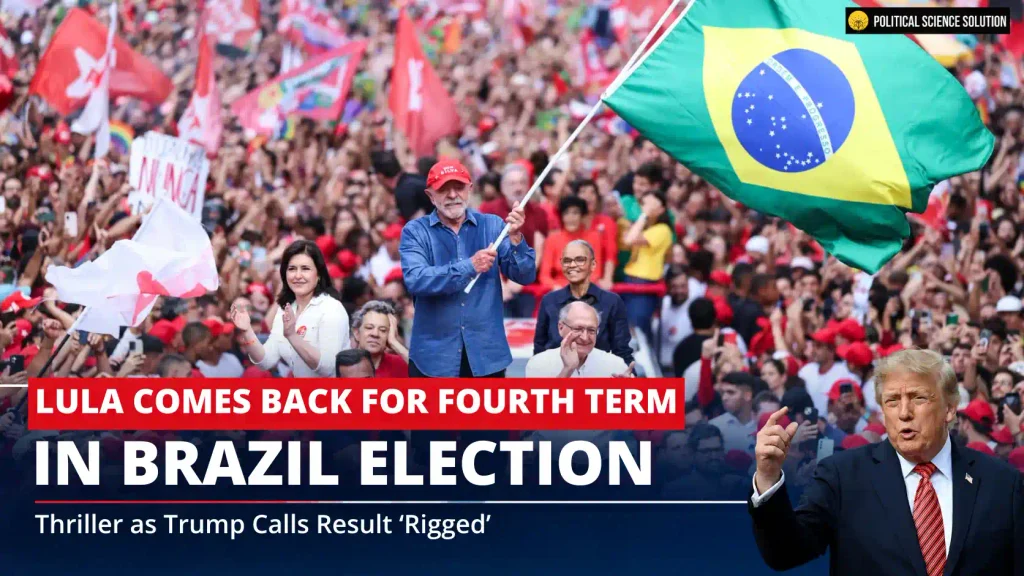
New Delhi: United States President Donald Trump declared on Monday that Brazil’s presidential runoff election “looked like another rigged election,” offering no evidence while describing the outcome as a “terrible look for the world.” The remarks came hours after leftist incumbent Luiz Inácio Lula da Silva secured a historic fourth term, defeating right-wing challenger Flávio Bolsonaro by a margin of nearly 4.4 million votes.
Trump Labels Brazilian Election ‘Rigged’ Without Evidence
Speaking to reporters at Joint Base Andrews in Maryland on October 26, Trump stated: “It looked like another rigged election, frankly. I didn’t take sides, but it was a terrible look for the world. Elections have to be indisputable, and it looked really bad to me.” When asked whether he would take action regarding the Brazilian vote, he replied: “I am not running Brazil, I’m running the USA.” Later comments added that the tabulation process and the last-minute extension of voting hours “looked so corrupt. So terrible” and that “the extension given was very strange.”
Trump never issued a formal endorsement of Flávio Bolsonaro, yet he had publicly promoted the elder Bolsonaro and hosted the son at the White House earlier in the year. Elements of the broader MAGA movement and some administration officials had quietly worked to support a Bolsonaro family return to power. After the result, prominent Trump ally Steve Bannon urged the White House and Secretary of State Marco Rubio to sever diplomatic ties and “shut down everything with Brazil.”
Lula Secures Historic Fourth Term with Clear Margin
Lula, who turns 81 this week, captured 51.8 percent of the valid votes—precisely 51.79 percent according to official tallies—against Flávio Bolsonaro’s share. Brazil’s electoral court confirmed the result with 100 percent of ballots counted, giving the Workers’ Party leader a lead of approximately 4.4 million votes. The victory marks the first time since the end of military rule in 1985 that a candidate who finished second in the first round has gone on to win the presidency. It also makes Lula the first Brazilian elected to four non-consecutive terms; his new mandate runs until 2030 and begins on January 5, 2027.
A Brazilian official, speaking on condition of anonymity, expressed confidence that the United States would ultimately recognize Lula’s victory, noting that the numerical margin was difficult to contest. “So what if Trump doesn’t recognize? At the most, we can break diplomatic ties, to the benefit of China, but the U.S. will not invade Brazil to impose a puppet government. We are not a Venezuela. Our government will stand.”
Bolsonaro Refuses to Concede and Demands Annulment
Flávio Bolsonaro, son of former President Jair Bolsonaro, refused to concede. He labeled the result “inexplicable” and called for the entire election to be annulled, centering his objections on the Supreme Court’s decision to keep polling stations open an extra two hours.
By Monday afternoon, Bolsonaro’s Liberal Party issued a formal statement signed by party president Valdemar Costa Neto acknowledging the official results while insisting that “the issues raised need to be properly clarified.” Flávio Bolsonaro himself remained publicly silent after the party statement. Earlier in the day he complied with a federal police order to surrender his passports following a visit to his father, who remains under house arrest while serving a 27-year sentence for plotting a coup after the 2022 election. Bolsonaro denied any intention to flee the country.
Last-Minute Voting Extension Sparks Controversy
That order, issued three minutes before the scheduled close by Justice Cristiano Zanin, followed requests from both campaigns. Lula’s team cited bus shortages that hindered voters in São Paulo and Salvador, cities that lean toward the incumbent. Bolsonaro’s side pointed to heavy rain in the south and parts of São Paulo. Zanin, who once served as Lula’s lawyer, drew criticism from Bolsonaro allies including Nikolas Ferreira, who highlighted the prior professional relationship.
The extension delayed the national count by two hours and produced localized confusion. In Brasília, many volunteer poll workers left shortly after the original closing time. In Rio de Janeiro, some electronic voting machines had already been powered down and could not be restarted. An independent analysis of electoral records later showed that fewer than 35,000 votes—roughly 0.03 percent of the total—were cast during the additional window, a figure widely viewed as insufficient to alter the multi-million-vote gap.
Vice President Geraldo Alckmin defended the electoral process in a television interview, calling Trump’s characterization “totally wrong” and “unfounded.” The president of the Supreme Electoral Court, Kássio Nunes Marques—an appointee of Jair Bolsonaro—formally confirmed Lula’s victory and stated that the two-hour extension did not change the outcome.
Markets Plunge on Unexpected Lula Victory
Financial markets reacted sharply to the unexpected outcome. The São Paulo stock exchange plunged as much as 15 percent at the open—its steepest one-day decline since 2020—triggering a brief trading halt before a partial recovery. The Brazilian real fell 8.1 percent against the dollar, its largest single-day drop since 2002. Interest-rate futures rose as investors scrutinized Lula’s fiscal plans. Analysts predicted that the initial sell-off could moderate once election-related positions were unwound, but that sustained recovery would require clearer signals on spending restraint.
World Leaders Congratulate Lula on Fourth-Term Win
International reaction was overwhelmingly congratulatory. Mexican President Claudia Sheinbaum wrote that “the people of Brazil won.” Peruvian President Keiko Fujimori praised a “democratic day.” Leaders from Chile, Ecuador, Canada, France, Spain, South Africa and the European Commission issued similar messages. European Commission President Ursula von der Leyen declared that “democracy and multilateralism” had prevailed. Spanish Prime Minister Pedro Sánchez called the result a “great victory.” French President Emmanuel Macron emphasized cooperation “in service of a more just world.” South African President Cyril Ramaphosa framed Lula’s win as a success for the “global south and progressive forces throughout the world.” Canadian Prime Minister Mark Carney noted the two countries’ existing partnership.
Lula’s Victory Speech and Path to Fourth Term
Lula addressed jubilant crowds in central São Paulo in the early hours of Monday, wearing distinctive star-shaped red glasses and kissing First Lady Rosângela “Janja” da Silva. “This is God’s work—and it’s thanks to all of you,” he said. “Today is a historic day. Democracy always, dictatorship never again. Democracy always, fascism never again.” He promised that his fourth term “will be the best of any president in the history of this country” and “the one in which I listen most to the Brazilian people.” In a pointed reference to what Trump has termed the “Donroe Doctrine,” Lula insisted that Brazil “will not accept being anyone’s backyard.”
Campaign Battles, Turnout Surge and Voter Concerns
The campaign had been bruising. Flávio Bolsonaro finished first in the October 4 first round with 47 percent to Lula’s 45 percent, a margin of more than 2.2 million votes. Lula’s team responded by intensifying outreach to young voters, mobilizing street demonstrations in defense of democratic institutions, and highlighting government social programs. Sunday’s runoff produced the largest reduction in abstention between rounds since 1989, a turnout surge credited by pollsters and campaign strategists with powering the comeback. Security and the cost of living dominated voter concerns. Bolsonaro emphasized a hard line on crime and lower food prices; Lula pointed to record-low unemployment, reduced illiteracy and declining Amazon deforestation while expanding targeted incentives.
Both candidates carried baggage from corruption investigations involving relatives and allies. Lula previously spent 580 days in prison on convictions later annulled after evidence of judicial bias surfaced; he narrowly defeated Jair Bolsonaro in 2022. Flávio Bolsonaro has been linked to a sprawling scandal still unfolding in Brazilian courts. The elder Bolsonaro’s 2022 refusal to accept defeat and subsequent coup conviction provided a ready template for the son’s post-election posture, though analysts consider a comparable mobilization of anti-democratic forces less likely this time.
Challenges Ahead for Lula’s Fourth Term
Lula now confronts a Congress heavily populated by Bolsonaro allies after the first-round legislative results shifted further right. Governing will require negotiation in a polarized legislature and a divided electorate. Economic headwinds, fiscal pressures and the strained relationship with Washington add further complexity. Lula has previously clashed with Trump over tariffs and maintains an independent foreign-policy stance that positions Brazil’s $2.6 trillion economy outside automatic alignment with the United States.
The episode leaves Brazil’s largest democracy navigating the immediate aftermath of a hard-fought contest while the world’s most powerful nation voices open skepticism. Official results, the scale of the victory margin, and the limited number of ballots cast after the extension form the factual core against which claims of irregularity will be measured. Lula’s fourth term begins in January against a backdrop of domestic division, legislative resistance, market volatility and an unpredictable bilateral relationship with the United States.
FAQs
1. Why did Donald Trump say the Brazil election looked “rigged”?
Trump told reporters at Joint Base Andrews that the election “looked like another rigged election” and described it as a “terrible look for the world.” He specifically criticized the last-minute two-hour extension of voting and the way the results were tabulated, calling both “very strange” and saying the overall process “looked so corrupt.” He provided no evidence and stressed he was not running Brazil.
2. By how much did Lula win his fourth term?
Luiz Inácio Lula da Silva secured 51.79% of the valid votes against Flávio Bolsonaro, winning by a margin of nearly 4.4 million votes. Brazil’s electoral court confirmed the result with 100% of ballots counted. This made Lula the first Brazilian president elected to four non-consecutive terms and the first candidate since 1985 to win the presidency after finishing second in the first round.
3. Why did Flávio Bolsonaro demand the election be annulled?
Bolsonaro refused to concede and called the result “inexplicable.” His main objection centered on the Supreme Court decision, issued three minutes before polls were due to close, that extended voting nationwide by two hours. He and his allies also highlighted that the justice who issued the order, Cristiano Zanin, had previously served as Lula’s lawyer. Bolsonaro’s Liberal Party later acknowledged the official results while still asking for the issues to be clarified.
4. Did the extra two hours of voting change the outcome?
No. An independent analysis of electoral records showed that fewer than 35,000 votes (about 0.03% of the total) were cast during the extended period. Both campaigns had requested the extension—Lula’s team citing bus shortages in key cities and Bolsonaro’s side pointing to heavy rain—but the small number of additional ballots was nowhere near enough to close the 4.4-million-vote gap.
5. What major challenges does Lula face in his fourth term?
Lula takes office on 5 January 2027 facing a Congress packed with Bolsonaro allies, a deeply divided country, economic pressure after markets reacted negatively (the real fell 8.1% and the stock exchange dropped as much as 15%), and a strained relationship with the United States. He has promised the term will be his best while insisting Brazil “will not accept being anyone’s backyard.”