

New Delhi: Mobile internet services faced temporary suspension once again in sections of Central Delhi as authorities responded to ongoing student demonstrations near Jantar Mantar. The latest restriction formed the sixth such directive issued within a single week, targeting connectivity in the vicinity of the protest site and extending effects outward. This development unfolded against the backdrop of India maintaining one of the highest global tallies of internet interruptions, with Access Now’s 2025 report documenting 65 shutdowns spanning 12 States and Union Territories.
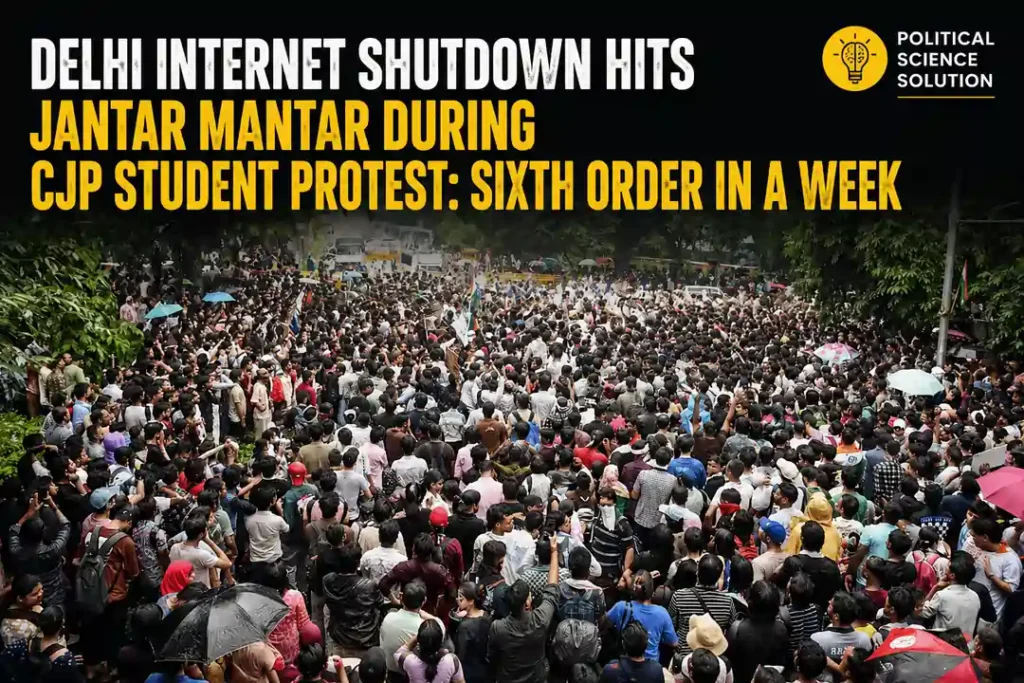
The Ministry of Home Affairs directed telecom operators to halt mobile data services within a 1.5-kilometre radius around Jantar Mantar. Impacts reached as far as the Mandi House metro station, situated nearly two kilometres from the core gathering point. An initial order set the cutoff until 4 pm on Thursday, only for officials to prolong it through midnight. Connectivity proved uneven or nonexistent across various Central Delhi locations from the early hours of that day onward. Individuals present for work rather than protest participation found themselves equally affected, while thousands assembled at the site struggled to place calls or send messages.
One Airtel subscriber near Mandi House received a notification stating that internet services had been temporarily stopped in the area under government directive, with the company expressing regret for the inconvenience. Mandi House itself lies outside the protest epicentre and hosts multiple commercial establishments. Hotels operating vehicle parking services in the zone informed customers that only cash payments would be accepted. Shopkeepers reported an inability to process Unified Payments Interface transactions. Users could neither initiate nor receive calls via messaging applications such as WhatsApp, and conventional phone connections suffered from network congestion near the demonstration area.
A roadside tea vendor described a sharp drop in business, noting that customers typically rely on digital transfers for small purchases yet could not complete them without functioning internet. Authorities have frequently employed focused internet interruptions during protests and related public order situations, maintaining that the measures limit the spread of inaccurate information and reduce the risk of unrest. At the same time, these steps interfere with routine activities, including digital payments, app-based transport options, general communication, navigation tools, and access to necessary online resources. They also generate expenses for commercial outlets and individuals dependent on daily earnings.
A comparable mobile internet restriction had already been imposed in portions of Central Delhi on July 20, coinciding with a surge in the scale of the student gathering. Rapid Action Force units remained positioned at Connaught Place during the period. Officials from Airtel, Reliance Jio, Vodafone Idea, the Ministry of Home Affairs, and the Department of Telecommunications did not respond to inquiries before the relevant reports reached publication.
The demonstrations originated with the Cockroach Janta Party, commonly referred to as CJP, under the leadership of its founder Abhijeet Dipke. Participants convened on the opening day of Parliament’s Monsoon Session for a Chalo Sansad initiative. Their central demand called for the resignation of Union Education Minister Dharmendra Pradhan, citing repeated examination paper leaks linked to the National Eligibility and Entrance Test, known as NEET, along with broader administrative irregularities in the conduct of entrance assessments. Supporters reclaimed the protest location after earlier activity, and reports indicated the deployment of signal jammers that further complicated internet access. Those present encountered obstacles when attempting to upload video footage or utilise navigation applications.
Internet Freedom Foundation and Software Freedom Law Centre India issued statements criticising the suspension. Legal questions have surfaced regarding the precise scope of governmental authority and the application of public safety provisions in this instance.
Internet shutdowns across the country operate under the Telecommunications (Temporary Suspension of Services) Rules, 2024. These regulations were issued pursuant to the Telecommunications Act, 2023, and supersede the earlier Telecom Suspension Rules of 2017. The framework governs the temporary interruption of telecom services, encompassing internet connectivity. Implementation becomes permissible during a public emergency or in the interest of public safety, restricted to defined objectives that include the preservation of public order.
Authority to issue such orders rests with the Union Home Secretary for nationwide measures and the State Home Secretary for state-level actions. Under unavoidable conditions, an officer holding a rank no lower than Joint Secretary, properly authorised by the relevant government, may issue the directive, subject to later confirmation. Every suspension order requires examination by a Review Committee. Separate committees function at the Union and State levels and must complete their assessment within the stipulated period.
Judicial guidance stems from the Supreme Court decision in Anuradha Bhasin versus Union of India, delivered in 2020. The court determined that indefinite internet interruptions violate constitutional standards and that any restrictions must satisfy the requirements of necessity and proportionality. Despite this precedent, numerous shutdown directives continue to appear without adequate supporting records or clear justification.
The sequence of events around Jantar Mantar illustrates the practical operation of these rules in a dense urban setting. The 1.5-kilometre zone captured not only the immediate protest footprint but also neighbouring commercial and transit points, producing collateral effects on residents and workers unconnected to the demonstration. Digital payment systems, which have become integral to small-scale commerce in the capital, ceased to function reliably, forcing a temporary reversion to cash. Communication platforms that many rely upon for both personal and professional coordination became unavailable, compounding logistical difficulties for those attempting to navigate the area or document proceedings.
The frequency of six orders within seven days underscores a pattern of repeated application during periods of sustained public assembly. Each instance required fresh administrative authorisation under the 2024 rules, followed by the mandatory review process. Whether the Review Committee’s examination occurred within the prescribed window for each successive order remains part of the broader documentation concerns highlighted by observers. The presence of signal-jamming equipment alongside formal service suspensions added a technical layer that further restricted residual connectivity options.
Student organisers framed their presence at Jantar Mantar as a direct response to recurring examination integrity failures. The call for ministerial accountability focused specifically on NEET-related leaks and associated irregularities, timed to coincide with the commencement of the legislative session. The resulting concentration of people prompted the security response that included both physical deployment of Rapid Action Force personnel and the digital restrictions. Non-participants operating businesses or commuting through the affected corridors absorbed the same connectivity losses, revealing the challenge of calibrating geographic limits in a tightly packed metropolitan environment.
From the standpoint of daily economic activity, the inability to process UPI transfers translated into immediate revenue shortfalls for vendors dependent on high-volume, low-value transactions. Parking facilities and retail outlets faced parallel constraints, illustrating how internet-dependent infrastructure underpins even traditional cash-adjacent services. Congestion on residual voice networks compounded the isolation, as ordinary telephone calls became unreliable precisely when alternative digital channels were unavailable.
The legal architecture attempts to balance emergency powers with procedural checks. The hierarchy of authorisation—from Home Secretaries down to authorised Joint Secretaries—aims to ensure senior oversight, while the Review Committee mechanism introduces an independent evaluation step. The Supreme Court’s insistence on necessity and proportionality supplies an additional constitutional filter. Application of these standards to successive short-duration orders in the same locality tests the practical effectiveness of the safeguards. Incomplete public documentation of the underlying assessments continues to generate scrutiny from civil society organisations that monitor digital rights.
India’s overall record of internet interruptions, quantified at 65 instances across a dozen administrative units in the Access Now compilation for 2025, places the Delhi sequence within a wider national pattern. Targeted suspensions during periods of protest or heightened public order concerns form a recurring category within that total. Each episode carries downstream consequences for commercial operations, emergency communication, and ordinary civic interaction in the restricted zones.
In the specific case of the Jantar Mantar perimeter, the combination of formal suspension orders, reported jamming devices, and the physical density of the urban core produced a near-total digital blackout for the duration of the measures. Recovery of services after midnight on the extended order restored connectivity, yet the cumulative effect of multiple interruptions across consecutive days left residual disruption for those whose livelihoods or routines intersected with the affected geography. The episode therefore supplies a concrete illustration of how the 2024 regulatory framework operates under conditions of sustained public demonstration, the reach of geographic targeting, and the interplay between administrative authority, judicial standards, and on-the-ground consequences for both participants and bystanders.
FAQs
1. Why were mobile internet services suspended around Jantar Mantar in Central Delhi?
Authorities ordered the temporary suspension of mobile data services in a 1.5-kilometre radius around Jantar Mantar (extending effects to areas like Mandi House metro station) in the interest of public safety, to avert a public emergency, and to prevent incitement to any offence. The action took place during the Cockroach Janta Party (CJP) students’ protest demanding the resignation of Union Education Minister Dharmendra Pradhan over NEET paper leaks and examination irregularities. This was the sixth such order issued within a week, with the latest directive initially valid until 4 pm on Thursday and later extended to midnight. Similar restrictions had been imposed on 20 July 2026 when the gathering gained momentum. Signal jammers were also reportedly used, further limiting connectivity.
2. What is the legal framework governing internet shutdowns in India?
Internet shutdowns are regulated by the Telecommunications (Temporary Suspension of Services) Rules, 2024, notified under the Telecommunications Act, 2023. These rules replaced the earlier Telecom Suspension Rules of 2017. Suspension is permitted only in cases of public emergency or in the interest of public safety, and solely for specified purposes such as maintaining public order. Orders can be issued by the Union Home Secretary (national level) or the State Home Secretary (state level). In unavoidable circumstances, an authorised officer not below the rank of Joint Secretary may issue the order, subject to subsequent approval. Every order must be reviewed by a designated Review Committee (constituted separately at Union and State levels) within the prescribed timeframe.
3. What did the Supreme Court rule regarding internet shutdowns?
In the landmark case of Anuradha Bhasin v. Union of India (2020), the Supreme Court held that indefinite internet shutdowns are unconstitutional. Any such restrictions must satisfy the twin tests of necessity and proportionality. Despite this precedent, many shutdown orders continue to be issued with inadequate documentation and justification, raising ongoing concerns about compliance with constitutional standards.
4. How did the Jantar Mantar internet suspension affect ordinary people and businesses?
The shutdown disrupted connectivity for both protesters and non-participants working or travelling through Central Delhi. Users received messages from operators such as Airtel confirming the temporary halt of services under government directive. Hotels accepted only cash for parking, shopkeepers and roadside vendors (including tea sellers) could not process UPI payments, WhatsApp calls and messages failed, and regular phone calls suffered from network congestion. Digital payments, app-based transport, navigation, and access to essential online services were all affected, imposing costs on businesses and daily wage earners. Thousands gathered at the protest site were unable to make calls or send messages, while residents and workers in the wider 1.5–2 km zone experienced patchy or absent internet from early Thursday hours.
5. How frequently does India impose internet shutdowns, and what was the specific context of the CJP protest?
According to Access Now’s 2025 report, India recorded 65 internet shutdowns across 12 States and Union Territories, placing it among the countries with the highest numbers worldwide. In the present case, the Cockroach Janta Party (CJP), led by founder Abhijeet Dipke, organised the “Chalo Sansad” protest on the opening day of Parliament’s Monsoon Session. Participants sought the Education Minister’s resignation over repeated NEET-related paper leaks and broader examination irregularities. The Internet Freedom Foundation (IFF) and Software Freedom Law Centre, India (SFLC) condemned the successive suspensions. Rapid Action Force contingents were deployed at Connaught Place, and protesters faced difficulties uploading videos or using navigation apps amid the blackout.