
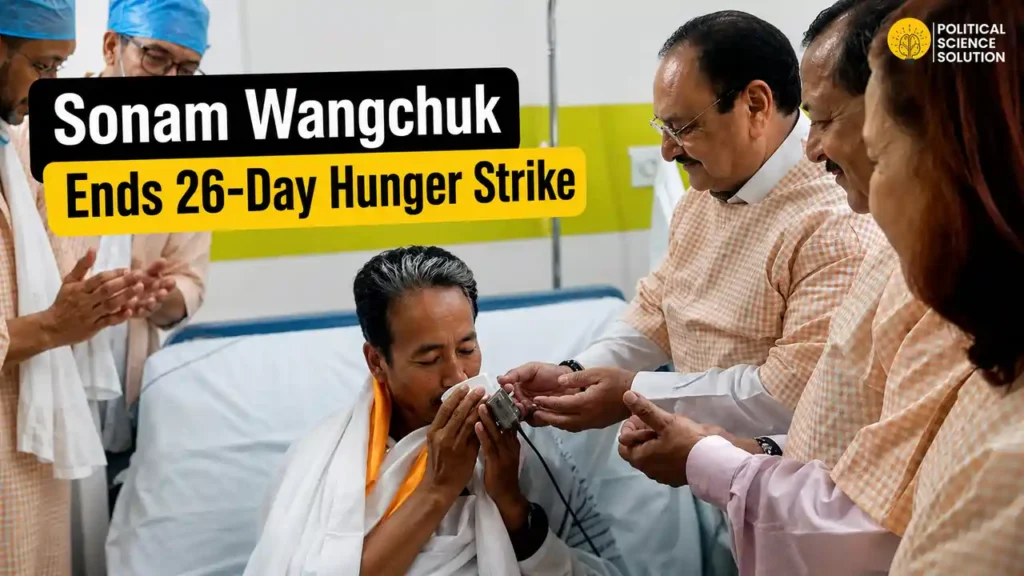
New Delhi: In a significant development that has captured national attention amid widespread student unrest, prominent activist Sonam Wangchuk broke his 26-day hunger strike on Friday, July 24, 2026. The decision came in the presence of two Union Ministers and followed intense negotiations, marking a pivotal moment in the ongoing protests against examination irregularities and broader systemic failures in India’s education and employment landscape.
Cherring Dorjay Lakruk, co-convenor of the Leh Apex Body, confirmed the development, stating that Wangchuk ended his fast under specific conditions. The government provided written assurances on key demands, including the withdrawal of cases against non-violent students and consideration of compensation for families of suicide victims linked to the crisis. This breakthrough arrives as protests led by the Cockroach Janta Party (CJP) continue to swell across the country, posing one of the most substantial challenges to the Narendra Modi government since its re-election in 2024.
The Hunger Strike: From Ladakh to the National Spotlight
Sonam Wangchuk, a 59-year-old activist renowned for his work on education and climate issues, began his hunger strike on June 28, 2026. He undertook the protest in solidarity with India’s youth, particularly those affected by repeated leaks in national entrance examinations. Wangchuk’s fast gained momentum at Jantar Mantar in New Delhi, a historic site that has become the epicenter of the demonstrations.
Reports indicate that Wangchuk’s health had deteriorated significantly, prompting authorities to move him to a hospital in accordance with court orders. Government ministers urged him to end the strike as concerns over his well-being intensified. In a late-night post on X (formerly Twitter) on Thursday, July 23, Wangchuk announced the end of his fast “after a long negotiation on various conditions and in view of possible violence in the country.” He emphasized the need for vigilance against any form of unrest and promised a detailed video explanation of the conditions agreed upon.
The activist’s move comes against the backdrop of mounting pressure on the education ministry. The protests were triggered primarily by the cancellation of medical college entrance tests in May 2026 due to widespread question paper leaks, forcing millions of aspirants to prepare for retakes. What began as outrage over exam malpractices has evolved into a larger youth-led movement addressing corruption, inadequate job opportunities, and deep-rooted issues in the education system.
Government Response and Written Assurances
According to Cherring Dorjay Lakruk, the government issued written commitments during the negotiations. Key among them is the assurance that criminal cases filed against students involved in the protests would be withdrawn, provided they did not resort to violence. Additionally, the government pledged to consider compensation for families of students who may have died by suicide amid the stress and uncertainty caused by the exam scandals.
Prime Minister Narendra Modi addressed the nation through a video on X, describing the paper leaks as “a matter of great pain” for hundreds of thousands of students. He announced plans for a tougher law to curb such leaks, including fast-track courts for those involved in fraud. The issue is slated for discussion in the cabinet on Friday, signaling a proactive stance from the highest levels of government. Notably, Modi’s address did not directly reference calls for Education Minister Dharmendra Pradhan’s resignation, a central demand of the protesters.
Wangchuk’s decision to break the fast was influenced by these developments and fears of escalating violence. Protests at Jantar Mantar have seen bouts of unrest this week, including instances where police used tear gas and baton-charged demonstrators attempting to march toward Parliament. Rights organizations such as Human Rights Watch and Amnesty International have criticized the government for what they describe as excessive use of force and the suspension of mobile internet services in the protest area.
The Cockroach Janta Party and the Youth Surge
At the heart of the sustained agitation is the Cockroach Janta Party (CJP), a youth-driven movement that originated as satire but has grown into a formidable force for change. The name itself derives from a derogatory label, which the group has reclaimed as a symbol of resilience. CJP founder Abhijeet Dipke expressed relief at Wangchuk’s decision, posting on X: “Thank you, sir, for your extraordinary courage and sacrifice. By putting your own life on the line, you awakened the conscience of an entire nation.”
Dipke made it clear, however, that the movement would not dissipate. “The Cockroach Janta Party’s peaceful protest at Jantar Mantar will continue until Dharmendra Pradhan resigns,” he stated. The group has called for nationwide rallies on Friday and reported that demonstrations have already spread to more than 30 cities across India. Thousands of students and young professionals, many juggling studies and jobs, have joined the rallies, voicing shared frustrations over education quality, employment prospects, and perceived government mismanagement.
The protests highlight a generational shift. India’s Gen Z, often criticized for being digitally distracted, has demonstrated sophisticated organization, leveraging social media to amplify their message while maintaining on-ground momentum. Analysts note that this movement represents a broader discontent with systemic issues that extend beyond exam leaks to include high youth unemployment and a sense of broken promises in the world’s largest democracy.
Broader Context: Exam Leaks and National Exam Scandals
The immediate catalyst for the current wave of protests was the NEET (National Eligibility cum Entrance Test) paper leak scandal in May 2026. The leak led to the cancellation of the exam, affecting millions of medical aspirants who had invested years in preparation. This was not an isolated incident; multiple national-level examinations under the education ministry’s purview have faced similar controversies in recent years, eroding public trust.
Wangchuk, who has a long history of advocating for educational reforms, positioned his hunger strike as a stand against these recurring failures. His action drew parallels with historical protests and hunger strikes in India, where individuals have used fasting as a tool for moral pressure and public mobilization.
As protests intensified, the Delhi Police and authorities faced criticism for their handling of crowds. Incidents of violence, though condemned by protest leaders, have added complexity to the narrative. Wangchuk specifically urged participants to avoid any form of violence, stressing that the fight must remain peaceful to retain legitimacy.
Reactions from Across the Spectrum
The end of Wangchuk’s fast has elicited mixed responses. Supporters of the CJP view it as a strategic pause rather than a surrender, with many pledging to carry forward the momentum. Opposition voices have accused the government of inadequate accountability, pointing to the absence of Pradhan’s resignation as evidence of reluctance to address core demands.
Civil society groups and education experts have called for comprehensive reforms, including stricter protocols for exam security, transparent investigation processes, and long-term investments in educational infrastructure. Some commentators have drawn attention to the psychological toll on students, with reports of increased anxiety, depression, and tragic suicides linked to the competitive pressures of India’s examination system.
What Lies Ahead: Vigilance, Negotiations, and Reform
With Wangchuk’s fast concluded, the focus shifts to the implementation of the government’s written assurances and the trajectory of the CJP-led protests. The activist is expected to provide further details in an upcoming video, which could offer clarity on the exact terms negotiated and his vision for the movement’s next phase.
For the Modi government, this episode presents both a challenge and an opportunity. Addressing exam integrity through fast-track legislation and judicial reforms could help restore confidence. However, failure to deliver on broader youth aspirations — quality education, skill development, and job creation — risks further alienation of a demographic that will shape India’s future.
As rallies continue and the nation watches, the events of July 2026 underscore a critical truth: India’s young citizens are no longer passive recipients of policy but active participants demanding accountability. The “Cockroach” movement, with its blend of satire, determination, and digital savvy, may well signal a new chapter in Indian civil society activism.
Wangchuk’s sacrifice has undeniably amplified these voices. Whether the government’s assurances translate into meaningful change will determine if this moment becomes a turning point or another footnote in the long struggle for educational justice.
FAQs
1. Why did Sonam Wangchuk break his 26-day hunger strike on July 24, 2026?
Sonam Wangchuk ended his fast after prolonged negotiations with government representatives, including two Union Ministers. He cited written assurances from the government and concerns over potential violence in the country as key reasons. The activist emphasized staying vigilant against any unrest and plans to share detailed conditions in a follow-up video. His decision came while his health was monitored in hospital under court orders.
2. What assurances did the government provide to Sonam Wangchuk and the protesters?
According to Cherring Dorjay Lakruk, co-convenor of the Leh Apex Body, the government issued written commitments. These include withdrawing cases against non-violent students involved in the protests and considering compensation for families of suicide victims linked to the exam stress. The assurances were a major condition for Wangchuk breaking his fast.
3. What is the Cockroach Janta Party (CJP) and will protests continue after Wangchuk ended his fast?
The Cockroach Janta Party (CJP) is a youth-led movement that started as satire but has become a major force demanding accountability in education. Founder Abhijeet Dipke expressed gratitude to Wangchuk but confirmed that peaceful protests at Jantar Mantar and across more than 30 cities will continue until Education Minister Dharmendra Pradhan resigns. Nationwide rallies were called for July 24-25, 2026.
4. What triggered the protests and Sonam Wangchuk’s hunger strike?
The protests erupted after massive paper leaks in national exams, particularly the medical entrance test (NEET) in May 2026, which was canceled, forcing millions of students to retake it. Wangchuk began his fast on June 28 in solidarity with affected students. The movement has since expanded to address broader issues like corruption in exams, poor job prospects, and education system failures under the current government.
5. How has the government responded to the exam leak crisis and protests?
Prime Minister Narendra Modi announced plans for stricter laws against paper leaks and fast-track courts. The cabinet was scheduled to discuss the issue on July 24, 2026. While police action at Jantar Mantar drew criticism from human rights groups for excessive force and internet suspensions, the government has engaged in negotiations leading to Wangchuk ending his strike. No confirmation yet on Pradhan’s resignation, the core demand of protesters.