

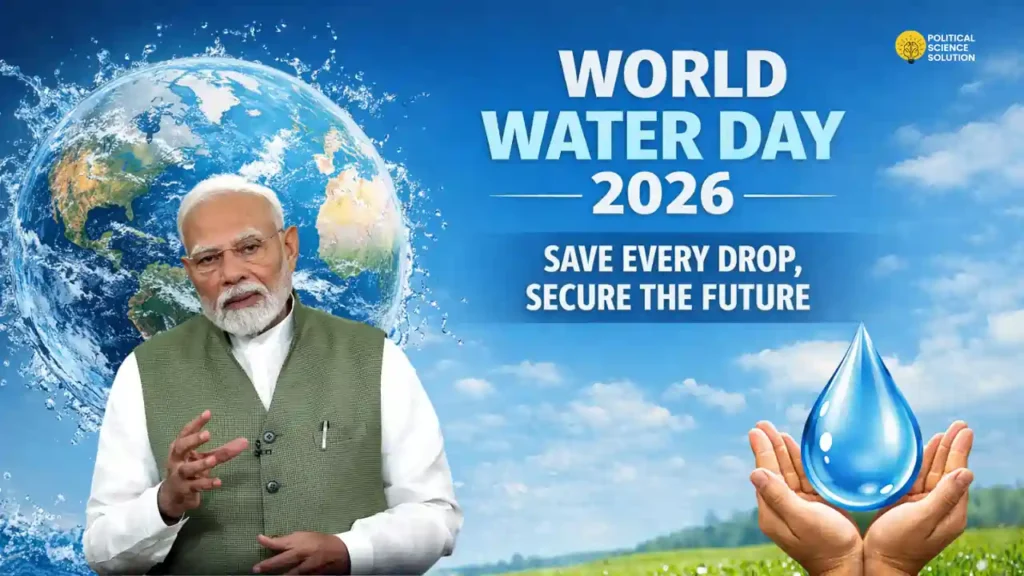
New Delhi: Prime Minister Narendra Modi has delivered a strong nationwide appeal for water conservation as the world observed World Water Day on March 22, 2026. In a powerful message shared on social media platform X, the Prime Minister reminded citizens that water is the lifeline that sustains humanity and shapes the planet’s future. He called upon every Indian to reaffirm their commitment to conserve every single drop and use water responsibly.
“Water sustains us and shapes our planet’s future. On World Water Day, let us reaffirm our commitment to conserve every drop of water and use it responsibly,” PM Modi posted. He further highlighted that the day should also serve as an occasion to appreciate individuals and communities actively engaged in sustainable practices, promoting awareness, and nurturing a deep culture of conservation across the country.
This year’s global theme for World Water Day 2026 — “Water and Gender: Where Water Flows, Equality Grows” — perfectly aligns with India’s ongoing efforts to place women at the centre of water management, making the Prime Minister’s message even more relevant.
Why Water Conservation Matters for India’s Future
India supports nearly 18 percent of the world’s population but possesses only about 4 percent of the planet’s freshwater resources. This stark imbalance has pushed several regions into high to extreme water stress, affecting close to 600 million people. Experts warn that without efficient water governance, the country could face a potential loss of up to 6 percent of its GDP by 2050, according to projections from NITI Aayog.
Efficient water governance is critical not just for managing scarcity but also for driving sustained economic growth and building long-term climate resilience. Integrated Water Resource Management (IWRM) has emerged as the most effective strategy to maintain the eco-hydrological cycle, protect biodiversity, and ensure water security for future generations.
Major Challenges Plaguing Water Governance in India
Despite progress, water governance in India continues to face serious structural problems. One of the biggest issues is fragmented governance, where different aspects of water — groundwater, surface water, irrigation, and domestic use — are handled in silos by separate institutions such as the Central Ground Water Board (CGWB) and the Central Water Commission (CWC). This lack of coordination often leads to inefficient planning and implementation.
Over-exploitation of groundwater aquifers remains a grave concern. Subsidized power for agriculture and weak regulatory mechanisms have accelerated depletion in many states, pushing water tables to dangerously low levels. Equitable access to sustainable water sources is still missing for large sections of society, particularly vulnerable communities. Women and girls bear a disproportionate burden when safe water and sanitation facilities are unavailable, affecting their health, education, and overall development.
Climate change has further complicated the situation by altering the hydrological cycle, resulting in more frequent and intense droughts, floods, and unpredictable rainfall patterns.
Constitutional and Legal Framework of Water Governance in India
Water governance in India operates within a clear constitutional framework. Water is primarily a State subject under the Seventh Schedule of the Constitution. However, the regulation and development of inter-state rivers fall under the Union List, giving the Centre a key role in resolving disputes and planning at the basin level.
Article 262 of the Constitution empowers Parliament to enact laws for the adjudication of disputes relating to the use, distribution, or control of waters in inter-state rivers or river valleys.
The legal architecture supporting water management includes several important Acts:
- The Inter-State River Water Disputes (ISRWD) Act, 1956, which provides for the constitution of tribunals to settle conflicts between states.
- The River Boards Act, 1956, enabling the establishment of River Boards for the regulation and development of inter-state rivers and river valleys.
- The Water (Prevention and Control of Pollution) Act, 1974, which focuses on preventing and controlling water pollution.
These laws have laid the foundation for coordinated action, though implementation challenges persist due to the federal structure.
Landmark Government Initiatives for Water Security
In a major step towards integrated planning, the government established the Ministry of Jal Shakti in 2019. This unified ministry brought together various water-related departments under one roof to promote holistic and coordinated water resource management.
Several flagship programmes are now driving change on the ground:
Jal Jeevan Mission (JJM): This ambitious scheme aims to provide functional household tap connections to every rural household. A unique feature of the mission is the mandatory formation of Jal Samitis (village water committees) with at least 50 percent participation from local women. This gender-responsive approach ensures that women, who traditionally manage household water needs, play a decisive role in planning and implementation.
Namami Gange: Launched as an integrated conservation mission, Namami Gange focuses on the rejuvenation of the River Ganga and its tributaries. The programme addresses pollution abatement, biodiversity conservation, and community participation along the entire river basin.
Atal Bhujal Yojana: Specifically designed for groundwater management, this scheme promotes community participation in mapping, monitoring, and conserving aquifers, particularly in water-stressed regions.
These initiatives, combined with widespread campaigns for rainwater harvesting and efficient irrigation techniques, are gradually shifting the paradigm from supply-side management to demand-side conservation and reuse.
The Way Forward: Integrated, Inclusive, and Community-Driven Solutions
To secure India’s water future, experts emphasize the urgent need to adopt Integrated Water Resource Management by treating entire river basins as unified planning units. This approach links land use, water resources, and ecosystems under a single framework.
Key elements of the way forward include:
- Promoting widespread behavioural change among citizens.
- Strengthening community participation at the grassroots level.
- Developing a circular water economy that treats and reuses wastewater.
- Ensuring gender-responsive water governance that empowers women in decision-making.
A practical example of this vision is “Jan Bhagidari” — the spirit of people’s participation. The government is actively empowering Gram Panchayats and village-level committees to manage local water systems. When communities take ownership, conservation becomes more effective, accountable, and sustainable.
PM Modi’s Call for Collective Action and Citizen Responsibility
Prime Minister Modi’s message on World Water Day 2026 goes beyond symbolism. By appreciating the efforts of those already involved in sustainable practices, he has spotlighted real-life water warriors across the country — from farmers adopting micro-irrigation to urban households practising recycling, and from students spreading awareness to industries investing in zero-liquid discharge systems.
The Prime Minister’s appeal aligns perfectly with the global 2026 theme of “Water and Gender.” India’s Jal Jeevan Mission, with its strong focus on women’s participation in Jal Samitis, is already demonstrating how centring women in water governance leads to more inclusive, effective, and lasting solutions.
As climate variability intensifies and water demand continues to rise with population and economic growth, the call for collective action has never been more urgent. Policymakers, experts, and citizens must work together to safeguard this precious resource for future generations.
Building a Water-Secure India: The Road Ahead
Water governance in India has come a long way with constitutional provisions, dedicated legal frameworks, institutional reforms, and people-centric missions. Yet the scale of the challenge demands faster implementation, better inter-institutional coordination, stricter regulation of groundwater extraction, and a nationwide shift in mindset.
The economic cost of inaction — potentially 6 percent of GDP by 2050 — and the social cost borne disproportionately by women and vulnerable sections make water conservation a national priority that transcends politics and geography.
From the Himalayan rivers to the arid regions of Rajasthan, from coastal communities to metropolitan cities, every Indian must internalize the message: every drop counts.
Prime Minister Narendra Modi’s timely appeal on World Water Day 2026 has set the tone for a renewed national movement. With integrated planning, community ownership through Jan Bhagidari, gender-inclusive policies, and sustained behavioural change, India can overcome its water challenges and build a resilient, water-secure future.
The time for action is now. Let every citizen, every panchayat, every state, and every ministry join hands to conserve water, protect ecosystems, and ensure that water truly becomes a force for equality and prosperity — where water flows, equality grows.
Frequently Asked Questions (FAQs)
1. What did PM Narendra Modi say on World Water Day 2026?
On March 22, 2026, Prime Minister Narendra Modi urged citizens to conserve every drop of water and use it responsibly. In his message on X (formerly Twitter), he said, “Water sustains us and shapes our planet’s future,” and called for collective action while appreciating individuals and communities working on sustainable water practices and spreading conservation awareness.
2. Why is water conservation critical for India in 2026?
India supports nearly 18% of the world’s population but has only 4% of global freshwater resources. Inefficient water management could lead to a 6% loss in India’s GDP by 2050 (as per NITI Aayog). Severe groundwater depletion, fragmented governance, climate change impacts, and lack of equitable access make strong water conservation and efficient water governance essential for economic growth, climate resilience, and social development.
3. What are the major challenges in water governance in India?
Key challenges include fragmented governance with institutions like CGWB and CWC working in silos, over-exploitation of groundwater due to subsidized power and weak regulation, lack of equitable access (especially affecting women and sanitation needs), and the growing impact of climate change on the hydrological cycle. These issues threaten both sustainability and inclusive development.
4. What are the key government initiatives for water conservation and management in India?
Major initiatives include:
• Ministry of Jal Shakti (2019) for integrated water planning.
• Jal Jeevan Mission (JJM) – providing tap connections with at least 50% women participation in Jal Samitis.
• Namami Gange – for comprehensive rejuvenation of the Ganga river.
• Atal Bhujal Yojana – community-led groundwater management. These programmes focus on integration, community participation, and gender-responsive governance.
5. What is the way forward for better water governance in India?
The way forward involves adopting Integrated Water Resource Management (IWRM) by treating river basins as single units, promoting behavioural change, strengthening community participation through Jan Bhagidari and Gram Panchayats, developing a circular water economy, and ensuring gender-responsive water governance. Empowering local communities and linking land, water, and ecosystems are critical steps toward long-term water security.