

New Delhi: In a stark reminder of simmering labour discontent, workers’ protests have erupted across key industrial centres in India since early 2026, culminating in violent clashes in Noida on April 13. From Bihar’s Barauni to Gujarat’s Surat, Haryana’s Manesar, and Uttar Pradesh’s Noida and Greater Noida, thousands of contract and factory workers have taken to the streets demanding higher minimum wages, better working conditions, and fair implementation of the four Labour Codes enforced from November 21, 2025. A police bike was set ablaze in Noida amid stone-pelting and arson, prompting swift government action including retrospective wage hikes in Uttar Pradesh and Haryana. As the energy crisis triggered by the closure of the Strait of Hormuz during the Iran war drives up living costs, especially for migrant workers reliant on LPG cylinders now selling at 3-4 times black-market rates, the unrest highlights deep cracks in India’s labour ecosystem.
The protests, which began well before the energy crunch intensified, underscore a perfect storm of unresolved issues: outdated wage structures, widespread informality, inadequate facilities, and confusion over the new Labour Codes. With over 80% of India’s workforce in the informal sector largely outside protective labour regulations, workers are now vocally asserting rights they expected from the landmark reforms. Uttar Pradesh Chief Minister Yogi Adityanath has appealed to workers to stay vigilant against elements attempting to spread industrial unrest, while trade unions link the flare-ups directly to unmet expectations from the Labour Codes.
Timeline of Workers’ Protests: From Barauni to Noida Violence
The wave of industrial unrest kicked off on February 2 in Barauni, an industrial town in Bihar, where workers protested for minimum wage revisions, an eight-hour workday, and social security benefits including provident fund and Employees’ State Insurance Corporation (ESIC) coverage. Similar demonstrations quickly spread to other refineries, including a massive protest on February 23 at Indian Oil Corporation Ltd’s Panipat refinery in Haryana. At least 30,000 contractual workers staged a violent agitation there, pelting stones at security personnel and vandalising vehicles over wages and conditions.
Just days later, on February 27, around 5,000 contract workers of Larsen & Toubro (L&T) at the AM/NS (ArcelorMittal Nippon Steel) project site in Hazira, Surat, Gujarat, turned violent. Policemen sustained injuries and multiple vehicles were set on fire. Protests then shifted to textile and recycling hubs like Panipat and diamond polishing centres in Surat.
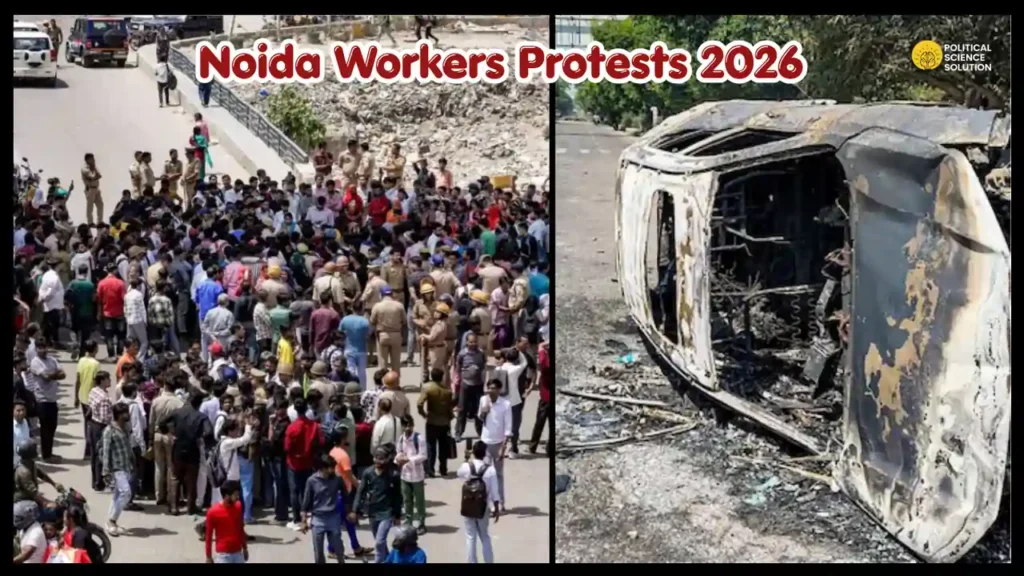
By March, the energy crisis exacerbated tensions. Shortages of LPG cylinders pushed living costs sky-high for migrant workers, sparking fresh demonstrations in industrial areas of Surat, Manesar, and Noida. The climax arrived on April 13 in Noida’s Gautam Buddha Nagar district. Thousands of factory workers from garments, footwear, textile, IT, and call centre units gathered at nearly 80-83 locations, including Sector 62, Phase-2, Sector 63, Sector 60, Sector 84, and parts of Greater Noida. An estimated 40,000 to 45,000 workers participated. Protesters pelted stones, vandalised property, broke factory gates, and set vehicles ablaze, leading to clashes with police. Trade union leaders claimed they had been under house arrest for five days prior, worsening the situation.
Common demands across all protests include better working conditions for contract workers, higher minimum wages, improved overtime payments, clearance of pending dues, and parity with regular employees. Workers also seek weekly offs, double overtime pay, safety measures, and dignified conditions. In Noida, unions specifically demanded over 35% wage hikes mirroring Haryana’s recent revision.
Root Causes Behind the Simmering Labour Unrest
The protests stem from multiple structural failures. The recent energy crisis has left migrant workers grappling with sharply higher costs of living, particularly LPG cylinders now trading at inflated black-market prices. This has compounded long-standing grievances.
Labour law ambiguities remain a flashpoint. The Code on Wages introduces a National Floor Wage and National Minimum Wage but provides no clear methodology for determining either, leaving implementation uncertain. More than 80% of India’s workers operate in the informal sector, excluded from most protections under the Labour Codes. Demands for improved facilities—adequate housing, workplace safety, proper ventilation, lighting, and regular bonuses—have gone largely unmet by employers.
Trade union dynamics have also played a role. Multiple unions in the same industry often clash internally, while some are perceived as politically motivated rather than focused on genuine worker interests. Workers and unions reported that authorities failed to engage in dialogue, with one Noida-based AITUC district secretary, Naeem, stating, “When there is no conversation by authorities with workers, then how will they listen to anyone?” He noted protests spreading across garments, IT, and call centres, with workers fully aware of the new Labour Codes and demanding rights aligned with them. The minimum wage in Uttar Pradesh’s Noida area had last been revised in 2012.
Siddhanth Raj, a trade union activist, attributed Noida’s unrest to influence from Manesar protests. Workers expected wage revisions from April 1 following the Labour Codes but were disappointed when these did not materialise.
Key Labour Reforms and the Four Codes Implemented in November 2025
The Labour Codes—Code on Wages, Code on Social Security, Industrial Relations Code, and Occupational Safety, Health and Working Conditions (OSH) Code—came into effect on November 21, 2025. Designed to ease compliance for employers while ensuring uniformity in wage structures and social security, the reforms were expected to deliver immediate benefits. However, workers claim revisions have not matched expectations.
Under the Code on Social Security 2020, gig and platform workers receive coverage, with aggregators required to contribute 1-2% of annual turnover (capped at 5% of payments to such workers).
The Industrial Relations Code 2020 introduces Fixed Term Employment (FTE) to curb excessive contractualisation and recognises trade unions with 51% membership as the sole Negotiating Union.
The Occupational Safety, Health and Working Conditions Code 2020 establishes a National Database for Unorganised Workers and mandates victim compensation in cases of injury or death. Additional initiatives include the “She-Box” portal for workplace safety complaints and the e-Shram portal for registration and support of unorganised workers.
These measures aim to modernise labour relations, yet implementation gaps have fuelled current protests. Textile unit owners in Noida, such as Anil Peshawari of Meenu Creation, described the situation as unprecedented in 10-12 years, with factories suspending operations and seeking police protection after workers breached gates.
Government Responses: Haryana and Uttar Pradesh Minimum Wage Hikes
States have moved quickly to defuse tensions. Haryana revised minimum wages on March 9, effective April 1, 2026—the first hike in over a decade following protests in Manesar and other hubs. For unskilled workers, the new monthly minimum stands at Rs 15,220.71; highly skilled workers receive Rs 19,428.50 (noted as Rs 19,42.85 in some references). Daily wages for contractual workers are set at Rs 582.40 for unskilled and Rs 747.14 for highly skilled. The last revision occurred on October 21, 2015.
In Uttar Pradesh, following the April 13 Noida violence, the government formed a high-level committee and approved an interim 21% hike in minimum wages on April 14, applicable retrospectively from April 1, 2026, in Gautam Buddha Nagar and Ghaziabad. Unskilled workers now receive Rs 13,690 per month (up from Rs 11,313), semi-skilled Rs 15,059, and skilled Rs 16,868. In other municipal corporation areas, rates are Rs 13,006 (unskilled), Rs 14,306 (semi-skilled), and Rs 16,025 (skilled). For remaining districts, the figures are Rs 12,356, Rs 13,591, and Rs 15,224 respectively.
The state rejected claims of a flat Rs 20,000 monthly minimum and clarified that final wage fixation will occur via a soon-to-be-constituted wage board. Additional welfare measures under consideration include workers’ health, pension schemes, and children’s education support. The decision followed consultations with employers’ bodies and labour organisations, balancing global economic challenges like rising input costs and declining exports with workers’ demands.
The committee noted that workers described their initial agitation as peaceful, focused on wages, weekly offs, double overtime, safety, and dignity. However, it flagged possible involvement of “external elements” in the violence, a concern echoed by workers themselves. Uttar Pradesh has established a district-level control room with helplines (120-2978231, 120-2978232, 120-2978862, 120-2978702) for complaints. Strict action is underway against anti-social elements through technical surveillance and intelligence.
Stakeholder Voices and Broader Implications
Trade unions view the protests as inextricably linked to the Labour Codes’ rollout. Employers, facing operational suspensions, emphasise the need for police deployment to resume activities. Industrial Development Commissioner Deepak Kumar and Gautam Buddha Nagar District Magistrate Medha Roopam confirmed the wage decisions were taken late on April 13 night by the high-powered committee to provide immediate relief.
The unrest occurs against a backdrop of global pressures on industries, yet the government maintains that the Labour Codes ensure fair wages and worker protections. As protests highlight the gap between policy intent and ground reality—especially for contract workers who form the backbone of manufacturing hubs—the coming weeks will test the effectiveness of dialogue mechanisms and wage boards.
With the energy crisis continuing to strain household budgets and informal workers still vulnerable, sustained engagement between authorities, employers, and unions will be critical. The retrospective wage hikes and welfare promises signal proactive steps, but long-term resolution depends on transparent implementation of the Labour Codes, clearer wage-setting methodologies, and inclusive facilities that address housing, safety, ventilation, lighting, and bonuses.
This unfolding labour story in 2026 serves as a critical test for India’s industrial relations framework. As Noida and other hubs return to normalcy under heightened security and new wage structures, the focus shifts to whether these measures can prevent future flare-ups and truly empower the workforce that drives the nation’s manufacturing engine
FAQs
1. What triggered the violent workers’ protests in Noida and other industrial hubs in 2026?
The protests erupted due to a combination of long-pending demands and immediate triggers. Key reasons include the recent energy crisis caused by the closure of the Strait of Hormuz during the Iran war, which drastically increased living costs, especially LPG cylinder prices in the black market (3-4 times higher). Workers were disappointed that the four Labour Codes implemented on November 21, 2025, did not bring the expected wage revisions from April 1, 2026. Other factors include outdated minimum wages (last revised in 2012 in parts of Uttar Pradesh), poor working conditions, lack of facilities like housing, ventilation, safety, and regular bonuses, and the high level of informality (over 80% of India’s workforce). Protests started in February 2026 in Barauni (Bihar) and spread to Surat, Manesar, Panipat, and finally turned violent in Noida on April 13, 2026, with stone-pelting and vehicles set on fire.
2. What are the new minimum wages announced by the Uttar Pradesh government after the Noida protests?
On April 14, 2026, the Uttar Pradesh government approved an interim ~21% hike in minimum wages, effective retrospectively from April 1, 2026. In Gautam Buddha Nagar (Noida) and Ghaziabad:
- Unskilled workers: ₹13,690 per month (up from ₹11,313)
- Semi-skilled: ₹15,059 per month
- Skilled: ₹16,868 per month
In other municipal corporation areas: ₹13,006 (unskilled), ₹14,306 (semi-skilled), ₹16,025 (skilled).
In remaining districts: ₹12,356 (unskilled), ₹13,591 (semi-skilled), ₹15,224 (skilled).
The government clarified it is not ₹20,000 per month and will constitute a wage board for final fixation. Haryana also revised wages earlier, setting unskilled daily wage at ₹582.40.
3. What are the four Labour Codes implemented in November 2025 and how do they affect workers?
The four Labour Codes effective from November 21, 2025 are:
- Code on Wages: Introduces National Floor Wage and National Minimum Wage (though methodology remains unclear).
- Code on Social Security, 2020: Extends coverage to gig and platform workers; aggregators contribute 1-2% of turnover.
- Industrial Relations Code, 2020: Allows Fixed Term Employment (FTE) and recognises a trade union with 51% membership as the sole Negotiating Union.
- Occupational Safety, Health and Working Conditions (OSH) Code, 2020: Creates a National Database for Unorganised Workers and provides compensation for injury or death.
Additional tools include e-Shram portal, She-Box for safety complaints, and better recognition of worker rights. Workers expected faster wage hikes and better conditions under these codes, but implementation gaps led to widespread protests.
4. How have the central and state governments responded to the 2026 workers’ protests?
Uttar Pradesh formed a high-level committee immediately after the April 13 Noida violence. CM Yogi Adityanath appealed to workers to beware of “external elements” spreading unrest. The state set up a control room with helplines (120-2978231, 120-2978232, etc.) and launched action against anti-social elements. Haryana hiked wages after Manesar protests. Both states consulted employers and unions for a “balanced approach.” The government is also considering extra welfare measures for health, pension, and children’s education. Police protection has been provided to factories, and operations remain suspended in some Noida units.
5. What are the main demands of the protesting workers across industrial belts?
Workers are demanding:
- Over 35% increase in minimum wages (aligned with Haryana’s hike).
- Better overtime payments (including double rate).
- Weekly offs and clearance of pending dues.
- Equal facilities and rights for contract workers as regular employees.
- Improved workplace safety, proper ventilation, lighting, housing, and regular bonuses.
- Full and effective implementation of the new Labour Codes.
- Social security benefits like PF and ESIC coverage.
Trade union leaders emphasised that lack of dialogue with authorities worsened the situation, with protests spreading from garments and textiles to IT and call centres.