

New Delhi: In a significant stride towards social justice and inclusive development, the Ministry of Social Justice and Empowerment has been making remarkable progress under the SMILE Scheme. This flagship initiative, formally known as Support for Marginalized Individuals for Livelihood and Enterprise, is transforming the lives of vulnerable sections of society, particularly those engaged in begging. With a clear vision of realizing “Bhiksha Vritti Mukt Bharat” – a Begging-Free India – the scheme stands as a beacon of hope, emphasizing dignity, rehabilitation, and sustainable livelihoods rather than mere short-term relief.
Launched as a Central Sector Scheme, the SMILE program adopts a comprehensive, dignity-based, and livelihood-oriented approach to address one of India’s most persistent social challenges. As of the latest updates from the Ministry, the scheme is actively operational in 216 cities across the country. More than 10,200 individuals engaged in begging have already been successfully rehabilitated. Looking ahead, the government has set an ambitious target to expand coverage to 295 cities and rehabilitate a total of 35,000 persons by the financial year 2030-31. This phased implementation reflects a strategic, long-term commitment to eradicating begging as a societal norm.
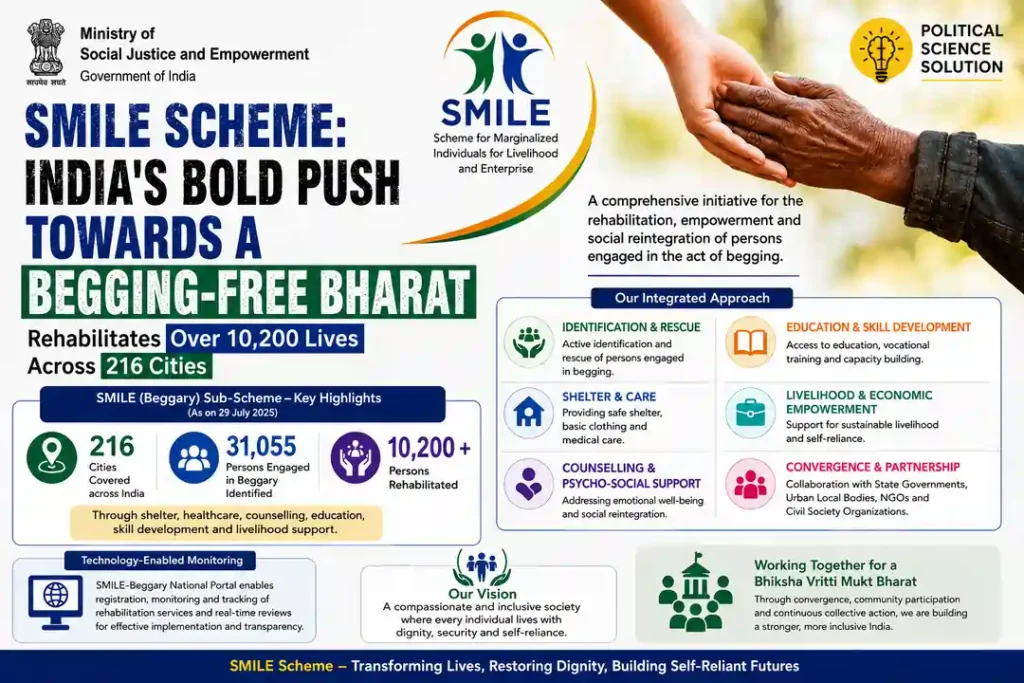
Understanding the Core Objectives and Structure of the SMILE Scheme
The primary objective of the SMILE Scheme is to provide comprehensive rehabilitation to persons engaged in begging. Unlike traditional welfare measures that might focus solely on immediate needs, this program integrates multiple dimensions – from rescue and shelter to skill-building and economic empowerment. It recognizes that begging is often a symptom of deeper issues such as poverty, lack of education, health concerns, and social exclusion.
The scheme operates under an umbrella framework that includes two key Central Sector Sub-Schemes:
- The Central Sector Scheme for Comprehensive Rehabilitation for Welfare of Transgender Persons.
- The Central Sector Scheme for Comprehensive Rehabilitation of Persons Engaged in the Act of Begging.
This dual structure ensures targeted interventions for different marginalized groups while maintaining a unified approach to social reintegration. By focusing on both transgender persons and those involved in begging, the Ministry underscores its commitment to holistic inclusion across intersecting vulnerabilities.
Key features of the SMILE Scheme highlight its multifaceted strategy:
Comprehensive Rehabilitation Process: The program begins with identification and rescue operations, followed by the provision of safe shelter homes. Beneficiaries receive essential healthcare services, psychological counselling, and structured rehabilitation support. This end-to-end approach ensures that individuals are not only removed from the streets but are also equipped to rebuild their lives with dignity.
Livelihood and Skill Development Focus: A cornerstone of the initiative is empowering participants through skill development training, formal education opportunities, and pathways to sustainable employment. By linking rehabilitation with economic self-reliance, the scheme moves beyond charity to create lasting change. Beneficiaries gain access to vocational courses tailored to local market demands, fostering independence and reducing the likelihood of relapse into previous circumstances.
Social Reintegration with Dignity: The ultimate goal is mainstreaming individuals into society. This involves building self-confidence, fostering community acceptance, and ensuring long-term monitoring to support successful transitions. The emphasis on dignity sets the SMILE Scheme apart, treating beneficiaries as partners in their own upliftment rather than passive recipients.
Convergence-Based Implementation: Success hinges on seamless coordination among various stakeholders. The Central Government works closely with State Governments, Union Territories, District Administrations, Urban Local Bodies, and Municipal Corporations. The scheme converges with other major initiatives such as DAY-NULM (Deendayal Antyodaya Yojana-National Urban Livelihoods Mission), NRLM (National Rural Livelihoods Mission), and Mission Vatsalya. This integrated model maximizes resources and avoids duplication of efforts.
Digital Transparency and Monitoring: In the digital age, accountability is paramount. The Ministry has developed the SMILE-Beggary National Portal, a robust platform for registration, real-time monitoring, and tracking of rehabilitation centres, shelter homes, and individual beneficiaries. This tool enhances transparency, enables data-driven decision-making, and allows for efficient oversight across geographies.
A senior official from the Ministry, as quoted in official communications dated July 20, 2026, highlighted these advancements. The official noted that the scheme would prioritize metropolitan cities, religious centres, tourist destinations, and historical places in the coming years. This targeted focus addresses high-visibility areas where begging is more prevalent due to economic opportunities and footfall.
Progress So Far and Future Roadmap
The numbers speak volumes about the scheme’s momentum. Over 10,200 persons have been rehabilitated in the 216 operational cities, marking a strong foundation. The remaining target of reaching 35,000 beneficiaries by FY 2030-31 will be pursued in a phased manner, aligning with approved implementation plans from the Standing Finance Committee for 2026-31.
This progress is not accidental but the result of meticulous planning and on-ground execution. Implementing agencies across states and union territories have benefited from revised operational guidelines and capacity-building programs. Awareness campaigns have been ramped up to encourage community participation, while institutional support structures continue to evolve.
Looking forward, the “Way Ahead” outlined in the scheme’s framework is equally critical. Experts and policymakers emphasize the need to tackle root causes head-on:
- Persistent poverty and homelessness.
- Mental health challenges and substance addiction.
- Issues related to human trafficking.
Addressing these underlying factors requires multi-sectoral collaboration beyond the Ministry alone. Legal measures form another vital pillar. Proposals include stricter enforcement of bans on begging and giving alms in public places. Such deterrence aims to disrupt organized begging networks while protecting genuine vulnerable individuals through rehabilitation channels.
Public awareness and monitoring are slated for significant enhancement. Community-driven initiatives can play a transformative role in discouraging exploitative practices. The success story of Indore – recognized as India’s first “Beggar-Free City” following a dedicated year-long rehabilitation campaign – serves as an inspiring model. Indore’s achievement demonstrates that with political will, administrative efficiency, and societal support, substantial change is possible at the city level. Other urban centres are now looking to replicate and adapt these best practices.
Broader Impact on Society and Economy
The SMILE Scheme’s implications extend far beyond individual beneficiaries. By rehabilitating thousands, it contributes to cleaner, safer public spaces and reduces the strain on urban infrastructure. Economically, skilled and employed former beneficiaries become productive contributors to the nation’s growth story. Socially, it promotes values of empathy, inclusion, and human dignity – core tenets of India’s constitutional ethos.
For families affected by poverty or disability, the scheme offers a lifeline that breaks intergenerational cycles of marginalization. Children in shelter homes gain access to education, while adults rebuild careers. The convergence with livelihood missions ensures that rehabilitation leads to sustainable income sources, whether in formal employment, self-enterprises, or community-based models.
Challenges remain, of course. Scaling operations to 295 cities demands robust funding, trained manpower, and continuous innovation in implementation. Ensuring quality of rehabilitation – not just numbers – will be key to long-term success. The digital portal will likely evolve with feedback from ground-level workers, incorporating advanced analytics for better predictive interventions.
Why the SMILE Scheme Matters in Today’s India
In an era of rapid urbanization and economic transformation, initiatives like SMILE address the human face of development. India’s growth trajectory must be inclusive; leaving behind the most vulnerable contradicts the spirit of “Sabka Saath, Sabka Vikas.” The scheme aligns perfectly with national goals under the Sustainable Development Goals (SDGs), particularly those related to poverty eradication, decent work, and reduced inequalities.
Public response has been encouraging, with many civil society organizations partnering in implementation. As awareness grows, more citizens are expected to support these efforts – whether by reporting cases responsibly, volunteering skills, or simply refraining from actions that perpetuate dependency.
The Ministry continues to refine strategies based on emerging data from the national portal. Regular reviews, stakeholder consultations, and success stories from rehabilitated individuals will shape the next phase. With over 10,200 lives already touched positively, the momentum is palpable.
Conclusion: Towards a Dignified and Self-Reliant Bharat
The SMILE Scheme exemplifies how targeted government intervention, backed by technology and convergence, can yield meaningful social change. From rescue to reintegration, every stage is designed with care and foresight. As India marches towards 2030-31 targets, the focus remains unwavering: building a society where no individual is forced to beg for survival.
This is more than a welfare scheme; it is a movement towards dignity and empowerment. By rehabilitating over 10,200 persons in 216 cities and setting sights on much larger goals, the Ministry of Social Justice and Empowerment is scripting a new chapter in India’s social development narrative. Citizens, policymakers, and administrators alike have a role to play in making “Bhiksha Vritti Mukt Bharat” a living reality.
For those seeking more information, the SMILE-Beggary National Portal serves as the primary resource. As the scheme expands, its impact will undoubtedly ripple across communities, reinforcing the idea that true progress is measured not just by economic indicators but by the upliftment of every citizen.
Frequently Asked Questions (FAQs)
1. What is the SMILE Scheme and what is its main objective?
The SMILE Scheme, or Support for Marginalized Individuals for Livelihood and Enterprise, is a Central Sector Scheme implemented by the Ministry of Social Justice and Empowerment. Its primary objective is to achieve the vision of a “Bhiksha Vritti Mukt Bharat” (Begging-Free India) by providing comprehensive, dignity-based rehabilitation to persons engaged in begging. This includes identification, rescue, shelter, healthcare, counselling, skill development, education, and sustainable livelihood opportunities to help beneficiaries reintegrate into mainstream society with self-reliance.
2. In how many cities is the SMILE Beggary Scheme currently operational, and what are the future targets?
As per the latest updates, the SMILE Beggary Scheme is operational in 216 cities across India. The government aims to expand it to 295 cities by the financial year 2030-31. The rehabilitation target is set at 35,000 persons by FY 2030-31, with a special focus on metropolitan cities, religious places, tourist destinations, and historical sites. Over 10,200 individuals have already been successfully rehabilitated in a phased manner.
3. What are the key features and sub-schemes under the SMILE Scheme?
The scheme includes two major Central Sector Sub-Schemes: one for the Comprehensive Rehabilitation for Welfare of Transgender Persons and another for the Comprehensive Rehabilitation of Persons Engaged in Begging. Key features include comprehensive rehabilitation services (rescue, shelter, healthcare, counselling), livelihood support through skill development and employment, social reintegration with dignity, convergence with other schemes like DAY-NULM, NRLM, and Mission Vatsalya, and digital monitoring via the SMILE-Beggary National Portal for transparency and tracking.
4. How does the SMILE Scheme ensure long-term impact and address root causes of begging?
The scheme adopts a convergence-based approach involving Central and State Governments, District Administrations, and Urban Local Bodies. It focuses on tackling root causes such as poverty, homelessness, mental illness, addiction, and trafficking. Legal deterrence (bans on begging and giving alms in public places with enforcement), enhanced public awareness, community participation, and monitoring of organized begging are emphasized. Successful models like Indore, India’s first Beggar-Free City, are being replicated. The digital portal further strengthens implementation and accountability.
5. How can one access information or support related to the SMILE Scheme?
Detailed information, registration, and tracking of rehabilitation centres are available through the SMILE-Beggary National Portal. The scheme is supported by revised operational guidelines and capacity-building for implementing agencies. For queries or participation, citizens can refer to official communications from the Ministry of Social Justice and Empowerment or contact local District Administrations and Urban Local Bodies involved in the program.