
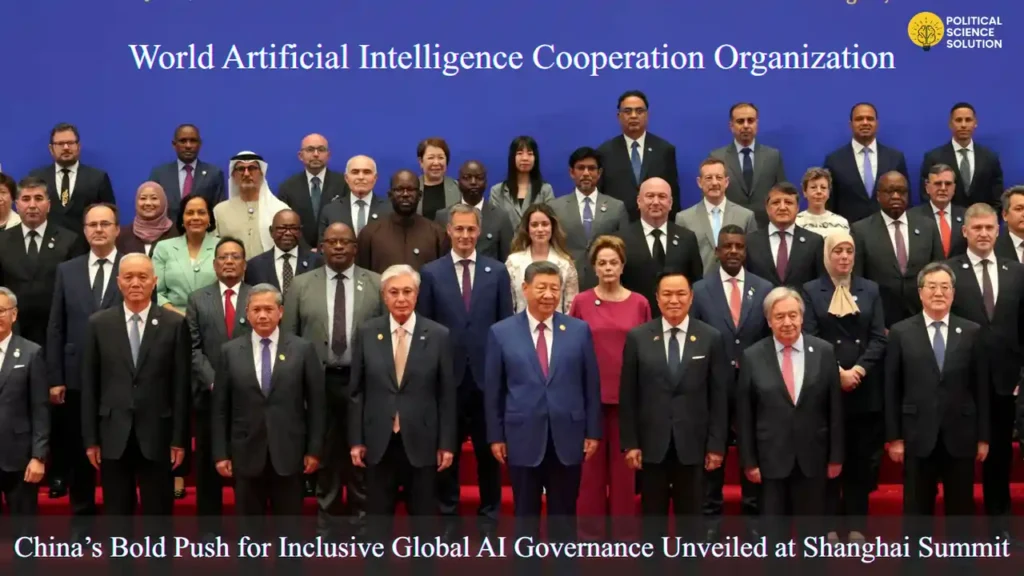
New Delhi: In a move set to reshape international technology collaboration, China formally operationalized the World Artificial Intelligence Cooperation Organization (WAICO) at the ongoing World Artificial Intelligence Conference (WAIC). This newly established body, backed by 29 founding countries from across the Global South and beyond, seeks to create a more equitable platform for AI development that prioritizes participation from developing nations over restrictive Western models.
The launch, which took place amid high-profile discussions on July 16 and 17, 2026, highlights Beijing’s determination to influence the rules governing one of the 21st century’s most powerful technologies. Chinese President Xi Jinping delivered a keynote address that framed AI progress as a collective endeavor, warning against dominance by any single nation and calling for open collaboration to prevent technological exclusion.
WAIC 2026: A Platform for Technological Diplomacy
Since its inception in 2018, the annual World Artificial Intelligence Conference in Shanghai has grown into a key gathering for AI innovators, policymakers, and researchers. The 2026 edition stood out not just for demonstrations of advanced systems — including humanoid robots capable of complex tasks — but for the formal debut of WAICO as a structured response to global AI imbalances.
WAICO operates as a fully independent intergovernmental entity dedicated to civilian-sector AI cooperation. Its charter stresses inclusivity and non-discrimination, with headquarters firmly based in Shanghai. The organization’s core mission centers on ensuring that AI benefits reach every corner of the world through joint efforts rather than unilateral control.
Founding Members, Structure, and China’s Concrete Commitments
The founding coalition comprises 29 nations, notably without India’s participation. Key signatories hail from diverse regions: Indonesia, Brazil, Russia, Pakistan, Oman, Kazakhstan, Laos, Malaysia, South Africa, Senegal, and others spanning Africa, Asia, Latin America, the Middle East, and parts of Europe.
China has outlined ambitious support measures for the coming five years. These include providing AI training to 5,000 professionals from developing countries, creating and distributing open-source AI models like DeepSeek, and directing investments toward building robust AI infrastructure in member states. Focus areas encompass partnerships with ASEAN, the African Union, SCO, and BRICS frameworks, aiming to bridge capability gaps for nations lacking homegrown AI expertise.
The idea for WAICO was initially floated at the 2025 WAIC and later embedded within China’s national Five-Year Plan covering 2026 to 2030. Its establishment through a multilateral agreement underscores a deliberate strategy to build alternative institutions that reflect priorities of the Global South.
Why Global AI Governance Matters Now More Than Ever
The creation of WAICO arrives against a backdrop of stark disparities and rising risks in artificial intelligence deployment. A pronounced “compute divide” sees the US and China dominating roughly 90 percent of worldwide AI processing capacity, leaving many countries vulnerable to exclusion from future economic and technological gains.
Additional challenges encompass massive workforce disruptions from automation, algorithmic biases that can reinforce inequalities, and misuse of AI tools in areas such as surveillance. AI’s inherently cross-border characteristics amplify concerns around data privacy violations, cybersecurity weaknesses, and the alarming surge in AI-generated child sexual abuse material (CSAM). These issues require coordinated global action that no single country can adequately address alone.
By focusing on capacity building and shared infrastructure, WAICO aims to mitigate these risks while promoting safe and beneficial applications for humanity.
Mapping the Landscape of International AI Initiatives
Multiple efforts already exist on the global stage. The G7’s Hiroshima Process yielded a set of principles and a voluntary code of conduct designed to foster trustworthy AI systems. India participates in the OECD-hosted Global Partnership on AI (GPAI). The Bletchley Declaration brought together nations, including India, to acknowledge both opportunities and potential dangers. The United Nations continues work through its Global Digital Compact and an independent scientific panel dedicated to AI.
WAICO differentiates itself by placing accessibility and development support at the forefront, targeting nations often sidelined in high-stakes technology conversations. Observers note that the alliance could serve as a vehicle for shaping discussions at the United Nations, leveraging the collective voice of its members.
Xi Jinping’s Vision: From Solo Acts to Global Symphony
In his remarks at WAIC, President Xi urged countries to embrace open-source AI as a pathway to shared prosperity. He highlighted China’s role in expanding training opportunities to avoid creating new forms of historical inequity and pledged continued engagement across Africa, Latin America, and Asia.
“AI development should not be a solo performance by a single country, but a symphony of international cooperation,” Xi stated. He called for joint resistance to the excessive use of national security justifications that hinder technology flows and advocated a people-centered model where humans retain ultimate oversight through robust safeguards, including regulatory frameworks, real-time monitoring, early warning systems, and rapid response protocols.
This outlook aligns with China’s broader industrial strategy, which has seen massive investments in semiconductor self-sufficiency, vast data center networks, control over rare earth supplies, and accelerated energy infrastructure expansion. China’s electricity output already exceeds twice that of the United States, providing a critical edge for powering energy-intensive AI training.
Addressing Criticisms and Potential Risks
While WAICO promotes cooperation, it has drawn notable concerns. The organization’s preference for strong governmental supervision, traceable data flows, and “secure and controllable” technologies echoes China’s cyber sovereignty principles. Analysts worry this could embed state-centric governance models internationally.
There are parallels drawn to challenges observed under the Belt and Road Initiative, where infrastructure dependencies sometimes led to strategic vulnerabilities. Critics caution that heavy reliance on Chinese AI cloud services, hardware, and data systems might create new forms of influence through digital leverage. Over time, technical collaborations and training programs could quietly spread Chinese regulatory approaches, affecting worldwide standards even alongside existing frameworks.
Such dynamics raise questions about balancing openness with protections against authoritarian tendencies in technology governance.
How WAICO Stacks Up Against Other Major Approaches
A clear contrast emerges when comparing frameworks:
Western models (led by the US, EU, and UK) concentrate on risk assessment, ethical standards, accountability, and multi-stakeholder involvement. They frequently employ export controls to manage frontier technologies, prioritizing safety, privacy, and national security.
WAICO’s approach emphasizes rapid access, open innovation, technology transfer, and sovereignty for participating states, with particular attention to uplifting developing economies.
India’s “AI for All” strategy focuses on leveraging AI for broad socioeconomic progress through Digital Public Infrastructure, national missions, and innovation-friendly policies. New Delhi maintains engagement in GPAI and other forums while safeguarding strategic autonomy and ethical considerations without fully aligning with either pole.
This tripartite landscape suggests a multipolar future for AI rule-making.
Looking Forward: Implications for the AI Era
The emergence of WAICO adds another layer to ongoing US-China technological friction, which includes restrictions on advanced chips, retaliatory measures on minerals, and competition in high-stakes applications. By consolidating support from numerous developing countries, China aims to strengthen its hand in international forums.
Success for WAICO will hinge on translating commitments into real-world outcomes — such as localized AI tools, widespread training programs, and infrastructure that genuinely empowers members. The initiative arrives as nations worldwide grapple with regulating fast-evolving technology while harnessing its potential for economic and social advancement.
As artificial intelligence continues transforming industries, security landscapes, and daily life, frameworks like WAICO will play an increasingly visible role. Whether it fosters genuine multilateral progress or contributes to fragmented standards remains a pivotal question for the years ahead.
This development signals that the conversation around AI is no longer confined to a handful of leading powers. Instead, it is expanding to include a broader chorus of voices seeking seats at the table.
FAQs
1. What exactly is the World Artificial Intelligence Cooperation Organization?
WAICO is an independent intergovernmental body based in Shanghai, launched by 29 countries to drive inclusive cooperation, regulation development, and capacity enhancement in civilian AI, especially benefiting developing regions.
2. What motivated China to initiate WAICO?
The goal is to counter technology barriers, amplify Global South voices, establish alternative governance pathways, and promote equitable participation in AI advancement.
3. Key differences from Western governance?
Western systems stress rigorous safety protocols and rights protections; WAICO prioritizes accessibility, collaborative development, and state-guided sovereignty.
4. Primary concerns linked to WAICO?
Potential spread of state-heavy control, risks of technological dependence, and gradual adoption of specific governance philosophies that could favor certain interests.
5. Relation to India’s AI policies?
India pursues a balanced, innovation-oriented path centered on inclusive growth, public infrastructure, and responsible use while engaging selectively in global platforms.