
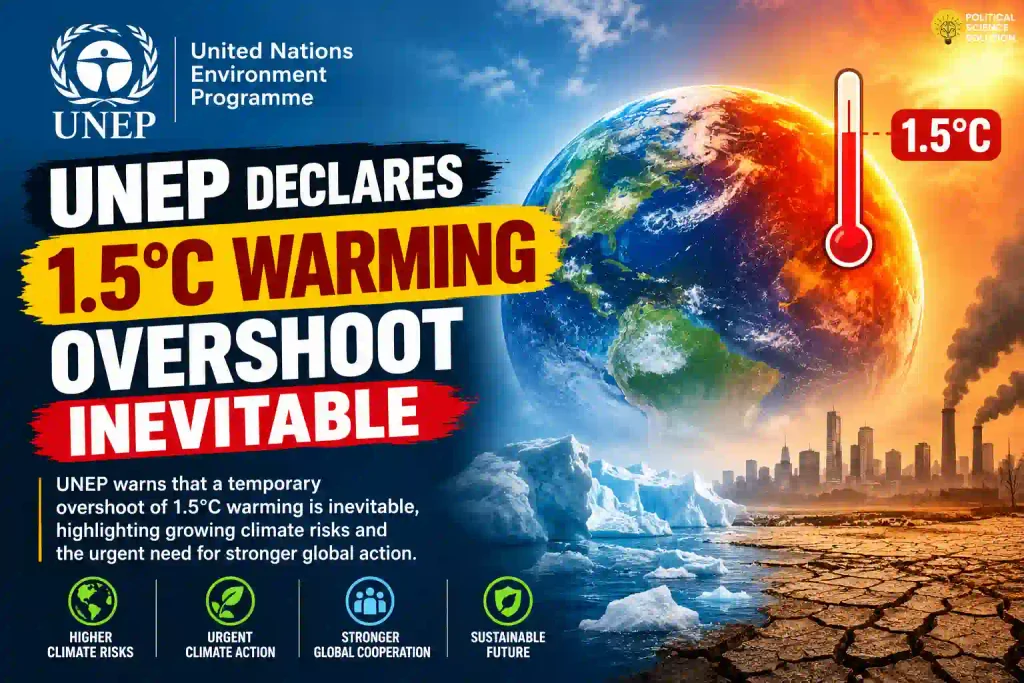
New Delhi: A landmark assessment from the United Nations Environment Programme has confirmed what many climate scientists have increasingly warned: the world is set to push past the 1.5°C global warming threshold above pre-industrial levels, and that crossing is now considered unavoidable. Even under the most optimistic assumptions about policy implementation, temperatures are projected to peak near 1.8°C. The findings, detailed in UNEP’s first dedicated report on the subject titled Limiting Overshoot, shift the conversation from prevention of exceedance to management of the overshoot period itself and the subsequent effort to return temperatures downward.
The report arrives at a moment of heightened urgency. Just one year earlier, UN Climate Change executive secretary Simon Stiell maintained that the 1.5°C goal remained achievable. The new analysis revises that outlook, stating that exceedance is likely within the next few years. Yet the document is careful not to frame the development as a signal to abandon the Paris Agreement target. Instead, it argues for a fundamental change in approach: treating 1.5°C as a level that will be approached from above rather than protected from below.
Why the 1.5°C Threshold Still Matters
The 1.5°C figure became a central pillar of international climate policy through the 2015 Paris Agreement. Under Article 2 of that accord, nearly 200 parties committed to holding the increase in global average temperature to well below 2°C above pre-industrial levels while pursuing efforts to limit the rise to 1.5°C. The lower figure was never presented as a risk-free ceiling. Scientific assessments have long shown that every additional fraction of a degree intensifies hazards, including extreme heat, drought, water stress, and ecosystem disruption. Staying closer to 1.5°C simply reduces the scale and severity of those impacts relative to higher levels of warming.
Historically, 2°C served as the primary benchmark for dangerous climate change. Yale economist William Nordhaus was among the first to suggest that warming beyond that level would push living conditions outside the range experienced by human civilization. Over subsequent decades the figure gained traction among scientists and policymakers. The Cancun Agreements, adopted at the 2010 UN Climate Change Conference, formally incorporated both 2°C and 1.5°C into an international climate text. Paris then elevated 1.5°C as the more ambitious and preferable objective because risks escalate substantially between the two marks.
The Limiting Overshoot report underscores that even 1.5°C is not a safe harbor. Impacts intensify continuously as temperatures rise, elevating the chance of irreversible shifts such as dieback of the Amazon rainforest, widespread permafrost thaw, and potential collapse of major ice sheets. The higher the peak and the longer temperatures remain elevated, the greater the difficulty and cost of eventual recovery. That recovery will almost certainly require large-scale carbon dioxide removal in addition to deep emissions reductions.
Importantly, a temporary breach measured over a few months or even a year or two does not by itself constitute failure of the Paris goal. The target refers to long-term average warming calculated over multi-decade periods, not the temperature recorded in any single calendar year.
Core Findings of the UNEP Assessment
UNEP’s analysis examines the full trajectory of overshoot: the initial exceedance of 1.5°C, the subsequent peak, and the eventual decline. Under current national climate plans and net-zero commitments—even if fully implemented—global temperatures are still expected to crest around 1.8°C. The report organizes its guidance around five central insights that together redefine the near-term climate agenda.
First, strategy must shift without discarding the 1.5°C objective. Mirey Atallah, chief of UNEP’s Adaptation and Resilience Branch and coordinator of the report, stated that decisions, science, and mindsets need to adjust so that 1.5°C is viewed as a goal approached from above. The practical implication is to keep the peak as low as possible, shorten the duration of exceedance, and then drive temperatures downward. This framing is presented as the essential starting point for understanding the scale of emissions reductions still required.
Second, some damage incurred during overshoot cannot be fully reversed. Higher temperatures and longer periods above 1.5°C raise the likelihood of extreme heat events, wildfires, glacier loss, and irreversible harm to ecosystems such as coral reefs. Specific systems of concern include the Greenland and West Antarctic ice sheets, the Amazon rainforest, and the Atlantic Meridional Overturning Circulation—the major ocean current system that helps regulate climate across the North Atlantic and beyond. Even if temperatures later fall, sea-level rise, species extinctions, and certain ecosystem transformations may continue. Carbon dioxide removal will be necessary to achieve net-negative emissions, yet optimistic deployment scenarios suggest it is unlikely to reverse more than a few tenths of a degree of warming within this century. At present rates, the report estimates that afforestation and improved forest management alone would require more than a century—assuming no residual emissions—to lower temperatures by just 0.1°C.
Third, the magnitude and duration of overshoot are decisive. A smaller and shorter excursion above 1.5°C produces less cumulative damage and improves the odds of returning below the threshold. Rapid cuts in methane and other short-lived climate pollutants can slow the rate of warming in the near term and thereby help constrain the peak.
Fourth, mitigation must follow a clear three-phase sequence. In the immediate period, nations need to slash greenhouse gas emissions while simultaneously protecting vulnerable populations and ecosystems. At the point of peak warming, the world must reach at least net-zero emissions while managing severe climate impacts. After the peak, sustained net-negative carbon dioxide emissions become essential to drive temperatures back down. Throughout, mitigation and adaptation must advance in parallel. Insufficient emissions cuts make adaptation more difficult and costly; inadequate adaptation leaves communities and infrastructure exposed to escalating risks.
Fifth, the burdens of overshoot will fall unevenly. Nations that have contributed least to historical emissions are frequently among those most exposed to impacts. This disparity featured prominently at COP30 in Belém, Brazil, where governments agreed on the need to scale up adaptation finance for developing countries. UNEP estimated before that summit that adaptation needs in those countries could exceed $310 billion annually by 2035—roughly twelve times the level of current international public finance flows.
Expert Perspective on the Implications
David Waskow, director of the World Resources Institute’s International Climate Initiative, issued a statement responding to the UNEP findings. He noted that crossing 1.5°C is no longer a distant prospect. Extreme heat, floods, fires, and droughts already illustrate the consequences of a hotter world: homes inundated, harvests destroyed, and communities still recovering when the next disaster arrives. With a developing Super El Niño potentially intensifying conditions, the near-term outlook carries additional risk. Every fraction of a degree increases the human and economic toll.
Waskow emphasized that the height of the peak, the length of time spent above 1.5°C, and the volume of resulting damage remain highly dependent on decisions taken now. Pathways exist that combine low-carbon development with climate resilience and economic growth rather than locking in greater future risk. Accelerating clean energy deployment, strengthening food and water systems, and advancing adaptation measures can protect people while lowering costs, generating employment, and reinforcing economic foundations. Achieving this outcome requires political commitment, inclusive governance, effective policy design, and the mobilization of both public and private capital.
On carbon removal, Waskow stressed that substantial and responsible scale-up is required, yet it cannot replace deep emissions reductions, including rapid cuts in methane. Both approaches are necessary and must proceed more quickly. Preparation for unavoidable warming is equally critical. For communities on the front lines, early adaptation can determine whether a climate shock becomes a catastrophe. Recent WRI research has shown that every dollar invested in adaptation can generate more than ten dollars in benefits.
Finally, Waskow observed that geopolitical tensions, trade disputes, and fractured diplomacy make international cooperation on climate more essential, not less. No country can fully insulate itself from the consequences of an overshoot. Delay simply transfers greater costs onto those least equipped to bear them.
Navigating the Overshoot Pathway
The UNEP report frames overshoot as a dynamic process rather than a single event. It examines the risks associated with successively higher levels of warming, the mitigation trajectories capable of limiting the peak and enabling subsequent decline, and the adaptations required as conditions evolve along that pathway. Evidence consistently shows that higher peaks and longer durations of exceedance correlate with greater risks to people, societies, economies, and natural systems. Therefore, decisions made in the present remain decisive: lower peaks reduce overall risk, and shorter overshoots lower the probability of crossing irreversible thresholds or exhausting adaptation limits.
The central message is one of urgency rather than resignation. Mitigation and adaptation must move forward together. Overshoot does not invalidate the Paris Agreement goals; it reframes how those goals must be pursued. Aggressive emissions reductions, responsible expansion of carbon dioxide removal that ultimately produces net-negative emissions, and immediate strengthening of adaptation and resilience form the three pillars of a viable response.
For policymakers, the practical agenda is clear. Near-term action must focus on steep cuts in both carbon dioxide and short-lived pollutants while simultaneously channeling resources into protection of the most vulnerable. At the same time, planning for the peak and the post-peak period requires investment in the technologies, institutions, and finance systems that will enable sustained net-negative emissions and continued adaptation under higher baseline temperatures. The uneven distribution of impacts further demands scaled-up support for developing countries so that adaptation finance matches the scale of need projected for the coming decade.
The Limiting Overshoot assessment does not claim that returning temperatures below 1.5°C will erase every consequence of the intervening years. Sea-level rise, biodiversity loss, and certain ecosystem transitions may persist. Yet the report demonstrates that the difference between a modest, brief overshoot and a higher, prolonged one remains large enough to justify maximum effort. The lower the peak and the shorter the duration, the greater the chance of limiting irreversible harm and of eventually restoring a climate closer to the Paris objectives.
In an era when international cooperation faces multiple headwinds, the UNEP findings reinforce a basic reality: climate change does not respect national borders. The costs of delayed action will continue to fall most heavily on those who contributed least to the problem. The window for constraining the overshoot is still open, but it is narrowing. The choices made in the next few years will determine how high temperatures climb, how long they remain elevated, and how much permanent damage is locked in before the long process of return can begin.
FAQs
1. What does UNEP mean when it says a 1.5°C overshoot is now “unavoidable”?
UNEP’s Limiting Overshoot report concludes that global average temperatures will temporarily exceed 1.5°C above pre-industrial levels, most likely within the next few years. Even in an optimistic scenario in which governments fully implement all current national climate plans and net-zero pledges, temperatures are still projected to peak around 1.8°C. The finding revises earlier statements (including those made by UN Climate Change head Simon Stiell in 2025) that the 1.5°C goal remained within reach. Importantly, the Paris Agreement target refers to long-term multi-decade averages, not a single calendar year, so a brief temporary breach does not automatically mean the goal has been permanently missed.
2. Does crossing 1.5°C mean the Paris Agreement target should be abandoned?
No. UNEP explicitly advises against abandoning the 1.5°C objective. Instead, the report calls for a strategic shift: countries must now approach the target “from above rather than below.” This means limiting the height of the temperature peak, keeping the duration of the overshoot as short as possible, and then driving temperatures back down through aggressive emissions cuts and sustained net-negative carbon dioxide emissions. Mirey Atallah, coordinator of the report, stressed that mindsets, science and policy all need to adjust to this new reality while still treating 1.5°C as the long-term goal.
3. What irreversible damage could occur during an overshoot, and can temperatures really be brought back down?
Higher and longer overshoots increase the risk of long-lasting or irreversible changes, including partial collapse of the Greenland and West Antarctic ice sheets, Amazon rainforest dieback, permafrost thaw, coral-reef loss, and disruption of the Atlantic Meridional Overturning Circulation. Even if temperatures later fall, sea-level rise, species extinctions and certain ecosystem shifts may continue. Returning below 1.5°C is still considered possible, but it will require rapid near-term emissions reductions (especially of methane and other short-lived pollutants), achievement of net-zero, and then sustained net-negative CO₂ emissions through responsible carbon-dioxide removal. UNEP notes that even optimistic carbon-removal scenarios are unlikely to reverse more than a few tenths of a degree this century; afforestation alone would take over a century to lower temperatures by just 0.1°C under ideal conditions.
4. What practical steps does the report recommend for governments and the international community?
UNEP outlines a three-phase response:
- Immediate term – slash greenhouse-gas emissions while protecting vulnerable people and ecosystems.
- At peak warming – reach at least net-zero emissions while managing severe climate impacts.
- After the peak – maintain net-negative CO₂ emissions to bring temperatures down.
Mitigation and adaptation must advance together. The report also highlights the need to scale up adaptation finance for developing countries, whose needs UNEP previously estimated could exceed $310 billion a year by 2035—about twelve times current international public flows. Rapid cuts in methane and other short-lived climate pollutants are singled out as especially effective for limiting the height and duration of the overshoot.
5. Why will the impacts of overshoot be felt unevenly, and what does that mean for climate justice?
Countries and communities that have contributed least to historical emissions are often the most exposed to extreme heat, floods, droughts, sea-level rise and ecosystem loss. This inequity was a major focus at COP30 in Belém, Brazil. The World Resources Institute’s David Waskow noted that every fraction of a degree raises the human and economic toll, and that delay simply shifts greater costs onto those least able to bear them. Effective responses therefore require not only deeper emissions cuts in high-emitting nations but also substantially increased adaptation finance, technology transfer and capacity support for the most vulnerable. Early adaptation investment can yield high returns—recent WRI research found that every $1 spent on adaptation can generate more than $10 in benefits—making timely action both a climate and a justice imperative.