

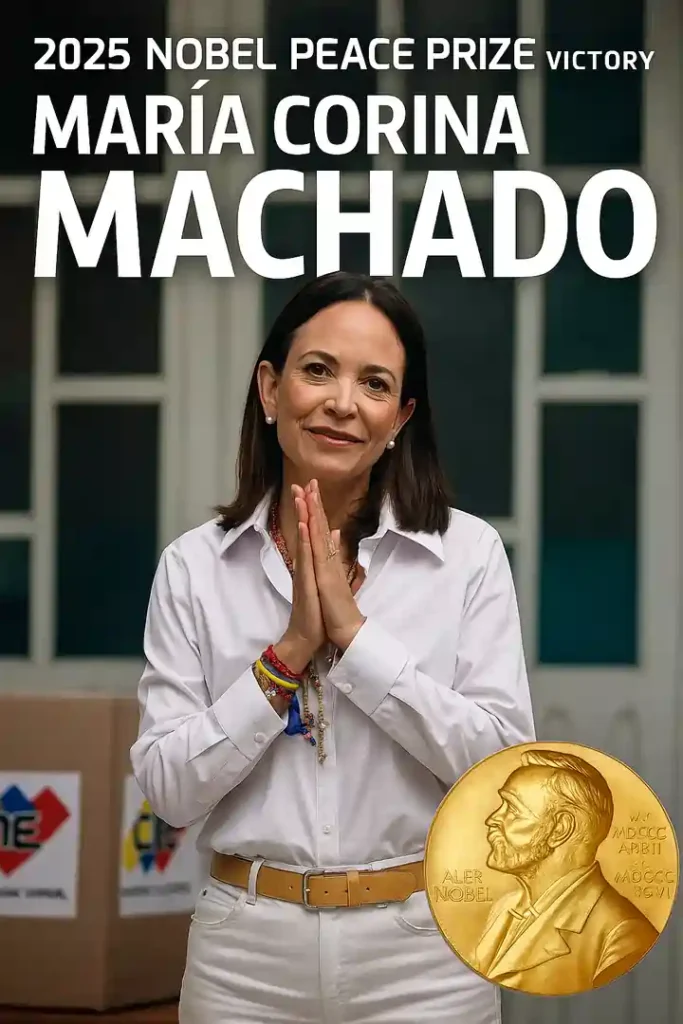
New Delhi: In a momentous announcement that has captured global attention, Venezuelan opposition figure María Corina Machado has been honored with the 2025 Nobel Peace Prize. This prestigious accolade recognizes her unwavering commitment to fostering democratic principles amid Venezuela’s turbulent political landscape. Machado, who has faced significant personal risks including going into hiding following disputed elections, swiftly responded to the award by dedicating it to the enduring spirit of the Venezuelan people and, notably, to United States President Donald Trump for his steadfast backing of her efforts.
Machado’s Emotional Response and Dedication
Machado, a prominent voice against authoritarianism in Venezuela, expressed her gratitude and resolve in a heartfelt message shared on the social media platform X. She described the Nobel recognition as a vital encouragement in the ongoing fight for liberty, stating that it propels the collective mission to secure freedom for all Venezuelans. Emphasizing the proximity to triumph, she underscored the importance of international partnerships, particularly highlighting President Trump, the American populace, Latin American communities, and global democratic forces as key supporters in realizing democracy and freedom.
In a poignant tribute, Machado specifically allocated the prize to the “suffering people of Venezuela” and extended her appreciation to President Trump for his critical role in championing their cause. This dedication comes against the backdrop of her exclusion from the 2024 presidential race, which was claimed by incumbent Nicolás Maduro but condemned worldwide for lacking fairness and transparency. Since then, Machado has operated from concealment to evade threats.
The Nobel Committee praised her as a valiant advocate for peace, noting her role in sustaining democratic aspirations during Venezuela’s challenging times. They lauded her for confronting oppressive governance and advocating for reforms that promote equality and justice.
Trump’s Campaign for the Prize and White House Reaction
President Donald Trump, who was among the contenders for the 2025 Nobel Peace Prize, had actively pursued the honor through public advocacy. Following the committee’s decision, the White House issued a statement critiquing the choice, asserting that it prioritized political agendas over genuine peace initiatives. This response reflects the administration’s view that Trump’s contributions to international stability warranted recognition.
In a separate development, Trump revealed during a Friday evening interaction that Machado personally contacted him post-announcement. According to Trump, she conveyed that he was the rightful recipient and that she was accepting the award in his honor. He described her gesture as gracious, adding that she might have relinquished the prize to him if requested, though he refrained from doing so. Trump highlighted this as a “very nice thing,” underscoring the mutual respect between them.
The White House further elaborated on the committee’s selection, reiterating that it demonstrated a bias toward politics rather than peace. Spokesperson Steven Cheung affirmed Trump’s dedication to forging peace agreements, resolving conflicts, and preserving lives, portraying him as a unique leader with unparalleled determination.
Nobel Committee’s Announcement and Rationale
The Norwegian Nobel Committee, led by Chair Jørgen Watne Frydnes, formally declared Machado the laureate on October 10, 2025. They commended her persistent endeavors in advancing democratic entitlements for Venezuelans and her push for a non-violent shift from autocracy to a democratic system. The committee noted that in the preceding year, Machado had endured life-threatening dangers while remaining in Venezuela, a decision that has motivated countless individuals.
Frydnes emphasized how Machado has unified the opposition and resisted the increasing militarization of Venezuelan society. Her consistent advocacy for a peaceful democratic handover was a cornerstone of the award’s justification. This year’s prize follows the 2024 honor bestowed upon Nihon Hidankyo, the Japanese group representing Hiroshima and Nagasaki atomic bomb survivors, known as Hibakusha.
The Nobel Prizes, including the Peace category, each include a monetary award of 11 million Swedish kronor, with ceremonies scheduled for December 10. Established per Alfred Nobel’s 1895 testament, the prizes aim to reward those conferring the utmost benefit to humanity. For 2025, the committee reviewed 338 nominations—244 individuals and 94 organizations—surpassing the previous year’s 286 candidates (197 individuals and 89 organizations).
Nominations closed on January 31, with committee members able to propose until their February gathering. Deliberations occur monthly, culminating in a decision typically by August or September, though occasionally later, as seen this year. The committee strives for unanimous agreement but resorts to majority vote if needed, guided by expert evaluations from advisers and international specialists.
Broader Context and Global Reactions
Committee leader Frydnes addressed external pressures, acknowledging that many political figures aspire to the prize but affirming the committee’s adherence to Nobel’s ideals of peace, disarmament, and global collaboration. He noted the heightened scrutiny, especially from the U.S., but maintained their standard procedures.
Analyst Nina Graeger from the Peace Research Institute Oslo critiqued actions like U.S. withdrawals from the World Health Organization and Paris climate agreement, as well as trade disputes with allies, arguing they contradict Nobel’s ethos. She outlined the will’s focus on peace brokering, disarmament promotion, and international unity.
Implications for Venezuela and International Relations
Machado’s laureate status amplifies calls for democratic restoration in Venezuela, where her ban from elections and subsequent seclusion highlight ongoing struggles. Her alliance with Trump signals potential U.S. involvement in regional affairs, amid White House vows to pursue peace despite the snub.
This award not only celebrates individual bravery but also galvanizes global support for oppressed voices, aligning with Nobel’s legacy of honoring humanitarian advancements. As Venezuela stands “on the threshold of victory,” Machado’s message resonates: international solidarity, spearheaded by figures like Trump, remains pivotal.
FAQs
1. Why was María Corina Machado awarded the 2025 Nobel Peace Prize?
María Corina Machado received the 2025 Nobel Peace Prize for her relentless efforts in promoting democratic rights in Venezuela and advocating for a peaceful transition from authoritarian rule to democracy. The Norwegian Nobel Committee praised her as a “brave and committed champion of peace” who has unified the opposition, resisted the militarization of Venezuelan society, and inspired millions by remaining in the country despite serious threats to her life.
2. Why did Machado dedicate her Nobel Peace Prize to Donald Trump?
Machado dedicated the prize to both the “suffering people of Venezuela” and U.S. President Donald Trump, citing his “decisive support” for her cause. In a post on X, she expressed gratitude for Trump’s backing and highlighted the United States, alongside Latin American and global democratic nations, as key allies in Venezuela’s fight for freedom. Trump later shared that Machado called him, stating she accepted the award in his honor, believing he deserved it.
3. How did the White House react to Machado’s Nobel Peace Prize win?
The White House criticized the Nobel Committee’s decision, claiming it “proved they place politics over peace.” They argued that President Trump, who was also a contender for the 2025 prize, deserved recognition for his work in brokering international ceasefire deals. White House spokesman Steven Cheung emphasized Trump’s commitment to peace, describing him as a unique humanitarian leader capable of monumental achievements.
4. What challenges has María Corina Machado faced in Venezuela?
Machado was barred from running in Venezuela’s 2024 presidential elections, which were won by President Nicolás Maduro but widely criticized as neither free nor fair. Since then, she has been in hiding due to serious threats against her life. Despite these dangers, she has remained in Venezuela, continuing her advocacy for democratic reforms and unifying the opposition against authoritarian governance.
5. How does the Nobel Peace Prize selection process work?
The Norwegian Nobel Committee, guided by Alfred Nobel’s 1895 will, selects the Peace Prize laureate after reviewing nominations submitted by January 31. For 2025, they considered 338 candidates (244 individuals, 94 organizations). Committee members can also propose candidates by February. Monthly deliberations, supported by expert assessments, aim for consensus, with a majority vote as a fallback. The decision, announced on October 10, 2025, for Machado, aligns with Nobel’s focus on peace, disarmament, and international cooperation.