

New Delhi: After nearly two decades of complex negotiations, India and the European Union have formally concluded a landmark Free Trade Agreement (FTA), hailed by leaders as the “mother of all deals.” The pact, announced on January 27, 2026, during the high-profile India-EU Summit in New Delhi, creates one of the world’s largest integrated economic zones, linking the world’s second-largest economy (India) with the fourth-largest (the 27-nation EU bloc), representing roughly 25% of global GDP and one-third of global trade. Together, the agreement opens a combined market of nearly 2 billion people.
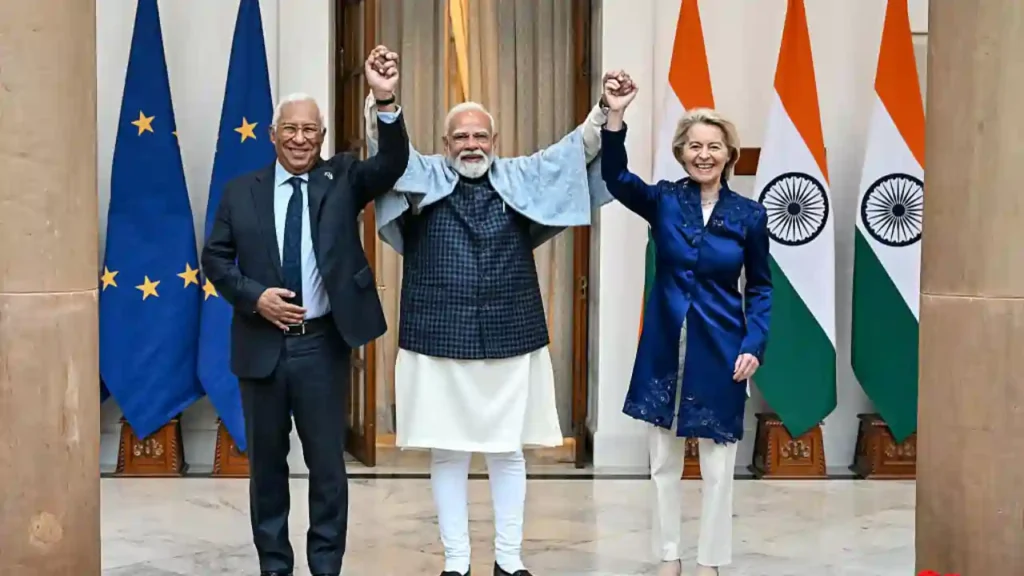
Prime Minister Narendra Modi described the deal as “India’s biggest free trade agreement ever,” calling it a “new blueprint for shared prosperity” that will boost manufacturing, services exports, job creation, and investor confidence worldwide. European Commission President Ursula von der Leyen echoed the sentiment, declaring: “We delivered the mother of all deals. We are creating a market of two billion people… a strong message that cooperation is the best answer to global challenges.”
The signing ceremony took place at Hyderabad House, with Commerce and Industry Minister Piyush Goyal and European Commissioner for Trade and Economic Security Maroš Šefčovič exchanging documents in the presence of PM Modi, von der Leyen, and European Council President António Luís Santos da Costa.
Sweeping Tariff Reductions and Market Access Breakthroughs
Under the agreement, the EU will provide India preferential access to 97% of its tariff lines, covering 99.5% of trade value. More than 99% of Indian exports will benefit from concessional or zero-duty entry. Key highlights include:
- Immediate zero-duty access for major labor-intensive sectors such as textiles, leather goods, footwear, gems and jewellery, marine products, apparel, handicrafts, and chemicals.
- Potential export gains of up to $33 billion in these labor-intensive categories on day one of implementation.
- Calibrated, quota-based liberalization for automobiles and certain steel products, shielding sensitive domestic sectors.
- Safeguards and phased liberalization retained for highly sensitive agricultural items including dairy, cereals, poultry, soymeal, and select fruits and vegetables to protect rural livelihoods and farmers.
In return, India has offered duty concessions on 97.5% of EU exports by trade value. The EU will enjoy:
- Duty elimination on 90% of its goods from the first day, with an additional 3% phased out over seven years.
- Gradual tariff reductions on premium European automobiles (potentially to 40% with annual quotas), luxury wines (from 150% to 20% for higher-value products), spirits, beer, olive oil, fruit juices, processed foods, machinery, chemicals, pharmaceuticals, electrical equipment, aircraft, and spacecraft.
Indian consumers stand to benefit from lower prices on high-end European cars (BMW, Mercedes-Benz, Porsche, Audi, Lamborghini), fine wines, and advanced industrial goods, while European consumers gain greater access to competitively priced Indian textiles, jewellery, spices, tea, coffee, and processed foods.
Services, Financial Sector, and Mobility Framework
The FTA goes far beyond goods, delivering robust gains in services trade—already valued at $83 billion in 2024. India secures stable, predictable access to 144 EU service sub-sectors, including IT and ITeS, education, research and development, professional services, and digitally delivered services. The EU gains access to 102 sub-sectors offered by India.
A dedicated Financial Services Annex—finalized in early January 2026—marks a major advancement over existing GATS commitments, featuring 16 forward-looking articles. Key provisions include:
- Enhanced collaboration on electronic payments, real-time cross-border transaction infrastructure, and interoperability—directly supporting India’s UPI ecosystem, diaspora remittances, and opportunities for Indian payment providers in Europe.
- Structured cooperation in fintech innovation, including SupTech, RegTech, Central Bank Digital Currencies (CBDC), and new business models.
- Non-discrimination guarantees ensuring Indian banks, insurers, and financial institutions receive parity in credit rating and regulatory treatment.
- Liberalized market access: India raises foreign direct investment caps to 74% in banking and permits EU banks to open up to 15 branches over four years (previously limited to 12 under GATS). The EU reciprocates with expanded opportunities for Indian financial service providers.
A comprehensive mobility framework eases temporary business travel, short-term assignments, and intra-corporate transferees (ICT), including dependent family rights. Commitments cover contractual service suppliers (37 sectors) and independent professionals (17 sectors). India also obtained provisions allowing practitioners of traditional Indian medicine to work in unregulated EU member states under their home title, along with a five-year roadmap for bilateral social security agreements.
Strategic, Defence, Technology, and Climate Partnerships
The summit produced several parallel breakthroughs:
- Adoption of a Joint India-EU Comprehensive Strategic Agenda to 2030 covering prosperity, sustainability, technology, innovation, security, defence, connectivity, and global challenges.
- Launch of a Security and Defence Partnership, including negotiations for a Security of Information Agreement to enable exchange of classified information.
- Commitment to co-development and co-production in defence, joint naval exercises to combat piracy, and Indian participation in the EU’s SAFE (Security Action for Europe) programme.
- Establishment of EU-India Innovation Hubs and a Startup Partnership to foster collaboration in emerging and critical technologies.
- Formation of a Green Hydrogen Task Force within the existing Clean Energy and Climate Partnership.
- Renewal of the India-EU Scientific and Technological Cooperation Agreement (2025–2030) and initiation of talks for India’s association with Horizon Europe, the EU’s flagship research programme.
Economic and Geopolitical Context
Bilateral goods trade reached $136.53 billion in 2024–25, with the EU remaining India’s largest trading partner. The agreement arrives amid global trade turbulence, including elevated U.S. tariffs, and is seen as a strategic hedge for both sides. Industry leaders, including the India Cellular and Electronics Association (ICEA), project that the FTA could help India build electronics exports worth nearly $50 billion by 2031, while promoting inclusive growth across regions and skill levels.
Commerce Minister Piyush Goyal emphasized that the deal complements India’s recent FTAs with the UK, EFTA, Oman, New Zealand, and Australia, reinforcing New Delhi’s pivot toward export-led integration into global value chains.
Formal signing is expected after legal vetting and parliamentary approvals on both sides, with implementation likely within calendar year 2026. Once in force, the India-EU FTA is poised to reshape supply chains, accelerate innovation, create millions of jobs, and send a powerful message in favor of rules-based trade cooperation in an increasingly fragmented world.
FAQs
1. What is the India-EU Free Trade Agreement and when was it finalized?
The India-EU FTA is a comprehensive bilateral trade pact between India and the 27-nation European Union that significantly reduces or eliminates tariffs on most goods and services, improves market access, and strengthens cooperation in services, investment, mobility, fintech, defence, and technology. Negotiations concluded on January 27, 2026, during the India-EU Summit in New Delhi, after nearly two decades of talks (launched in 2007, relaunched in 2022). Leaders called it the “mother of all deals,” creating a market of nearly 2 billion people.
2. What are the major benefits for India from this FTA?
India gains preferential/zero-duty access to over 99% of its exports to the EU by value (covering 99.5% of trade value). Key labor-intensive sectors—textiles, leather, footwear, gems & jewellery, apparel, marine products, handicrafts—get immediate zero-duty entry, potentially boosting $33 billion in exports. Services exporters (IT, professional services, education) secure stable access to 144 EU sub-sectors. Indian banks and fintech firms benefit from better market access, non-discrimination, and collaboration on UPI-style payments and fintech innovation. Mobility rules ease temporary business travel and intra-corporate transfers for professionals.
3. What does the EU gain from the agreement?
The EU secures duty concessions on 97.5% of its exports to India by trade value, with 90% of goods seeing duty elimination or reduction from day one (phased for the rest). European luxury cars, wines (duties cut from 150% to 20% for premium varieties), spirits, beer, olive oil, machinery, chemicals, pharmaceuticals, aircraft, and processed foods become significantly cheaper in India. EU financial institutions gain higher FDI limits (up to 74% in banking), permission for more bank branches, and expanded access to India’s fast-growing services market.
4. Which sensitive sectors are protected in the FTA?
India has carefully safeguarded sensitive agricultural and rural sectors through exclusions, phased liberalization, or quotas. Protected areas include dairy, cereals, poultry, soymeal, and certain fruits and vegetables to shield farmers and domestic livelihoods. The EU also retains safeguards on select sensitive items. Automobiles and steel receive calibrated quota-based liberalization rather than full immediate duty elimination on both sides.
5. When will the India-EU FTA come into effect and what else was agreed at the summit?
The agreement is expected to enter into force within calendar year 2026 after legal scrubbing, translation, and approvals by the European Parliament, EU member states, and Indian authorities. Beyond trade, the summit launched: a Security and Defence Partnership (including classified information exchange and co-production), EU-India Innovation Hubs and Startup Partnership, a Green Hydrogen Task Force, renewal of scientific cooperation (2025–2030), and talks for India’s association with Horizon Europe. A Joint Comprehensive Strategic Agenda to 2030 was also adopted, covering technology, sustainability, security, and global issues.