

New Delhi: The World Trade Organization’s 14th Ministerial Conference (MC14), the highest decision-making body of the global trade body that convenes every two years to shape international trade rules, wrapped up on Monday after stretching into the early hours without resolving several critical outstanding matters. Held in the capital of Cameroon from March 26 to March 30, 2026, the four-day gathering of nearly 2,000 trade officials, including more than 90 trade ministers, marked only the second time the Ministerial Conference has taken place on African soil, following MC10 in Nairobi in 2015.
While ministers secured limited advancements on integrating small economies, strengthening special and differential treatment provisions, and continuing fisheries subsidies talks, deep divisions prevented agreement on extending the long-standing moratorium on customs duties for electronic transmissions and on incorporating the Investment Facilitation for Development (IFD) agreement into the WTO framework. Cameroon’s Minister of Trade, Luc Magloire Mbarga Atangana, who chaired the conference, acknowledged that negotiators “ran out of time” on pivotal issues such as the WTO’s work programme on electronic commerce and the continuation of existing moratoriums on customs duties for electronic transmissions as well as non-violation complaints under the Trade-Related Aspects of Intellectual Property Rights (TRIPS) Agreement. Discussions on these unresolved topics will now resume in Geneva at the WTO headquarters during the next General Council meeting.
WTO Director-General Ngozi Okonjo-Iweala welcomed incremental progress on advancing a work programme for WTO reform discussions, further disciplines on harmful fisheries subsidies, and other negotiating areas. She urged members to build on the draft texts developed during the ministerial sessions to finalise agreements in Geneva. However, the lack of concrete outcomes on core files has raised fresh questions about the WTO’s effectiveness in a geopolitically fractured world.
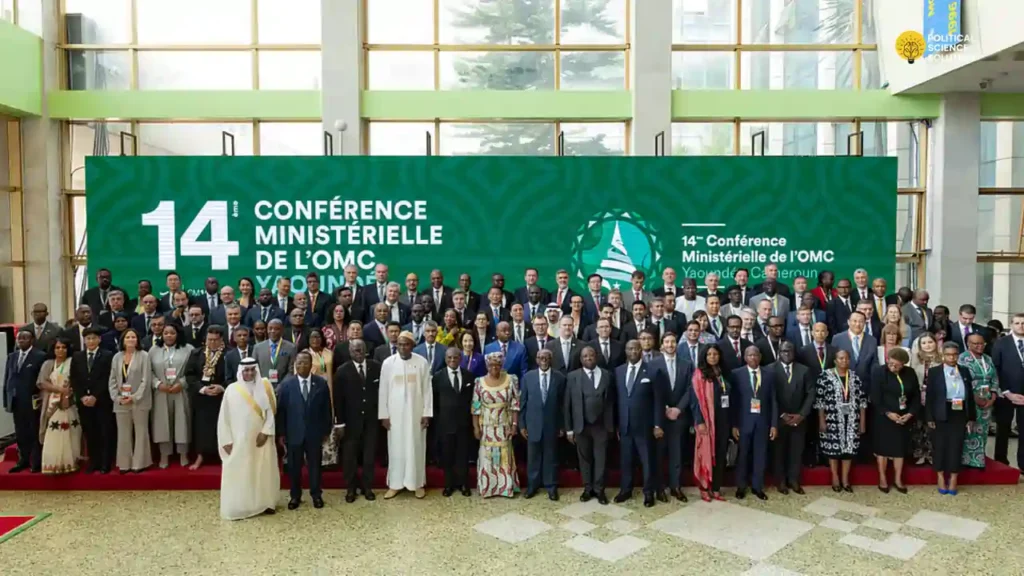
Key Decisions Secured at MC14 Despite Limited Scope
Ministers did reach consensus on a handful of forward-looking measures aimed at supporting vulnerable participants in the global trading system. They agreed to enhance the integration of small economies into the multilateral trading framework, recognising the unique challenges these nations face in competing on the world stage. Additionally, members committed to bolstering the implementation of Special and Differential Treatment (S&DT) provisions within two cornerstone WTO agreements: the Agreement on Sanitary and Phytosanitary Measures (SPS) and the Agreement on Technical Barriers to Trade (TBT).
The SPS Agreement establishes fundamental rules governing food safety as well as animal and plant health standards. These sanitary measures address human and animal health concerns, while phytosanitary measures focus on plant health. Importantly, such standards apply equally to food, animals, and plants produced domestically or affected by local diseases, as well as to imported products from other WTO members. The TBT Agreement, meanwhile, seeks to guarantee that technical regulations, standards, and conformity assessment procedures remain non-discriminatory and do not impose unnecessary obstacles to international trade.
On the fisheries subsidies front, ministers decided to sustain ongoing negotiations with the goal of developing comprehensive disciplines ahead of the 15th Ministerial Conference (MC15). This decision comes despite strong resistance from India, which highlighted potential annual revenue losses of approximately $1 billion for developing countries and argued that the proposed framework exhibits a clear bias toward developed nations with large industrial fishing fleets.
Separately, the conference addressed the Investment Facilitation for Development (IFD) proposal. The IFD, grounded in the Most-Favoured-Nation (MFN) principle, seeks to streamline the flow of foreign direct investment (FDI) among participating parties and remains open for any WTO member to join. India, however, firmly opposed embedding the IFD within the WTO structure, contending that it could undermine the organisation’s established functional boundaries and its longstanding tradition of consensus-based decision-making.
E-Commerce Moratorium: Historic Lapse After 26 Years Triggers New Tariff Possibilities
The most prominent impasse at MC14 centred on the extension of the e-commerce moratorium, a temporary pact first established in May 1998 under which WTO members agreed not to impose customs duties on electronic transmissions. Initially set for two years, the moratorium has been renewed biennially at every subsequent ministerial conference. Its scheduled expiry on March 31, 2026, alongside the parallel moratorium on non-violation complaints under the TRIPS Agreement, has now become reality following the failure to secure consensus.
The deadlock pitted the United States, which advocated for a five-year or even permanent extension, against Brazil, which insisted on limiting any renewal to roughly two years. While India had initially opposed any extension whatsoever, it later indicated willingness to explore a compromise. Ultimately, the irreconcilable positions between Washington and Brasília prevented closure. The WTO defines e-commerce broadly as the production, distribution, marketing, sale, or delivery of goods and services by electronic means. In practice, this covers digital downloads, streaming services, cloud computing, and data-based offerings that have increasingly replaced physical formats such as CDs, DVDs, and printed books.
Think tank Global Trade Research Initiative (GTRI) noted that the United States, backed by the European Union and Japan, pushed aggressively for a long-term or permanent extension, while India and other developing countries resisted, warning that it would permanently lock in substantial revenue losses and curtail policy space in the booming digital economy. With no agreement reached, the moratorium lapsed for the first time in 26 years, clearing the path for any member to introduce customs or import duties on electronic transmissions.
Revenue implications are significant. Estimates suggest developing countries collectively stand to lose around $10 billion in potential tariff revenue annually, with India facing losses exceeding $500 million each year from untaxed digital imports such as movies, music, video games, and electronic printed matter. GTRI Founder Ajay Shrivastava emphasised that the primary beneficiaries of the duty-free regime have been major US technology firms including Google and Meta. The expiry also removes developing countries’ ability to regulate surging digital imports and harness additional tariff income as revenues of global digital platforms continue to climb.
Compounding the setback, the simultaneous lapse of the TRIPS non-violation complaint moratorium removes a vital safeguard that developing nations have relied upon since 1995 to protect domestic policy flexibility, particularly in public health. Without this protection, even WTO-consistent measures—such as compulsory licensing of medicines—could now face legal challenges from developed countries claiming undermined commercial expectations. For India, this heightens vulnerability around its intellectual property regime, including Section 3(d) of the Patents Act, 1970, which prevents the grant of patents on known drugs unless new claims demonstrate significantly enhanced efficacy, thereby curbing patent evergreening practices.
WTO Reform, Investment Facilitation, Agriculture, and Fisheries: Persistent Divides
Reform of the WTO itself occupied centre stage during the first two days of MC14 through thematic discussions. A draft Yaoundé Ministerial Declaration on WTO Reform was circulated on March 28, focusing on three pillars: decision-making processes, development concerns including S&DT, and ensuring a level playing field. The text defers detailed action-oriented recommendations until MC15. Consultations on the dispute settlement system will continue, yet no convergence has emerged.
India, South Africa, and Oman mounted notable pushback against the current reform trajectory, issuing a joint communication that demanded a more inclusive, member-driven approach. They insisted that any reform facilitator be appointed by the full General Council following comprehensive consultations rather than through restricted channels, and stressed the need for open-ended negotiating formats to avoid marginalising developing countries via small-group meetings.
The proposal to integrate the China-led Investment Facilitation for Development Agreement as an Annex 4 plurilateral accord—binding solely on those members that accept it—also stalled. India reiterated its position that investment matters lie outside the WTO’s core trade mandate. Critics warned that incorporating such plurilateral deals risks normalising rule-making that bypasses broad consensus and gradually expands the organisation’s scope without universal buy-in.
Agriculture negotiations exposed another fault line, with the United States and Brazil clashing over domestic support levels and market access. Brazil explicitly linked advancements on e-commerce to movement on agricultural files, further complicating the agenda.
On fisheries subsidies, India advocated strongly for a 25-year transition period for developing countries, stricter disciplines on distant-water industrial fishing fleets, and permanent safeguards for subsidies supporting small-scale and artisanal fishers who rely on the sector for livelihoods. These negotiations will now proceed in Geneva using the draft text prepared in Yaoundé, with the aim of delivering recommendations to MC15.
Emerging Trade-Climate Interface Gains Traction
Beyond traditional trade files, MC14 provided space for advancing the trade-climate agenda. On the opening day, members received briefings on the Integrated Forum on Climate Change and Trade (IFCCT), launched by Brazil at COP30 in partnership with Australia. The forum will convene its inaugural meeting in Bonn in June 2026 to launch a three-year work programme.
The Coalition of Trade Ministers on Climate, established in 2023 and co-led by Ecuador, the European Union, Kenya, and New Zealand, adopted a communiqué outlining a menu of voluntary actions to steer future work at the trade-climate nexus. Separately, 48 WTO members reaffirmed their commitment to reforming fossil fuel subsidies, focusing on improved transparency and principles to ensure that any energy crisis-related support remains transparent, targeted, and temporary.
Parallel to the official sessions, the International Institute for Sustainable Development’s trade and sustainability hub facilitated side discussions on navigating unilateral climate-related trade measures and accelerating the diffusion of green technologies.
US Stance, Geopolitical Fractures, and Outlook for Geneva
Analysts describe the MC14 outcome as emblematic of Washington’s mounting impatience with a multilateral system it perceives as increasingly resistant to its priorities. The United States showed readiness to press the WTO toward outcomes aligned with its interests while signalling openness to alternatives beyond the institution. Broader concerns about the WTO’s relevance in an era of geopolitical fragmentation were underscored by the absence of breakthroughs on reform, e-commerce, and agriculture.
With talks shifting back to Geneva, members will attempt to bridge these entrenched divides using the ministerial draft texts as a foundation. Whether the organisation can regain momentum ahead of MC15 remains an open question, particularly as developing countries continue to defend policy space, consensus-based decision-making, and equitable integration into global value chains.
The Yaoundé conference, though short on headline-grabbing deals, has nevertheless crystallised the fault lines shaping 21st-century trade governance—from digital economy taxation and fisheries sustainability to climate linkages and institutional reform. As negotiators reconvene in Switzerland, the stakes for the multilateral trading system have seldom been higher.
FAQs
1. What was the main outcome of the WTO MC14 Ministerial Conference held in Yaoundé, Cameroon?
The 14th WTO Ministerial Conference (MC14) concluded on March 30, 2026, without consensus on extending the e-commerce moratorium. Talks on several key issues including WTO reform and Investment Facilitation for Development (IFD) also failed to reach agreement and will resume in Geneva.
2. Why did the e-commerce moratorium lapse after 26 years at MC14?
The moratorium on customs duties on electronic transmissions lapsed because the US pushed for a five-year or permanent extension while Brazil insisted on only a two-year renewal. India and other developing countries opposed a long-term extension citing revenue losses and limited policy space. No compromise was reached.
3. What are the implications of the e-commerce moratorium expiry for India and developing countries?
The expiry allows countries to impose customs duties on digital downloads, streaming, and electronic transmissions. India could potentially gain over $500 million annually in tariff revenue, while developing countries collectively may recover around $10 billion. It also ends the TRIPS non-violation complaint moratorium, increasing risks to public health policies like compulsory licensing.
4. What decisions were successfully adopted at the WTO MC14 in Yaoundé?
Ministers agreed to improve integration of small economies into global trade, strengthen Special & Differential Treatment (S&DT) in SPS and TBT agreements, and continue negotiations on fisheries subsidies aiming for outcomes by MC15.
5. What is India’s stand on key issues at the WTO MC14 conference?
India opposed the extension of the e-commerce moratorium due to revenue losses, resisted incorporating the Investment Facilitation for Development (IFD) agreement, demanded a 25-year transition period and stronger disciplines on distant-water fishing in the fisheries subsidies talks, and pushed for an inclusive, consensus-based approach to WTO reforms.