

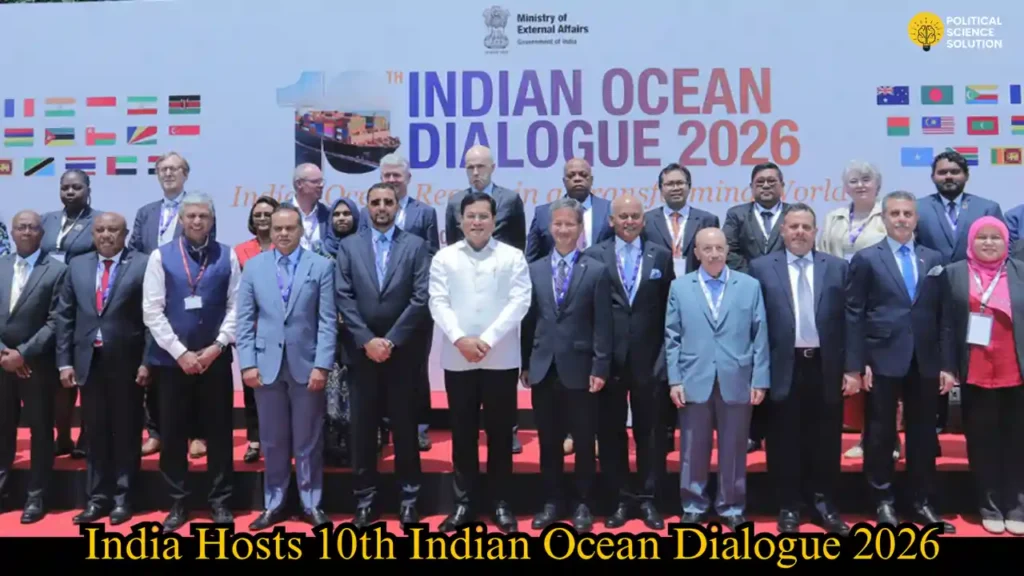
New Delhi: As geopolitical fault lines deepen across strategic waterways, India has positioned itself at the forefront of regional maritime cooperation. The 10th edition of the Indian Ocean Dialogue (IOD), hosted under the Indian Ocean Rim Association (IORA), concluded in the national capital on May 8, 2026, bringing together ministers, diplomats, naval experts, and policymakers from across the littoral states. Held under the theme “Indian Ocean Region in a Transforming World,” the high-level Track 1.5 platform underscored India’s leadership as IORA Chair for 2025-27 and highlighted urgent priorities including maritime security, blue economy development, innovation, and resilience.
This gathering arrives at a pivotal moment. Escalating instability in West Asia, repeated attacks on commercial shipping, and major disruptions in critical sea lanes have thrust maritime security into the spotlight as both an economic imperative and a strategic necessity for nations dependent on the Indian Ocean.
Understanding IORA: A Platform for 23 Nations United by the Ocean
The Indian Ocean Rim Association, established in 1997, emerged from a shared vision articulated by Nelson Mandela during his 1995 visit to India. Initially conceptualized as the Indian Ocean Rim Initiative, it evolved into its current form as an intergovernmental body focused on economic cooperation and sustainable development. With its Secretariat in Ebène, Mauritius, IORA now includes 23 member states — such as India, Australia, Bangladesh, Indonesia, Kenya, France, the UAE, South Africa, and Sri Lanka — along with 12 Dialogue Partners.
India currently holds the Chairship until 2027, coinciding with the grouping’s 30th anniversary summit. The Council of Ministers serves as the apex decision-making body, meeting annually to guide priorities. For New Delhi, IORA offers a unique multilateral forum distinct from SAARC, BIMSTEC, or the Quad, enabling engagement across East Africa, the Arabian Peninsula, South Asia, Southeast Asia, and Australia under one umbrella.
The association serves multiple strategic purposes for India. It provides a legitimate platform to project its role as a net security provider in the Indian Ocean, counterbalance external influences through cooperative rather than transactional frameworks, and advance energy and trade security. It also supports blue economy initiatives, disaster diplomacy, and cultural exchanges rooted in shared civilizational ties.
Core Areas of Cooperation Under IORA Framework
Participants at the 10th IOD deliberated extensively on IORA’s priority sectors. Maritime safety and security topped discussions, focusing on collective responses to piracy, human trafficking, maritime crimes, and hybrid threats. Trade and investment facilitation aimed at boosting regional commerce and connectivity, while the blue economy agenda emphasized sustainable fisheries, marine resource management, and ocean-based industries.
Disaster risk management received significant attention, given the region’s vulnerability to cyclones, tsunamis, and coastal hazards. Tourism and cultural exchanges were promoted to strengthen people-to-people linkages. A notable cross-cutting priority under India’s chairship is women’s economic empowerment, aligning with broader goals of inclusive growth.
Union Minister for Ports, Shipping and Waterways Sarbananda Sonowal highlighted India’s progress in this area during his keynote address. He noted that women’s participation in the country’s maritime sector has surged by 340% since 2020, crediting initiatives like “Sagar Mein Samman” for advancing dignity, inclusion, and leadership opportunities. Sonowal was joined by Mauritius Minister of Regional Integration and International Trade Dhananjay Ramful and Yemen’s Minister of State Waleed Mohammed Al Qadimi.
Why Maritime Security Dominates the Indian Ocean Agenda
The Indian Ocean, covering nearly one-fifth of the world’s oceanic area, serves as a vital lifeline for billions. Home to approximately 2.7 billion people — nearly one-third of humanity — the region facilitates extraordinary levels of global trade and energy flows. More than 90% of India’s trade by volume and 68% by value moves via maritime routes, while the country imports around 85% of its crude oil, much of it transiting through these waters. Globally, the Indian Ocean handles roughly 25% of maritime oil trade and about 80% of seaborne oil passing through major chokepoints like the Strait of Hormuz, Bab-el-Mandeb, and Malacca Strait.
Undersea fibre-optic cables carrying over 90% of global internet traffic further amplify the ocean’s strategic importance. Any disruption here ripples across economies, supply chains, and digital infrastructure worldwide.
Recent events have amplified these vulnerabilities. The ongoing West Asian conflict has severely impacted shipping patterns. Attacks in the Red Sea prompted major carriers like Maersk to reroute vessels around Africa’s Cape of Good Hope, adding up to 3,500 nautical miles and 10-14 days to journeys. In a notable escalation, the United States sank the Iranian frigate IRIS Dena near Sri Lanka in March 2026, demonstrating how tensions can extend far beyond traditional conflict zones.
The Strait of Hormuz faced direct threats, with disruptions from February 28, 2026, affecting 20% of global oil supplies. Brent crude prices surged 10-13% to over $80-$82 per barrel, raising fears of $100 peaks and broader inflationary pressures, as warned by analysts at J.P. Morgan and the IMF. War-risk insurance premiums for vessels in the area jumped dramatically from 0.2% to as high as 3% of a ship’s value, imposing massive additional costs on operators. Freight rates on Asia-Europe routes remained 25-40% higher than pre-crisis levels into April 2026.
Supply chain impacts extend beyond energy. The strait handles one-third of global seaborne fertilizer trade, and disruptions have threatened agricultural productivity and food security across Indian Ocean nations. Rerouting has also strained global container fleet capacity by 5-7%, causing equipment shortages even on unaffected routes. Humanitarian consequences include restricted fishing activities, affecting coastal livelihoods and regional food security.
In response, India unveiled its Indian Navy Maritime Security Strategy 2026 (INMSS-2026), shifting towards a more proactive stance focused on protecting undersea infrastructure and countering hybrid threats.
Challenges Hindering Effective Regional Cooperation
Despite its potential, IORA faces structural limitations. As a consensus-based body, it lacks strong enforcement mechanisms compared to more integrated organizations like ASEAN. Geopolitical rivalries among member states often impede consensus, while the grouping’s primarily consultative nature limits its security role. Unequal economic priorities among diverse members — from advanced economies like Australia and Singapore to smaller island nations — create uneven benefits.
Fragmented regionalism poses another hurdle, with overlapping mandates from BIMSTEC, ASEAN, Quad, and the Indian Ocean Naval Symposium (IONS) diluting focus. Pakistan’s earlier membership bid was denied due to concerns over sovereign equality principles, reflecting underlying bilateral tensions. Additionally, IORA’s charter excludes bilateral disputes, constraining its ability to directly address conflicts driving current maritime instability.
India’s Strategic Maritime Vision: From SAGAR to MAHASAGAR
India’s approach integrates multiple policy frameworks. The SAGAR doctrine — Security and Growth for All in the Region — emphasizes cooperative security and regional stability. Building on this, the MAHASAGAR vision advances mutual and holistic advancement across security, economic, climate, and developmental domains. These align with the Act East Policy for enhanced eastern connectivity and broader Indo-Pacific engagement.
India’s 7,500 km coastline and strategic island territories, including the Andaman and Nicobar Islands near the Malacca Strait, provide natural advantages. Historical experiences, such as its swift response to the 2004 Indian Ocean tsunami that aided multiple neighboring countries, have solidified its image as a first responder. Naval exercises like MILAN and bilateral partnerships further strengthen these ties.
At the Dialogue, Secretary (East) P. Kumaran and other officials reiterated India’s commitment to innovation, openness, resilience, and adaptability. Former Maldives President Mohamed Nasheed addressed participants, while discussions covered digital connectivity, trade, maritime governance, and humanitarian assistance.
Path Forward: Concrete Measures for a Secure and Sustainable Indian Ocean
Delegates emphasized several actionable steps. Enhancing Maritime Domain Awareness through expanded satellite surveillance, information-sharing via mechanisms like the Information Fusion Centre-Indian Ocean Region (IFC-IOR), and systems such as MANTRA is critical. Naval cooperation, including coordinated patrols and joint exercises, needs deepening.
Economic resilience requires diversifying supply chains and shipping routes. Institutional strengthening of IORA, potentially through increased budgets, public-private partnerships, and an expanded operational mandate, was recommended. Sustainable blue economy governance, including standards for fisheries and marine pollution, alongside academic collaborations for building maritime human capital, will support long-term goals.
India has pledged to boost IORA’s capacity, particularly in maritime sectors like shipping, energy, and tourism. The IORA Blue Carbon Hub, managed by Australia’s CSIRO, offers a replicable model.
The Broader Geopolitical Context: Rivalry and Shared Opportunities
The Indian Ocean has become a theater where great power competition intersects with cooperative possibilities. China’s expanding naval presence and infrastructure projects across littoral states add complexity, though China participates only as a Dialogue Partner. Non-traditional threats — piracy, illegal unreported unregulated (IUU) fishing, trafficking, maritime terrorism, and climate impacts — demand collective action beyond any single nation’s capacity.
The Dialogue, which originated from the 2013 Perth meeting and produced the 2014 Kochi Consensus, continues to evolve as a flexible platform for open exchange among diverse political systems. It avoids rigid alliances while addressing shared vulnerabilities in an ocean that functions as the “bloodstream of globalisation.”
Conclusion: India’s Leadership in Shaping a Stable Maritime Future
Maritime security in the Indian Ocean Region has transcended traditional naval domains to become a multifaceted challenge encompassing economics, geopolitics, climate resilience, and human security. The 10th Indian Ocean Dialogue demonstrated a clear recognition among participants that stability in these waters directly influences global trade, energy security, food prices, and digital connectivity.
Through its stewardship of IORA and visionary frameworks like SAGAR and MAHASAGAR, India is actively shaping an inclusive, rules-based order grounded in international law, transparency, and mutual benefit. As Union Minister Sarbananda Sonowal affirmed, India remains committed to collaborating with all partners for a safe, secure, and stable Indian Ocean Region.
The success of these efforts will depend on sustained political trust, enhanced institutional capabilities, and collective responsibility. For India and its IORA partners, the Indian Ocean represents not just a geographic expanse but a shared destiny — one that demands proactive diplomacy today to secure prosperity tomorrow.
FAQs
Q1. What is the Indian Ocean Dialogue (IOD) and why was the 10th edition held in New Delhi in May 2026?
The Indian Ocean Dialogue is the flagship Track 1.5 platform of the Indian Ocean Rim Association (IORA). The 10th edition was hosted by India in New Delhi on May 7-8, 2026, under the theme “Indian Ocean Region in a Transforming World.” As the current Chair of IORA (2025-27), India used the platform to highlight priorities such as maritime security, blue economy, innovation, resilience, and women’s economic empowerment under its MAHASAGAR vision. The timing was significant due to escalating West Asia conflicts, Red Sea disruptions, and threats to critical sea lanes like the Strait of Hormuz.
Q2. What is IORA and why is it important for India?
The Indian Ocean Rim Association (IORA) is an intergovernmental organisation established in 1997 with 23 member states and 12 Dialogue Partners. It focuses on economic cooperation, maritime safety, blue economy, disaster risk management, and sustainable development. For India, IORA serves as a key platform to assert its role as a net security provider, advance the SAGAR and MAHASAGAR doctrines, counterbalance external influences, secure energy and trade routes, and promote inclusive regional cooperation across East Africa, South Asia, Southeast Asia, and Australia — distinct from other groupings like QUAD or BIMSTEC.
Q3. Why has maritime security become a major concern in the Indian Ocean Region?
Maritime security is critical because the Indian Ocean handles nearly 25% of global maritime oil trade, over 90% of India’s trade by volume, and 85% of its crude oil imports. Strategic chokepoints such as the Strait of Hormuz, Bab-el-Mandeb, and Malacca Strait are highly vulnerable. Recent West Asian conflicts have caused Red Sea rerouting (adding 10-14 days and thousands of nautical miles), surged oil prices to over $80-82 per barrel, increased insurance premiums dramatically, disrupted fertilizer supplies, and affected global supply chains. The sinking of the Iranian frigate IRIS Dena near Sri Lanka in March 2026 further highlighted how tensions can spill over across the region.
Q4. What are India’s key maritime initiatives and strategies discussed at the 10th IOD?
India emphasised the SAGAR doctrine (Security and Growth for All in the Region) and the newer MAHASAGAR vision (Mutual and Holistic Advancement for Security and Growth Across Regions). Other initiatives include the Indian Navy Maritime Security Strategy 2026 (INMSS-2026), enhanced Maritime Domain Awareness, naval exercises like MILAN, humanitarian assistance leadership (as seen in the 2004 tsunami), and women’s empowerment in the maritime sector (which grew 340% since 2020 through initiatives like Sagar Mein Samman). India also focuses on blue economy governance, disaster preparedness, and strengthening IORA’s institutional capacity.
Q5. What challenges does IORA face and what measures were suggested to strengthen maritime security?
Major challenges include institutional weaknesses (lack of enforcement), geopolitical rivalries, overlapping regional organisations, unequal development levels among members, and a limited security mandate. Suggested measures include expanding Maritime Domain Awareness through satellite surveillance and information-sharing (e.g., IFC-IOR), deeper naval cooperation and joint exercises, supply chain diversification, institutional strengthening of IORA, sustainable blue economy standards, and building maritime human capital through academic partnerships. India has pledged increased support via public-private partnerships to make IORA more effective.