

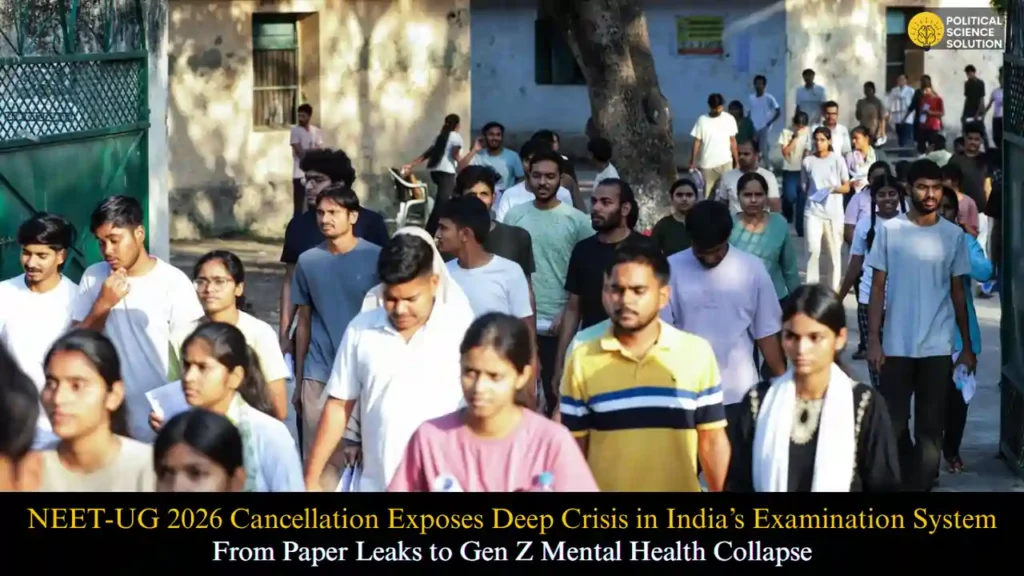
New Delhi: The National Testing Agency’s decision to cancel the NEET-UG 2026 examination has sent shockwaves across India’s education landscape. Conducted on May 3 for over 22 lakh aspiring medical students, the exam was scrapped following serious allegations of paper leaks and widespread malpractices. This marks the first complete cancellation of the country’s largest single-day undergraduate medical entrance test, highlighting systemic vulnerabilities that go far beyond one incident. As India grapples with repeated exam controversies, the episode underscores a broader failure of the examination ecosystem, its impact on millions of Gen Z students, and the urgent need for structural overhaul.
The NEET-UG 2026 Cancellation: What Happened and Why
On May 7, the NTA received reports of a PDF containing alleged NEET-UG questions circulating shortly after the exam. The matter was promptly referred to law enforcement agencies on May 8. Investigations revealed disturbing evidence: a “guess paper” recovered by the Rajasthan Special Operations Group contained around 410 questions, with approximately 120 matching those in the actual examination.
Citing the need to preserve the trust and credibility of the national examination system, the NTA announced the full cancellation. The agency emphasized that inaction could cause greater long-term damage to the integrity of public exams. The re-examination will be conducted without requiring fresh registration or additional fees from candidates. This decisive step comes amid growing public scrutiny, especially after similar controversies in NEET-UG 2024 involving leaks in Jharkhand and Bihar, claims of candidates paying for solved papers, and involvement of centre officials.
The Supreme Court had earlier refused to cancel the 2024 exam, noting that while localized leaks existed, there was no evidence of a systemic breach affecting the entire process. In contrast, the 2026 case prompted a complete reset, reflecting heightened concerns over organized malpractices.
Understanding the National Testing Agency and Its Mandate
Established in 2017 by the Ministry of Education under the Societies Registration Act of 1860, the NTA was created to conduct standardized entrance and recruitment examinations across the country. Its formation aimed to bring professionalism and uniformity to high-stakes testing. However, repeated failures have raised questions about whether the agency’s structure and operational model are equipped to handle the immense scale and expectations placed upon it.
Root Causes Behind the Failure of India’s Exam Ecosystem
The NEET-UG 2026 cancellation is not an isolated event but a symptom of deep-rooted issues plaguing India’s examination system.
Unequal Education Standards Across Boards
A massive gap exists between different educational boards — CBSE, various State Boards, and International Baccalaureate (IB) programmes. This disparity creates an uneven playing field where students from privileged backgrounds or better-resourced schools hold inherent advantages, undermining the principle of merit-based competition.
Persistent Corruption and Paper Leaks
History is littered with major scams, most notably the Vyapam scam in Madhya Pradesh, which exposed deep collusion and compromised the credibility of entire recruitment processes. Such incidents erode public faith and highlight vulnerabilities in question paper handling, storage, and distribution.
Over-Centralization and the “One Nation, One Exam” Approach
Pushing a uniform testing model ignores India’s vast regional, linguistic, and educational diversity. The intense pressure on a single exam day for life-altering outcomes amplifies risks and leaves little room for error or accommodation of varied student backgrounds.
Weak Cybersecurity and Technological Gaps
Despite digital advancements, many processes remain susceptible to breaches. Online question papers and related materials are vulnerable to unauthorized access, with inadequate safeguards in place.
Cultural and Social Factors
In certain regions, such as Bihar, there have been reported incidents of mass cheating, pointing to a degree of social acceptance of unfair means in high-stakes examinations. This cultural dimension complicates enforcement efforts and normalization of ethical conduct.
The Human Cost: How India’s Exam System is Breaking Gen Z
Beyond logistical failures, the crisis is devastating an entire generation. Indian youth today navigate one of the world’s most hyper-competitive educational environments, with exams like JEE, NEET, CUET, and UPSC defining their futures through percentiles, ranks, and institutional prestige. Education has shifted from a tool for intellectual growth to a brutal survival mechanism.
Cities like Kota, once symbols of academic excellence, have become synonymous with extreme psychological distress. Thousands of student suicides are reported annually across India, with examination pressure and academic stress frequently cited as key factors. The coaching-industrial complex has turned learning into an exhausting marathon where sleep deprivation is glorified as discipline and burnout mistaken for commitment.
Social media exacerbates the problem. Gen Z, India’s most educated and tech-savvy generation, faces constant algorithmic comparison. Curated success stories create a “culture of perpetual inadequacy,” leaving little space for failure or vulnerability. Family expectations compound the burden, especially for middle-class and lower-income households where a child’s success is tied to collective social mobility. Failure is often internalized not as a setback but as a personal and familial catastrophe.
The neoliberal view of education as a marketplace producing “human capital” further intensifies pressure. Students are pushed toward constant self-optimization through CVs, certifications, and networking, while structural inequalities in access, economic status, and mental health support are overlooked. Institutional responses remain inadequate, with superficial counselling and motivational rhetoric replacing meaningful structural reforms.
This paradox is stark: greater education and awareness have not translated into psychological security or guaranteed opportunities. Degrees no longer ensure jobs, financial independence, or social mobility in an uncertain economy, trapping young people in cycles of anxiety and self-surveillance.
Ethical Dimensions of the Exam System Failure
The repeated breakdowns raise profound ethical questions:
- Fairness and Integrity: Unequal opportunities compromise transparency and accountability, violating the principle of equal chance.
- Deontological Ethics: Cheating for better results prioritizes ends over moral means.
- Virtue Ethics: Acts of deception undermine virtues like honesty, trust, and character excellence.
- Equity: Disadvantaged students suffer disproportionately, affecting their liberty and right to fair access to opportunities.
Legal Framework and Recent Measures
To combat these issues, the government enacted the Public Examination (Prevention of Unfair Means) Act, 2024. The legislation targets leaks, individual malpractices, and organized fraud in recruitment and entrance exams. Complementing rules published under the Act mandate that venue-in-charge officials file FIRs in cases of malpractice. Probe committees are also required to investigate potential involvement of management or service providers.
Despite these provisions, implementation challenges persist, as evidenced by the 2026 leak.
Structural Challenges and Past Controversies
NEET-UG’s massive scale — nearly 25 lakh candidates in a single day and single shift — creates inherent logistical vulnerabilities in transportation, coordination, and security. Continued reliance on pen-and-paper testing (PPT) heightens risks: physical movement of papers involves multiple intermediaries, enabling local collusion.
Previous incidents, including the 2015 AIPMT cancellation ordered by the Supreme Court due to electronic cheating devices, underscore long-standing issues. Following the 2024 controversies, the Union Government formed a high-level committee headed by former ISRO Chairman K. Radhakrishshan. Its key recommendations remain largely unimplemented.
K. Radhakrishnan Committee Recommendations
The committee advocated a gradual transition to Computer-Based Testing (CBT) conducted across multiple shifts to minimize physical handling risks. It proposed encrypted digital delivery of papers with local printing at centres shortly before exams, multi-session testing to reduce pressure, enhanced coordination with local police and administration, GPS tracking, and centralized CCTV surveillance.
Challenges in Implementation
The primary hurdle is “normalisation” — statistically adjusting scores to account for varying difficulty levels across shifts. With potentially 15+ shifts needed for 25 lakh candidates, concerns over fairness could spark litigation. Judicial observations in related cases have also highlighted these complexities.
Steps Taken by NTA and Persistent Gaps
Post-2024, the NTA introduced Aadhaar-based biometrics, GPS-enabled transport, police escorts, centralized CCTV, district administration coordination, and security drills. While helpful, these measures proved insufficient to prevent the 2026 breach, indicating the need for more robust, technology-driven solutions.
The Way Forward: Comprehensive Reforms Needed
Restoring credibility demands more than reactive measures. Experts call for:
- Phased implementation of secure CBT infrastructure.
- A transparent, publicly audited normalisation framework.
- Stronger enforcement of the 2024 Act with stringent penalties.
- Creation of an autonomous national examination authority incorporating cybersecurity experts, psychometricians, and academics.
- End-to-end encryption, blockchain audit trails, and AI-driven anomaly detection.
- Expanded mental health support, timely communication during disruptions, and reduced over-reliance on single high-stakes tests.
- Broader public education strengthening and a cultural shift to redefine success beyond ranks and marks.
Society must move away from viewing education as a machinery of fear. Failure should not be equated with moral weakness. Structural reforms addressing inequalities, coaching commercialisation, and economic realities are essential to prevent further alienation of Gen Z.
The NEET-UG 2026 cancellation serves as a critical wake-up call. India’s demographic dividend depends on nurturing capable, resilient youth rather than breaking them under unsustainable pressure. Without decisive, holistic action — technological, administrative, ethical, and societal — the crisis of credibility in the examination system will continue to deepen, with far-reaching consequences for national development.
Frequently Asked Questions (FAQs)
1. Why was the NEET-UG 2026 exam cancelled by NTA?
The NTA cancelled the entire NEET-UG 2026 examination, held on May 3 for over 22 lakh candidates, after credible evidence emerged of a paper leak. Investigations found a “guess paper” containing 410 questions, with around 120 matching the actual exam. This is the first complete cancellation of the country’s largest single-day medical entrance test. The agency took the decision to protect the credibility and integrity of the national examination system.
2. What are the main reasons behind the repeated failure of India’s examination ecosystem?
The key reasons include unequal education standards across CBSE, State Boards, and IB; rampant corruption and paper leaks (such as the Vyapam scam); over-centralization through the “One Nation, One Exam” policy; weak cybersecurity; logistical challenges in conducting massive exams like NEET-UG; and cultural acceptance of cheating in some regions. These issues have severely undermined trust in the system.
2. What are the main reasons behind the repeated failure of India’s examination ecosystem?
The key reasons include unequal education standards across CBSE, State Boards, and IB; rampant corruption and paper leaks (such as the Vyapam scam); over-centralization through the “One Nation, One Exam” policy; weak cybersecurity; logistical challenges in conducting massive exams like NEET-UG; and cultural acceptance of cheating in some regions. These issues have severely undermined trust in the system.
3. How is the NEET-UG exam crisis affecting Gen Z students in India?
The hyper-competitive exam ecosystem (NEET, JEE, CUET, UPSC) has turned education into a high-pressure survival race, leading to widespread anxiety, burnout, and thousands of student suicides annually. Cities like Kota have become symbols of psychological distress. Social media amplifies the pressure through constant comparison, while degrees no longer guarantee jobs or social mobility, leaving Gen Z emotionally drained despite being the most educated generation.
4. What did the K. Radhakrishnan Committee recommend to fix NEET and other exams?
The committee, formed after the 2024 controversies, strongly recommended shifting from pen-and-paper mode to Computer-Based Testing (CBT) in multiple shifts, encrypted digital delivery of question papers, local printing at centres, multi-stage testing, GPS tracking, enhanced police coordination, and robust normalisation procedures. Most recommendations are yet to be fully implemented.
5. What is the Public Examination (Prevention of Unfair Means) Act, 2024 and how does it help?
This central law aims to curb paper leaks, malpractices, and organised cheating in public examinations. It mandates FIRs by venue-in-charge officials and probes into the involvement of management or service providers. The Act, along with its 2024 Rules, seeks to strengthen accountability and deter unfair means, though enforcement challenges remain evident from the NEET-UG 2026 cancellation.