

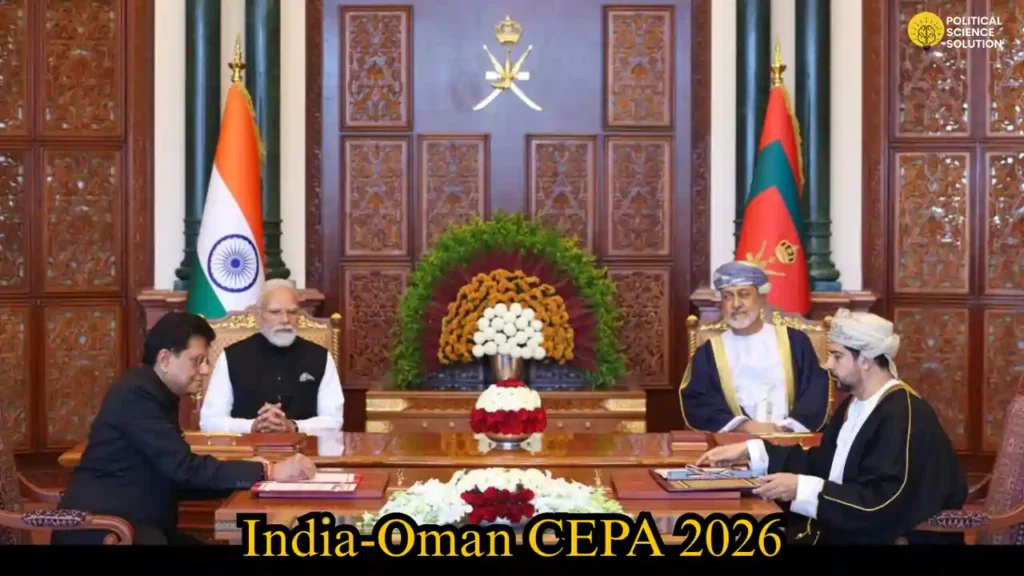
New Delhi: The India-Oman Comprehensive Economic Partnership Agreement (CEPA) officially came into effect on June 1, 2026, ushering in a transformative phase for bilateral economic ties between the two nations. This landmark pact, signed on December 18, 2025, in Muscat in the presence of Prime Minister Narendra Modi and Sultan Haitham bin Tarik Al Said, is set to reshape trade dynamics, investment flows, and regional connectivity across the Gulf and beyond.
With Oman serving as India’s second-largest trading partner in the Gulf region, the agreement promises to elevate the existing USD 11.18 billion bilateral trade volume recorded in FY 2025-26 — a notable increase from USD 10.61 billion in the previous fiscal year. Union Commerce and Industry Minister Piyush Goyal, alongside Oman’s Ambassador to India Issa Saleh Al Shibani, marked the occasion by flagging off the first consignments of agricultural products and gems and jewellery from Mumbai, Kolkata, and Chennai under the new preferential tariff framework.
Comprehensive Market Access: A Game-Changer for Indian Exporters
At the heart of the India-Oman CEPA lies an exceptionally generous offer from Oman, granting immediate zero-duty access to 99.38% of India’s exports by value, covering 98.08% of Oman’s tariff lines. This represents a dramatic improvement over the pre-CEPA Most Favoured Nation (MFN) regime, under which only 15.33% of Indian exports enjoyed duty-free entry.
Oman’s nearly USD 28 billion import market now stands wide open for Indian goods with full tariff elimination effective immediately across key labour-intensive sectors. India has become only the second country after the United States to secure such an ambitious bilateral trade deal with Oman.
In return, India has extended tariff liberalisation on 77.79% of its tariff lines, encompassing 94.81% of imports from Oman by value. However, the agreement carefully shields sensitive domestic sectors through a robust exclusion list and protective mechanisms, demonstrating a balanced approach that prioritises both export growth and food security.
Sectoral Breakthroughs: Agriculture, Marine Products, and Food Processing Lead the Charge
The CEPA delivers substantial gains for India’s agricultural and food export ecosystem. Products including honey, basmati rice, cashew kernels, onions, potatoes, butter, sweet biscuits, and various processed foods will now enter Oman duty-free. India already dominates Oman’s bovine meat imports with over 94% share and fresh egg imports with more than 98% share.
All marine products — shrimp, fish, cuttlefish, and others — receive immediate duty-free access, replacing previous duties of up to 5%. This opens significant opportunities for exporters in coastal states such as Andhra Pradesh, Kerala, Tamil Nadu, and Gujarat. Oman’s marine imports stood at USD 35.3 million in 2025, with Indian exports at USD 10 million, pointing to considerable untapped potential.
Mango exports featuring premium varieties like Alphonso, Kesar, and Dasheri are also positioned for enhanced competitiveness in Gulf markets. Overall, India’s agricultural exports to Oman, which reached USD 552.85 million in 2025 with a 9.13% CAGR, are expected to accelerate further, benefiting farmers, processors, and exporters across Uttar Pradesh, Punjab, Haryana, Maharashtra, Gujarat, Andhra Pradesh, and Tamil Nadu.
Gems and Jewellery: Six-Fold Export Growth on the Horizon
One of the most promising segments under the agreement is gems and jewellery. The complete elimination of import duties of up to 5% provides Indian exporters a decisive price advantage in Oman’s USD 1.07 billion jewellery market.
Indian exports in this category stood at USD 25.78 million in 2025 (comprising USD 18.48 million in polished natural diamonds and USD 6.67 million in gold jewellery). Industry projections indicate a potential six-fold surge to USD 150 million within three years. Manufacturing clusters in Surat, Jaipur, Mumbai, Kolkata, and Chennai are poised to reap major benefits, creating employment opportunities and strengthening India’s global leadership in the sector.
Pharmaceuticals and Engineering Goods: Regulatory Fast-Track and Tariff Certainty
The agreement introduces a groundbreaking fast-track approval mechanism for pharmaceuticals. Medicines and vaccines approved by major regulators such as the USFDA, European Medicines Agency (EMA), UK’s MHRA, and Australia’s TGA will secure marketing authorisation in Oman within 90 days. This provision, along with acceptance of GMP and inspection reports, significantly reduces compliance burdens for Indian pharma exporters.
Oman’s pharmaceutical market, valued at USD 302.84 million in 2025, is projected to reach USD 473.71 million by 2031 at a 6.6% CAGR. Zero-duty access for pharmaceutical ingredients including penicillins, streptomycins, and tetracyclines further bolsters prospects.
In engineering goods, automobiles, electrical equipment, machinery, iron and steel, and related categories, full duty-free access replaces earlier MFN tariffs of up to 5%. India’s engineering exports to Oman reached USD 875.83 million in FY 2025-26. Projections suggest this could climb to USD 1.3–1.6 billion by 2030. Electronics exports, currently at USD 146 million against Oman’s USD 1.7 billion imports, stand to gain substantially through tariff certainty covering boards, cabinets, static converters, and TV reception apparatus.
Services Sector and Professional Mobility: Deepest Commitments Yet
The India-Oman CEPA features Oman’s most comprehensive services offer to India, spanning 127 sub-sectors. These include information technology, healthcare, engineering, education, finance, telecommunications, tourism, professional services, computer-related services, audio-visual, research and development, construction, environmental services, and more.
Bilateral services trade stood at USD 863 million in 2024, with India enjoying a USD 447 million surplus. India accounted for just 5.31% of Oman’s USD 12.52 billion global services imports, indicating vast potential. The agreement includes MFN commitments ensuring automatic extension of any better treatment offered to third countries.
Mobility provisions mark a significant advancement: Business visitors can stay up to 90 days, independent professionals up to 180 days, and intra-corporate transferees up to four years. Dedicated commitments cover engineers, doctors, IT professionals, teachers, accountants, and consultants. The pact also paves the way for future negotiations on a Social Security Agreement to avoid dual contributions and ensure benefit continuity.
Oman has additionally raised the ICT ceiling from 20% to 50% for certain joint ventures, benefiting nearly 6,000 India-Oman entities.
Strategic Gateway: Oman’s Role in Regional Connectivity and Geopolitical Resilience
Oman’s strategic location and advanced logistics hubs at Sohar, Duqm, and Salalah ports position it as a vital gateway to the Gulf Cooperation Council (GCC) and East African markets. This is particularly relevant amid ongoing geopolitical tensions, including the US-Iran conflict that has disrupted shipping through the Strait of Hormuz — a chokepoint handling 20% of global daily oil consumption and 25% of seaborne oil trade.
Unlike many Gulf nations, much of Oman’s coastline lies outside the Strait on the Arabian Sea and Gulf of Oman. Ports like Salalah and Duqm remain accessible during disruptions. India’s imports from Oman surged 246.4% in April 2026 compared to the previous year, while exports declined only marginally. This resilience underscores Oman’s value as an alternative trade and energy route.
Safeguarding Domestic Interests: Exclusions and Protective Measures
While ambitious in its liberalisation, the CEPA incorporates strong protections for India’s sensitive sectors. Dairy products, cereals, fruits, vegetables, edible oils, oilseeds, spices, rubber, leather, and key agricultural items remain outside market access commitments.
Tariff rate quotas and minimum import price mechanisms provide additional safeguards for domestic industries and farmers. This calibrated approach ensures that export ambitions do not compromise food security or rural livelihoods.
Trade Facilitation, Investment, and Regulatory Cooperation
Beyond tariffs, the agreement establishes robust frameworks for investment facilitation, regulatory cooperation, trade facilitation, sanitary and phytosanitary (SPS) measures, and technical barriers to trade (TBT). Oman will mandatorily accept certificates from India’s Export Inspection Council (EIC), recognise NPOP organic and halal certifications, and implement dedicated SPS and TBT chapters to reduce non-tariff barriers.
Standard cargo clearance timelines and fast-track mechanisms for perishables will lower logistics costs. The pact also supports investment across manufacturing, logistics, energy, and services, enhancing MSME competitiveness and integration into regional value chains.
Official Perspectives and Vision for Viksit Bharat 2047
Commerce Minister Piyush Goyal described the CEPA as a “force multiplier” for India’s Gulf engagement, highlighting benefits for farmers, fishermen, youth, women entrepreneurs, MSMEs, and professionals. He emphasised its role in creating jobs, attracting investment, and positioning Indian enterprises on equal footing with competitors.
Commerce Secretary Rajesh Agrawal noted that the agreement addresses evolving global trade patterns through supply chain diversification and new economic corridors, fostering resilient value chains.
The CEPA aligns seamlessly with India’s Viksit Bharat 2047 vision, strengthening economic integration across South Asia, the Gulf, and East Africa while building diversified, trusted trade partnerships.
Looking Ahead: Projected Impact and Long-Term Economic Architecture
Analysts anticipate substantial expansion in bilateral trade, exports, employment generation, and investment. The agreement goes far beyond traditional tariff reduction, creating a comprehensive economic architecture encompassing goods, services, professional mobility, and regulatory alignment.
With strong momentum already evident in bilateral trade figures, the India-Oman CEPA is expected to deliver tangible gains across labour-intensive sectors, reinforce manufacturing competitiveness under schemes like PLI, and deepen strategic cooperation.
As global trade landscapes continue to evolve, this partnership exemplifies India’s proactive strategy to forge resilient economic linkages that support inclusive growth, job creation, and long-term prosperity for both nations.
The operationalisation of the India-Oman CEPA on June 1, 2026, marks not just the beginning of enhanced commercial exchanges but the foundation of a deeper strategic economic corridor connecting key regions and advancing shared development goals.
FAQs
1. When did the India-Oman Comprehensive Economic Partnership Agreement (CEPA) come into force, and what are its key highlights?
The India-Oman CEPA officially entered into force on June 1, 2026. It was signed on December 18, 2025, in Muscat in the presence of Prime Minister Narendra Modi and Sultan Haitham bin Tarik Al Said. The agreement provides Oman’s most generous offer to India yet — immediate zero-duty access to 99.38% of India’s exports by value (covering 98.08% of Oman’s tariff lines). In return, India has liberalised tariffs on 77.79% of tariff lines covering 94.81% of imports from Oman, while protecting sensitive sectors. It also includes deep services commitments across 127 sub-sectors and enhanced professional mobility.
2. How will the India-Oman CEPA benefit Indian exporters in key sectors?
The agreement delivers immediate benefits to labour-intensive sectors. Gems & jewellery exporters gain full duty elimination (up to 5% previously removed), with projections of exports rising nearly six-fold to USD 150 million within three years. All marine products (shrimp, fish, cuttlefish), agricultural items (basmati rice, honey, cashews, onions, potatoes, mangoes), and processed foods receive zero-duty access. Pharmaceuticals get fast-track marketing authorisation within 90 days for products approved by USFDA, EMA, MHRA, or TGA. Engineering goods, automobiles, electronics, and machinery also enjoy full tariff-free entry. These changes significantly boost competitiveness in Oman’s USD 28 billion import market.
3. What protections has India kept for sensitive domestic sectors under the CEPA?
India has carefully safeguarded its farmers and domestic industries. Dairy products, cereals, fruits, vegetables, edible oils, oilseeds, spices, rubber, leather, and several key agricultural items are completely excluded from tariff concessions. Additionally, Tariff Rate Quotas (TRQs) and Minimum Import Price (MIP) mechanisms have been introduced for certain sensitive products. This balanced approach ensures that while exports are boosted, food security, farmer incomes, and rural livelihoods remain protected.
4. Why is Oman strategically important for India under this CEPA, especially amid geopolitical tensions?
Oman serves as India’s second-largest trading partner in the Gulf with bilateral trade reaching USD 11.18 billion in FY 2025-26. Its ports at Sohar, Duqm, and Salalah act as a strategic gateway to the GCC and East African markets. Crucially, unlike other Gulf nations, much of Oman’s coastline lies outside the Strait of Hormuz on the Arabian Sea, making it a reliable alternative trade and energy route during disruptions (as seen during the recent US-Iran conflict). India’s imports from Oman surged 246.4% in April 2026, highlighting its growing importance as a resilient trade corridor.
5. What are the key benefits for Indian professionals and service providers under the India-Oman CEPA?
The agreement offers Oman’s most comprehensive services commitments to India, covering 127 services sub-sectors including IT, healthcare, engineering, education, finance, tourism, and telecommunications. Mobility provisions are significantly enhanced: Business visitors can stay up to 90 days, independent professionals up to 180 days, and intra-corporate transferees up to 4 years. Dedicated commitments exist for engineers, doctors, IT professionals, teachers, accountants, and consultants. The ICT ceiling for joint ventures has been raised from 20% to 50%, and future negotiations on a Social Security Agreement are planned. This opens major opportunities for Indian professionals and nearly 6,000 India-Oman joint ventures.