

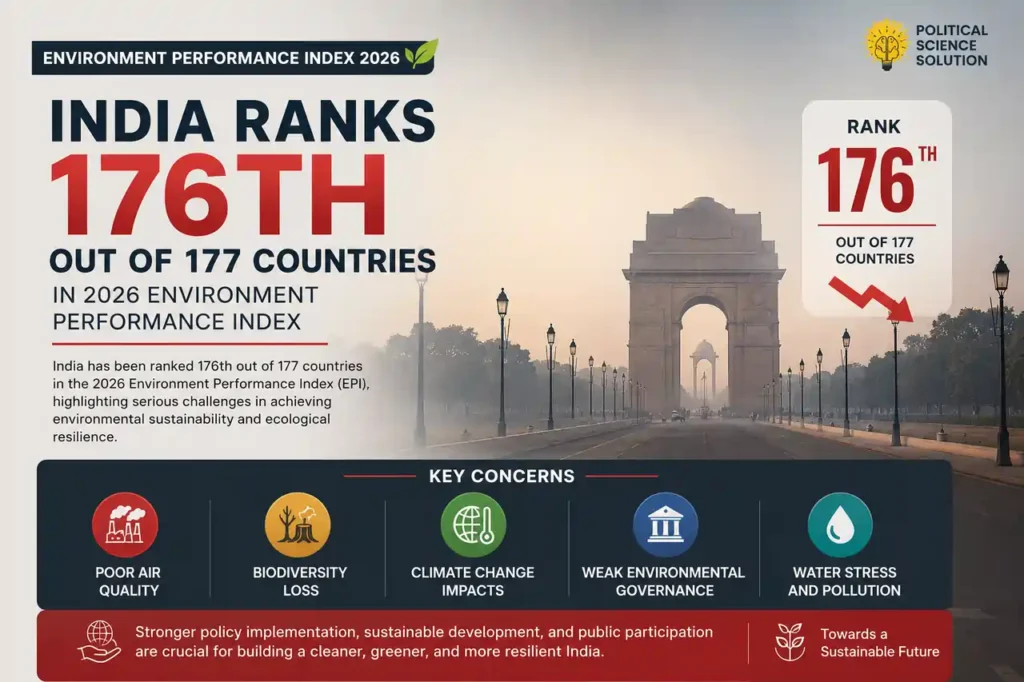
New Delhi: In a stark reminder of the environmental hurdles facing one of the world’s fastest-growing economies, India has secured the 176th position out of 177 countries in the highly anticipated 2026 Environment Performance Index (EPI). This global benchmarking tool, released recently, places the nation just one spot above Laos, highlighting critical gaps in air quality management, ecosystem protection, and broader sustainability efforts despite notable strides in slowing certain pollution trends.
The 2026 EPI, a collaborative effort by researchers from Yale University, Columbia University, and other leading institutions, evaluates nations across comprehensive metrics that reflect real-world environmental conditions. With India scoring a modest 22.46 out of 100, the results underscore a complex tension between rapid development and ecological stewardship in the South Asian giant.
Understanding the Environment Performance Index Framework
The EPI stands as one of the most authoritative assessments of national environmental stewardship, updated biennially to track progress and shortcomings. For the 2026 edition, experts analyzed 177 countries using 47 distinct indicators grouped under 12 issue categories and three primary policy objectives: environmental health (weighted at 25%), ecosystem vitality (45%), and climate change mitigation (30%).
This year’s index introduced grassland conversion as a new indicator for the first time, recognizing the vital role of these habitats in carbon sequestration, biodiversity support, and other ecosystem services that have often been overlooked in policy discussions. Methodologies evolve with each cycle—previous editions in 2022 and 2024 incorporated varying numbers of indicators (40 and 58 respectively)—making direct year-on-year comparisons nuanced but still revealing important trajectories when historical data is recalibrated.
India’s overall performance breaks down as follows: 174th in environmental health, 171st in ecosystem vitality, and a relatively stronger 130th in climate change mitigation. Regionally, the country finished last among eight South Asian nations, trailing behind Bhutan, Sri Lanka, Nepal, Afghanistan, Pakistan, Maldives, and Bangladesh.
For context, top-performing Estonia achieved an impressive 74.79 score, driven largely by substantial reductions in greenhouse gas emissions from its power sector through aggressive renewable energy adoption and the phase-out of fossil fuels. European nations dominated the upper ranks, with Luxembourg, the United Kingdom, Finland, and the Netherlands rounding out the top five. At the opposite end, Laos recorded the lowest score of 21.78, claiming the 177th spot.
India’s Environmental Scorecard: Key Areas of Concern
The report paints a detailed picture of India’s environmental realities. Per-capita emissions remain comparatively low on a global scale, yet they are rising quickly as millions gain access to modern energy services. This development-versus-pollution dynamic has manifested in severe urban air pollution and escalating greenhouse gas outputs.
Several air quality indicators over the past decade registered negative trends, including the burden of disease and death linked to fine particulate matter exposure, as well as elevated levels of carbon monoxide and sulphur dioxide. India’s continued dependence on coal-fired power plants emerges as a central factor, compounded by insufficient protections for biodiversity and natural habitats.
Ecosystem vitality metrics also revealed weaknesses. Marine Protected Area effectiveness scored a concerning -51.77 over the ten-year period, signaling limited success in safeguarding ocean resources. Additionally, the Regional Marine Trophic Index showed a negative shift of -10.27, which researchers interpret as potential overfishing of higher-trophic-level species, leading to increased reliance on lower-level fish stocks. While alternative economic explanations exist—such as fleets targeting more profitable species— the metric highlights pressures on marine ecosystems.
Zachary Wendling, Research Director for the EPI at the Yale Center for Environmental Law and Policy, elaborated on these findings. He noted that India’s weak showing reflects “critical air quality problems, continued reliance on coal-fired power and inadequate biodiversity protections.”
Signs of Progress: A Positive Ten-Year Trajectory
Despite the low absolute ranking, the 2026 EPI records a meaningful improvement for India on its ten-year change metric, posting a gain of +7.47. This positive shift stands out when compared to declines in countries like Romania (-0.91) and the Dominican Republic (-3.04).
Wendling emphasized that applying the current EPI methodology to historical datasets demonstrates overall advancement. While emissions of carbon dioxide and other greenhouse gases remain elevated and continue to rise, the pace of increase has moderated for several pollutants. Rates of growth for sulphur dioxide and nitrous oxides, for instance, have slowed appreciably.
“While emissions of carbon dioxide and some other greenhouse gases are still too high and rising, they are not rising as quickly as they have in the past,” Wendling told reporters. These decelerations suggest that targeted interventions in energy efficiency, industrial processes, and pollution control may be yielding incremental benefits, even as the country grapples with scaling clean energy solutions for its vast population.
Government Response and Methodological Debates
India’s poor showing in previous EPI editions has not gone unchallenged. When the 2022 index placed the country at the absolute bottom (180th out of 180), the Union Environment Ministry swiftly issued a statement rejecting the analysis and conclusions. Officials cited shifts in methodology, alleged reliance on “surmises and unscientific methods,” and the index’s failure to adequately factor in India’s historically low per-capita emissions. They also raised concerns about evolving weightings of different environmental indicators.
The EPI team has consistently maintained that rankings prioritize the current state of environmental conditions rather than historical contributions or policy aspirations. In response to past criticism, the lead scientist expressed openness to collaboration with Indian authorities to refine data and analytical approaches moving forward.
The 2026 findings echo many of these earlier patterns, with India again near the bottom. Yet the documented improvements provide a foundation for constructive dialogue between policymakers and the international research community.
Broader Implications for India’s Environmental Future
India’s position in the 2026 EPI arrives at a pivotal moment. As the nation pursues ambitious economic growth targets, balancing development with sustainability has never been more pressing. Urban centers continue to battle hazardous air quality, particularly during winter months when pollution spikes affect millions, as evidenced by widespread reports from cities like Gurugram and across northern India.
The report’s emphasis on ecosystem vitality points to additional priorities: strengthening biodiversity corridors, enhancing protected area management, and addressing habitat loss. Grassland conservation, newly spotlighted in this edition, could offer opportunities for innovative policy measures given these ecosystems’ underappreciated contributions to climate resilience.
Climate change mitigation efforts receive a somewhat better relative score, reflecting initiatives in renewable energy deployment—solar and wind capacity additions have been notable in recent years. However, coal’s enduring role in the energy mix remains a significant drag on overall performance.
Experts argue that addressing these challenges requires integrated strategies. Improving air quality not only boosts EPI scores but delivers immediate public health dividends by reducing respiratory illnesses and premature deaths. Similarly, investing in sustainable fisheries and marine protection can safeguard livelihoods for coastal communities while preserving biodiversity.
Pathways Forward: Learning from Global Leaders
Estonia’s success offers instructive lessons. The Baltic nation’s top ranking stems from decisive action on power sector decarbonization and robust biodiversity safeguards. Other European frontrunners demonstrate how policy coherence, technological innovation, and international cooperation can drive high performance across EPI pillars.
For India, accelerating the transition away from coal, enforcing stricter emission norms, expanding green infrastructure, and mainstreaming nature-based solutions could yield compounding benefits. The positive ten-year trend indicates that momentum exists; scaling successful pilots in renewable integration, waste management, and habitat restoration will be key.
The EPI also serves as a call for better data transparency and localized monitoring. Satellite imagery and ground-level measurements already inform the index, but strengthening domestic capacity in environmental data collection could improve both national planning and future international assessments.
Conclusion: Turning Rankings into Action
India’s 176th ranking in the 2026 Environment Performance Index, with a score of 22.46, captures the scale of work ahead. Yet the +7.47 improvement over the decade and slower emission growth rates provide grounds for measured optimism. As hundreds of millions continue transitioning to modern energy, the choices made today will determine whether development and environmental health can advance in tandem.
Policymakers, industry leaders, civil society, and citizens all have roles to play. From urban air quality action plans to nationwide biodiversity strategies and aggressive climate targets, the EPI underscores the urgency of evidence-based interventions. By addressing core issues—air pollution, coal dependency, and habitat protection—India can not only climb future rankings but secure a healthier, more sustainable future for its people and the planet.
This latest assessment arrives as global attention on environmental performance intensifies. For India, transforming low rankings into catalysts for transformative change represents both a challenge and a profound opportunity in the years ahead.
FAQs
1. What is India’s exact ranking and score in the 2026 Environment Performance Index (EPI)?
India ranked 176th out of 177 countries in the 2026 EPI with an overall score of 22.46 out of 100. It placed second from the bottom, just ahead of Laos (177th, score 21.78). India also finished last among the eight South Asian countries evaluated.
2. Which countries topped the 2026 EPI and what makes them stand out?
Estonia secured the top position with a score of 74.79, followed by Luxembourg, the United Kingdom, Finland, and the Netherlands. Estonia’s strong performance is attributed to major reductions in greenhouse gas emissions from its power sector, rapid scaling of renewable electricity, and excellent biodiversity and ecosystem protection measures.
3. Why did India rank so low in the 2026 Environment Performance Index?
India’s low ranking stems from persistent challenges in environmental health (174th) and ecosystem vitality (171st), despite a better 130th position in climate change mitigation. Key issues highlighted include severe air quality problems (especially fine particulate matter, carbon monoxide, and sulphur dioxide), continued heavy reliance on coal-fired power plants, inadequate biodiversity protections, and low effectiveness of Marine Protected Areas. The report notes the tension between rapid development and rising pollution as millions gain access to modern energy.
4. Has India’s environmental performance shown any improvement over the past decade?
Yes. Despite the low absolute ranking, India recorded a positive ten-year change score of +7.47. According to EPI Research Director Zachary Wendling, recalibrating historical data with current methodology shows overall progress. While emissions remain high, the rate of increase for pollutants like sulphur dioxide and nitrous oxides has slowed, and some greenhouse gas growth has moderated compared to earlier periods.
5. How has the Indian government responded to previous EPI rankings?
In response to the 2022 EPI (where India ranked last), the Union Environment Ministry rejected the findings, citing changes in methodology, alleged unscientific approaches, and the index’s failure to account for India’s historically low per-capita emissions. The ministry has raised similar concerns about indicator weightings. EPI researchers maintain that rankings are based on current environmental conditions rather than historical data or intentions, and have welcomed potential collaboration with Indian authorities.