

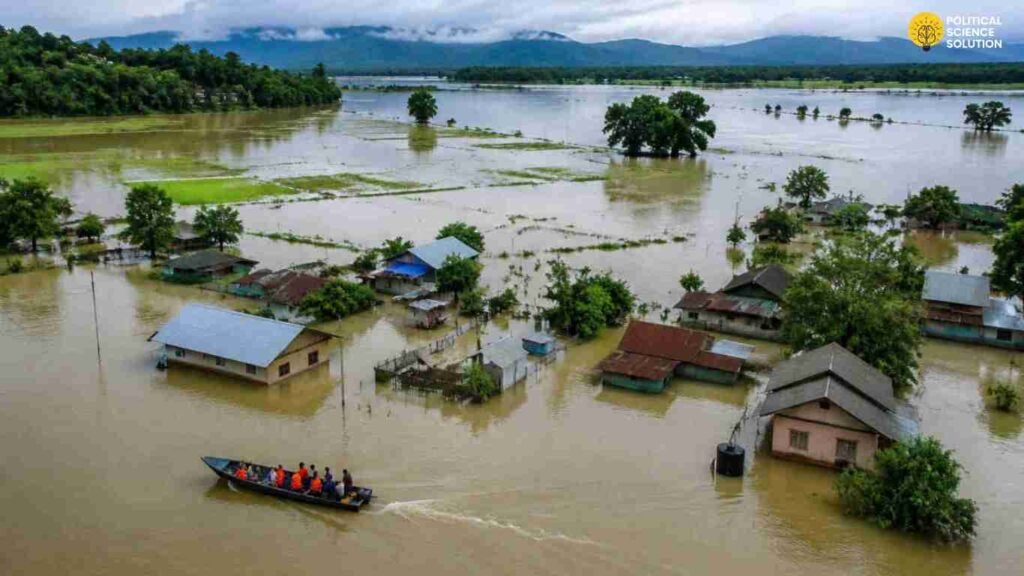
New Delhi: Assam is confronting a major humanitarian and environmental emergency as intense monsoon rains have pushed the statewide death toll to 85. More than 1.36 lakh residents remain affected, with over 160 villages still underwater. Thousands of families have been forced from their homes, hundreds of houses stand damaged or submerged, and rescue teams continue working across the worst-hit districts. Chief Minister Himanta Biswa Sarma has toured several flooded areas to evaluate conditions on the ground and accelerate the delivery of aid while landslides and persistent high water levels slow progress.
This year’s inundation ranks among the most destructive the state has experienced in living memory. Flooding is a regular seasonal feature in Assam, where nearly 40 percent of the land is officially designated flood-prone. The Brahmaputra, one of the largest rivers on the planet, dominates the landscape. Fed by more than fifty tributaries that drain the surrounding hills, the river carries enormous volumes of water and sediment during the monsoon. As it crosses Assam’s low-lying plains it deposits sand and silt, gradually shrinking its own channel and increasing the likelihood of overflow.
Additional pressures have made recent floods more severe. Deforestation in upstream catchment areas, aging embankments that no longer hold reliably, and heavier rainfall patterns associated with climate change have all contributed. Exceptionally intense rain that began in mid-July across parts of Nagaland and Assam unleashed the present crisis. State minister Pijush Hazarika has called the floods the worst Assam has seen in sixty years. Earlier official counts recorded at least sixty-eight deaths within four weeks, fifty-eight of them in a single recent week, while roughly forty people remained missing. Peak estimates indicated more than six hundred thousand people affected. On 21 July alone, twenty-one lives were lost in twenty-four hours, most to drowning or being swept away; others died in landslides or when dwellings collapsed under the force of water.
Upper Assam Bears the Brunt of Rapid River Rise
The heaviest impact fell on Upper Assam, where hill tributaries feed directly into the Brahmaputra. Districts including Sivasagar, Charaideo, Jorhat and parts of Golaghat suffered widespread submersion. Chief Minister Sarma reported that rainfall in the critical period reached 435 to 490 percent above normal levels, causing rivers to swell at unprecedented speed. Villages were cut off overnight, leaving rescue crews struggling to reach stranded residents. Assam Chief Secretary Ravi Kotta confirmed that senior officers had been posted to the most severely affected zones to speed the distribution of relief materials and the restoration of basic services.
Survivor Accounts Reveal Sudden and Total Loss
Individual stories capture the speed and completeness of the destruction. In Jorhat district, eighteen-year-old Saline Patro was at home in Seleng Sumoni Pathar village on the banks of the Jhanji River when the water arrived on the afternoon of 19 July. Within minutes knee-deep floodwater entered the house. She guided her elderly parents and younger brother to higher ground, then returned to salvage what she could. By the time she forced her way back through the current, the house itself had been carried away. A television, cupboard, sofa and even a drinking glass were gone. The family now shelters in a relief camp. Both parents earn daily wages; the home they spent years constructing is lost, and the prospect of rebuilding feels distant.
In Sivasagar’s Holang Katoni village, Rekhamoni Gogoi and her seven-year-old son faced a night of equal terror on the same day. Water rose to chest height within an hour. After first taking refuge at a neighbour’s house they fled again as levels continued to climb. Around 8 p.m. they climbed a large mango tree in the courtyard, with other women helping Gogoi lift her child into the branches. They spent the night without food or water in total darkness. Her son tried to comfort her by suggesting they could eat the leaves. Rescuers reached them the next morning. The pair are now in a relief camp waiting for the waters to fall.
Across Sivasagar, Jorhat and Golaghat the floods followed a cloudburst in Nagaland and arrived with almost no warning. Entire settlements disappeared under water within hours. Houses vanished, roads were erased, fields became temporary rivers, and livestock that represented years of rural savings drowned. Standing crops were destroyed, small shops lost their stock and premises, and the economic foundation of thousands of households was wiped out in a single night. At one point approximately twenty-five thousand people were living in formal relief camps while many others stayed with relatives or friends.
Immediate Relief Operations and Community Response
Government disaster teams, central agencies, non-governmental organisations, local volunteers and ordinary citizens mobilised quickly. Boats, food packets, drinking water, clothing, medicines and temporary shelters formed the first line of support. The people of Assam displayed strong mutual aid during the acute phase. Chief Minister Sarma has now directed attention toward rehabilitation, assigning ministers to coordinate recovery work across districts. Priority remains the restoration of roads, power, drinking water and other essential services as water levels begin to drop in some areas.
The Deeper Challenge Begins After the Water Recedes
The most difficult phase often starts once the floodwaters withdraw. Families return to find only bare ground where homes once stood. Furniture, household goods, documents, savings, tools and years of labour have disappeared. Many already carry home loans, business loans, vehicle loans or agricultural debts. Income sources are gone, yet the repayment obligations remain. Farmers have lost an entire season’s investment. Shopkeepers face ruined inventories. Daily-wage workers have nowhere to work. Without substantial support, the economic consequences risk locking families into poverty for years, interrupting children’s education, driving young people to migrate, preventing small businesses from reopening and reducing local food production.
Meaningful rehabilitation must therefore become the central focus. Financial packages need to be large enough to enable permanent housing rather than temporary repairs. Farmers require quality seeds, fertilisers, equipment and technical assistance to resume cultivation. Small-business owners need grants or interest-free capital to restart. Banks and financial institutions should consider loan restructuring, longer repayment periods, reduced interest rates or, in the worst cases, partial or full waivers so that households that lost everything are not crushed by pre-disaster debt. Schools, colleges, hospitals, markets, roads, bridges and tourism facilities—particularly in historically important areas such as Sivasagar—must be rebuilt promptly so that education continues, commerce revives and communities regain access to services. Tourism supports numerous direct and indirect livelihoods; restoring related infrastructure can help generate employment and stimulate local recovery.
Sustained Collective Effort Required for Long-Term Recovery
Society’s contribution should not end with emergency donations of food and clothing. Individuals, companies, charitable organisations, educational institutions and community groups can adopt villages, schools or individual families and support long-term rebuilding—new homes, educational materials, replacement livestock, farming tools or start-up capital for entrepreneurs. Corporate social-responsibility programmes can finance schools, health centres, drinking-water systems and community facilities. Universities, youth organisations and volunteer networks can help restore libraries, digital learning spaces and other shared resources.
Natural disasters of this scale cannot always be prevented, yet the depth of human suffering can be reduced through coordinated planning and lasting commitment. Recovery should be judged not by how quickly the water vanishes from news headlines, but by how successfully affected families regain dignity, livelihoods and independence. As public attention inevitably shifts, the residents of Sivasagar, Jorhat, Golaghat and other flooded regions of Assam need practical opportunities and continued partnership. No family should be left to rebuild alone. The monsoon may have erased homes and harvests, but determined collective action can restore the foundations on which communities stand.
The Assam floods of 2026 highlight both the long-standing vulnerability of the Brahmaputra valley and the urgent requirement for durable solutions that address immediate survival and long-term resilience. With the death toll still rising, villages remaining submerged and hundreds of thousands of lives disrupted, the weeks ahead will test the capacity of government agencies, financial institutions, civil society and citizens to convert short-term relief into lasting recovery.
Frequently Asked Questions
1. What is the current death toll and how many people are affected by the Assam floods in 2026?
As of early August 2026, the death toll from the Assam floods has risen to 85. More than 1.36 lakh people continue to be affected, with over 160 villages still inundated. Earlier peak figures indicated that more than 600,000 residents had been impacted at the height of the crisis, and around 25,000 people were staying in formal relief camps while many others took shelter with relatives or friends.
2. Which areas of Assam have been hit hardest and why did the floods become so severe this year?
Upper Assam suffered the greatest damage, especially the districts of Sivasagar, Charaideo, Jorhat and parts of Golaghat. The floods followed exceptionally heavy rainfall (435–490 percent above normal) across parts of Nagaland and Assam from mid-July. The Brahmaputra and its tributaries rose at unprecedented speed. Long-term factors such as upstream deforestation, ageing embankments, heavy silt deposition and climate-driven heavier rainfall have made seasonal flooding increasingly destructive. State officials have described the event as the worst in six decades.
3. What happened to individual families during the sudden onset of flooding?
On 19 July, 18-year-old Saline Patro in Jorhat’s Seleng Sumoni Pathar village saw knee-deep water enter her home within minutes. After helping her parents and brother reach higher ground, she returned to find the entire house washed away, along with all belongings. In Sivasagar’s Holang Katoni village, Rekhamoni Gogoi and her seven-year-old son climbed a mango tree and spent 12 hours there without food or water after floodwaters rose to chest level; they were rescued the next morning. Many other families lost homes, livestock, crops and livelihoods in a matter of hours.
4. What relief and rescue measures have been put in place so far?
Rescue teams, state and central agencies, NGOs and local volunteers have been operating boats, distributing food, drinking water, clothes and medicines, and running temporary shelters. Chief Minister Himanta Biswa Sarma has visited affected areas and deployed ministers to coordinate recovery. Assam Chief Secretary Ravi Kotta confirmed that senior officials were posted to the worst-hit districts to speed up relief and restore essential services. The immediate focus is now shifting toward rehabilitation as water levels begin to recede in some places.
5. Why is long-term rehabilitation considered more critical than immediate relief, and what support is needed?
Once floodwaters recede, families often return to bare land where homes once stood. Many already carry loans, yet their sources of income—crops, livestock, shops and daily-wage work—have been destroyed. Without adequate support they risk prolonged poverty, interrupted education and migration. Experts and local voices stress the need for sufficient financial packages to rebuild permanent houses, quality seeds and tools for farmers, grants or interest-free capital for small businesses, loan restructuring or waivers, and rapid restoration of schools, roads, markets, hospitals and tourism infrastructure. Corporate social responsibility programmes, NGOs and community groups can also adopt villages or families to sustain recovery long after the emergency phase ends.