

New Delhi: The Stockholm International Peace Research Institute (SIPRI) has released its much-anticipated Yearbook 2026, providing a comprehensive snapshot of global security dynamics as of early 2026. This authoritative annual assessment highlights a world grappling with record military spending, persistent nuclear buildup in certain regions, and a surge in interstate armed conflicts. For India, the report underscores its growing strategic footprint, positioning the nation as the fifth-largest military spender worldwide while noting steady advancements in its nuclear capabilities.
As nations navigate complex rivalries and technological disruptions in warfare, the SIPRI findings serve as a critical reference for policymakers, defense analysts, and international observers. This in-depth analysis delves into every aspect of the report, examining nuclear arsenals, expenditure trends, arms trade patterns, conflict zones, and emerging techno-strategic challenges.
Global Nuclear Landscape: Approximately 12,187 Warheads Worldwide
According to the SIPRI Yearbook 2026, the nine nuclear-armed states—the United States, Russia, the United Kingdom, France, China, India, Pakistan, North Korea, and Israel—collectively possessed around 12,187 nuclear warheads as of January 2026. Of these, approximately 9,745 are classified as military stockpiles and potentially available for operational use.
While the overall global stockpile shows a marginal decline, this trend is attributed primarily to the United States and Russia dismantling retired warheads rather than broad disarmament efforts. The report emphasizes that many states are increasingly viewing nuclear weapons as essential instruments of national power, a shift that reverses earlier progress toward reduction and heightens risks of miscalculation and escalation.
Focusing on South Asia, India has expanded its nuclear arsenal to an estimated 190 warheads. This figure marks a slight increase from previous years, reflecting ongoing modernization efforts. Notably, 12 of these warheads are now deployed on missiles, signaling a significant policy development in operational readiness. In comparison, Pakistan’s estimated stockpile stands at 170 warheads. The report details how India’s program prioritizes long-range delivery systems capable of reaching targets across China, even as it maintains focus on its enduring competition with Pakistan.
SIPRI observes that India will continue developing new types of nuclear delivery systems throughout 2025. Pakistan, meanwhile, advanced its own delivery mechanisms and fissile material production, indicating potential further expansion of its arsenal in the coming years. These developments occur against a backdrop of heightened regional sensitivities, including a brief but intense armed confrontation between the two neighbors in May 2025.
The report also contextualizes these arsenals within broader global mechanisms aimed at curbing proliferation and promoting disarmament. Key institutions and treaties include the United Nations Office for Disarmament Affairs (UNODA), which advocates for worldwide disarmament and aids in implementing arms control measures. The Conference on Disarmament (CD), established in 1978, remains the primary multilateral platform for negotiating related agreements.
Major treaties highlighted are the 1968 Treaty on the Non-Proliferation of Nuclear Weapons (NPT), which seeks to prevent the spread of nuclear arms while supporting peaceful applications and eventual disarmament; the 1996 Comprehensive Nuclear-Test-Ban Treaty (CTBT), prohibiting all nuclear explosions; and the 2017 Treaty on the Prohibition of Nuclear Weapons (TPNW), which comprehensively bans development, possession, stockpiling, and use of such weapons. Despite these frameworks, the SIPRI data illustrates the challenges in achieving meaningful reductions beyond the legacy dismantlements by the two largest possessors.
Record-Breaking Global Military Expenditure Hits $2.9 Trillion in 2025
One of the most striking revelations in the SIPRI Yearbook 2026 is the unprecedented rise in global military spending. In 2025, worldwide expenditure reached a record $2.9 trillion, representing 2.5 percent of global GDP and marking the 11th consecutive year of growth. This surge reflects deepening geopolitical uncertainties and ongoing conflicts.
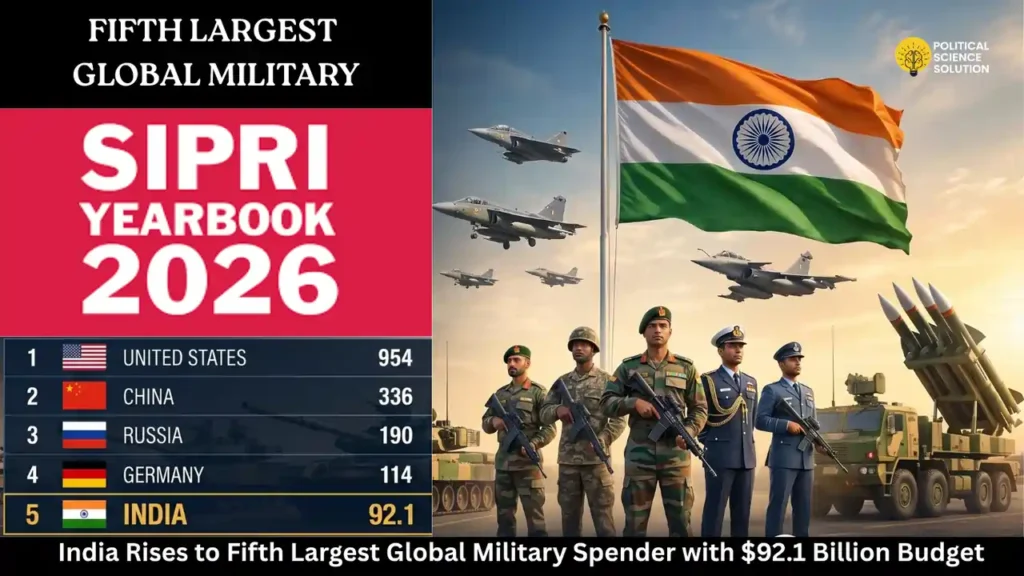
The United States maintained its dominant position as the top spender, allocating $954 billion—accounting for 33 percent of the global total, though this marked a 7.5 percent decrease from 2024 levels. China followed as the second-largest spender with $336 billion, while Russia ranked third at $190 billion. Germany secured the fourth spot, and India emerged firmly in fifth place with $92.1 billion in military expenditure for 2025. This represents an 8.9 percent increase over the previous year and solidifies India’s role as a major player in global defense dynamics.
The top 15 military spenders together contributed 80 percent of total world expenditure, amounting to $2.304 trillion. Many of these nations were directly or indirectly involved in the conflicts in Gaza and Ukraine during 2025. SIPRI notes that this concentration of spending underscores the transactional and power-oriented shifts in international relations, moving away from earlier liberal peacemaking paradigms.
For India, the $92.1 billion investment highlights sustained commitment to capability enhancement amid regional security challenges. The report positions this spending within a broader context of modernization, including advancements in delivery systems tailored to potential threats from both China and Pakistan.
Arms Trade Dynamics: India as Second-Largest Importer
The SIPRI analysis of the international arms market from 2021-2025 reveals significant shifts in supply and demand. India ranked as the second-largest arms importer globally during this period, capturing approximately 8 percent of the market share, trailing only Ukraine. The five largest recipients—Ukraine, India, Saudi Arabia, Qatar, and Pakistan—accounted for 35 percent of total major arms imports.
On the export side, the United States led with a commanding 42 percent share. Together with France, Russia, Germany, and China, these top suppliers represented 70 percent of global arms exports. This data illustrates the enduring influence of established powers in the defense industry while highlighting emerging dependencies and strategic partnerships.
Rising Interstate Conflicts and the India-Pakistan Crisis
The Yearbook documents a doubling of interstate armed conflicts, from three in 2024 to six in 2025. This escalation points to increasing geopolitical instability across multiple regions. The number of locations experiencing armed conflict slightly decreased from 50 states in 2024 to 49 in 2025, but the intensity and interstate nature of disputes grew.
A prominent example cited is the unusually severe military crisis between India and Pakistan in May 2025. The report describes intense cross-border exchanges of fire between May 7 and 10, with India targeting Pakistani air and missile bases potentially linked to nuclear roles. Both sides, however, exercised restraint to prevent further escalation. This episode marked the first overt integration of cyber operations into their armed conflict dynamics, adding a new layer of complexity to traditional kinetic engagements.
SIPRI identifies several critical regional flashpoints vulnerable to broader escalation, with the India-Pakistan situation serving as a notable case study. The think tank also references coordinated digital responses in other confrontations, such as between Iran and Israel, as indicative of evolving conflict patterns.
Techno-Strategic Warfare Reshaping Global Security
Beyond traditional metrics, the SIPRI Yearbook 2026 emphasizes the transformative impact of emerging technologies on warfare. Increasing reliance on artificial intelligence, drone swarms, autonomous weapons systems, cyber tools, and the strategic weaponization of critical minerals, semiconductors, and supply chains is fundamentally altering geopolitical competition.
Cyber operations have become integral to modern conflicts, with Russia-Ukraine providing ongoing examples. The India-Pakistan May 2025 crisis further demonstrated this integration. These developments signal a broader shift toward hybrid and technology-driven strategies that complicate traditional arms control and escalation management frameworks.
Broader Implications and the 60th Anniversary Context
This edition of the SIPRI Yearbook coincides with the institute’s 60th anniversary since its founding in 1966. Over the past two decades, SIPRI has tracked a gradual evolution in conflict resolution approaches, from dominant liberal peacemaking models toward more pragmatic, power-based, and transactional methods.
The report’s comprehensive data—covering nuclear postures, spending patterns, arms flows, and conflict trends—offers valuable insights for understanding current instabilities. It warns of rising risks associated with nuclear reliance and technological proliferation, even as overall warhead numbers see limited decline due to retirements rather than verifiable disarmament.
For India, the findings affirm its strategic maturation. With 190 nuclear warheads (including 12 deployed), fifth-place military spending of $92.1 billion, and active modernization focused on long-range capabilities, the country is navigating a complex neighborhood while contributing to global security discussions through established non-proliferation commitments.
Conclusion: Navigating an Uncertain Security Environment
The SIPRI Yearbook 2026 paints a picture of a world at a strategic crossroads. Record military budgets, expanding roles for nuclear forces in national strategies, proliferating interstate tensions, and rapid technological integration demand renewed attention to arms control, confidence-building measures, and multilateral dialogue.
As stakeholders review these insights, the emphasis remains on balancing deterrence needs with efforts to mitigate escalation risks. India’s trajectory, as detailed in the report—from its nuclear expansion and defense investments to its role in regional crises—exemplifies the challenges and opportunities facing rising powers in the 21st century.
This detailed assessment from SIPRI reinforces the urgency for sustained international cooperation on disarmament mechanisms like the NPT, CTBT, and TPNW, even as practical realities of power competition persist. Policymakers and analysts will undoubtedly reference the 2026 Yearbook extensively in shaping responses to these evolving threats.
FAQs
1. How many nuclear warheads does India have according to SIPRI Yearbook 2026?
As of January 2026, India possesses an estimated 190 nuclear warheads, according to SIPRI. Out of these, 12 warheads are deployed on missiles. This marks a slight expansion of India’s nuclear arsenal in 2025. The report notes that India is modernizing its delivery systems with a focus on long-range weapons capable of reaching targets throughout China, while still maintaining capabilities relevant to its rivalry with Pakistan.
2. What is India’s rank and military expenditure in 2025 as per SIPRI?
India ranked as the 5th largest military spender globally in 2025 with an expenditure of US$ 92.1 billion. This reflects an 8.9% increase from the previous year. The United States topped the list with $954 billion, followed by China ($336 billion), Russia ($190 billion), and Germany. India’s spending forms part of the record global military expenditure of $2.9 trillion in 2025 — the highest ever recorded by SIPRI and the 11th consecutive year of growth.
3. How does India’s nuclear stockpile compare with Pakistan and China?
According to the SIPRI Yearbook 2026:
- India: ~190 nuclear warheads
- Pakistan: ~170 nuclear warheads
- China: ~620 nuclear warheads
The report highlights that both India and Pakistan continued developing new delivery systems and expanding capabilities in 2025. It specifically mentions the brief but intense India-Pakistan military crisis in May 2025, during which India struck Pakistani air and missile bases with potential nuclear roles, though both sides avoided full escalation.
4. What does SIPRI say about global arms imports and India’s position?
India remained the second-largest arms importer in the world during 2021–2025, with approximately 8% share of global imports, behind only Ukraine. The top five arms importers (Ukraine, India, Saudi Arabia, Qatar, and Pakistan) together accounted for 35% of total major arms imports. On the export side, the USA dominated with a 42% share, while the top five exporters (USA, France, Russia, Germany, and China) controlled 70% of the global arms market.
5. What major global trends and conflicts does the SIPRI Yearbook 2026 highlight?
Key highlights include:
- Total global nuclear warheads: ~12,187 (of which 9,745 are in military stockpiles).
- Interstate armed conflicts doubled from 3 in 2024 to 6 in 2025.
- Growing integration of AI, drone swarms, autonomous weapons, cyber operations, and weaponization of supply chains in modern warfare.
- The May 2025 India-Pakistan crisis was cited as an example where cyber operations were overtly integrated into armed conflict for the first time by both nations.
- Overall decline in nuclear numbers is mainly due to US and Russia dismantling old warheads, not new disarmament progress.