
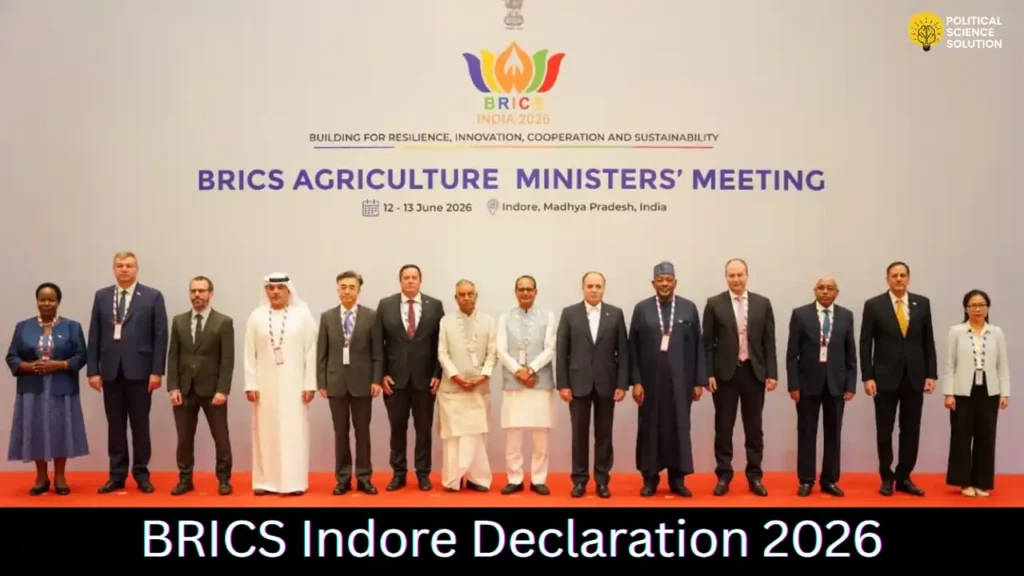
New Delhi: In a landmark development for international agricultural cooperation, the 16th BRICS Agriculture Ministers’ Meeting concluded successfully in Indore, Madhya Pradesh, with the unanimous adoption of the BRICS Indore Declaration. Hosted under India’s BRICS Presidency in 2026, the two-day event from June 12 to 13 brought together agriculture leaders, officials, and experts from BRICS member and partner nations. The declaration outlines a comprehensive roadmap focused on resilience, innovation, cooperation, and sustainability in agriculture, placing small and marginal farmers, women, and youth at the heart of global food systems.
This gathering, which saw participation from nearly 100 delegates including around 60 foreign representatives, underscores BRICS’ growing influence in addressing pressing challenges like food security, climate change, and technological transformation in farming. Union Agriculture Minister Shivraj Singh Chouhan emphasized that the declaration keeps farmers central to policymaking, highlighting their critical role in ensuring nutrition, livelihoods, and sustainable rural development.
BRICS Agricultural Powerhouse: Key Statistics Driving the Agenda
BRICS nations collectively represent nearly half of the world’s population and command significant agricultural resources. They possess about 42% of global agricultural land and contribute nearly 42% to world foodgrain production. These figures highlight the bloc’s strategic importance in shaping global food security and agricultural policies. The Indore Declaration leverages this collective strength to foster deeper collaboration among member countries, which now include original members Brazil, Russia, India, China, and South Africa, along with newer additions such as Indonesia, Egypt, Ethiopia, Iran, and the United Arab Emirates. Saudi Arabia has also received an invitation to join.
The theme of the meeting, “Building for Resilience, Innovation, Cooperation and Sustainability” (BRICS), reflects a forward-looking approach amid geopolitical tensions, climate vulnerabilities, and the need for inclusive growth in food systems.
Four Core Priorities of the BRICS Indore Declaration
The Indore Declaration identifies four major priority areas to guide BRICS agricultural cooperation:
1. Food Security, Nutrition, and Livelihoods
This priority recognizes farmers as custodians of traditional knowledge, biodiversity, and seed heritage. It stresses the need to protect and promote indigenous practices that have sustained communities for generations. A key highlight is the emphasis on supporting small and marginal farmers, women, and youth through better access to resources, markets, finance, technology, and training. The declaration aims to enhance nutrition security and reduce food loss while improving farmer incomes.
2. Promotion of Agricultural Trade and Cooperation
BRICS countries committed to strengthening trade mechanisms for fair and transparent agricultural exchanges. This includes support for the proposed BRICS Grain Exchange, which could revolutionize intra-bloc grain trading. The declaration also promotes the utilization of the BRICS Basic Agricultural Information Exchange System (BAIES) as a vital platform for ongoing cooperation and data sharing.
3. Regenerative Farming, Climate-Resilient, and Sustainable Agriculture
Addressing climate challenges head-on, this priority focuses on regenerative and agroecological practices. It calls for joint efforts in biodiversity conservation, climate resilience, fisheries, livestock development, and sustainable farming methods. The goal is to build agricultural systems that are productive yet environmentally responsible, reducing vulnerability to extreme weather and promoting long-term soil health.
4. Innovation, Technology, and Partnerships in Future-Ready Agriculture
The fourth priority emphasizes digital transformation and technological integration. It promotes the expansion of Digital Public Infrastructure (DPI) in agriculture and encourages partnerships that harness artificial intelligence, geospatial technologies, and data-driven solutions. This forward-looking approach aims to modernize farming practices across BRICS nations, making them more efficient and inclusive.
These priorities collectively address the entire spectrum of challenges facing global agriculture, from traditional knowledge preservation to cutting-edge innovation.
Four Landmark Institutional Initiatives Launched Under the Declaration
To translate priorities into action, the declaration introduces four key institutional mechanisms, each designed to foster practical collaboration:
1. Global Forum on Farmers’ Rights in Seed Systems
This forum aims to safeguard farmers’ rights related to seeds, preserve traditional knowledge systems, and conserve indigenous seed diversity. It will function primarily through virtual modalities and will be initially coordinated by the Protection of Plant Varieties and Farmers’ Rights Authority (PPV&FRA) in New Delhi. By protecting seed heritage and promoting dialogue, the forum seeks to empower farmers as key contributors to agricultural biodiversity.
2. BRICS AGRIN (Agro-Inputs, Genetic Resources and Information Network)
The BRICS AGRIN framework will facilitate information sharing, capacity building, technical cooperation, and partnerships. It focuses on seeds, genetic resources, and agricultural inputs, enabling member nations to exchange superior varieties, best practices, and resources more effectively. This network is expected to accelerate innovation and address gaps in agricultural inputs across the bloc.
3. BRICS Network of Centres of Excellence on Agroecology and Regenerative Agriculture
This network will serve as a collaborative platform for joint research, capacity building, and knowledge exchange on climate-resilient and sustainable farming. It will initially be coordinated by the ICAR–Indian Institute of Farming System Research (IIFSR) in Modipuram, which will also act as India’s Centre of Excellence on Natural Farming. The initiative promotes agroecology, organic practices, and regenerative methods to enhance productivity while ensuring environmental sustainability.
4. BRICS Network on Digital Agriculture
Coordinated initially by IIT Delhi, this network will strengthen cooperation in artificial intelligence, geospatial technologies, digital public infrastructure, and data-driven solutions. Member countries will share experiences, innovations, and policy initiatives to modernize farming systems. The emphasis on low-cost, virtual collaboration makes it accessible and scalable across diverse economies.
In addition to these new initiatives, the declaration strengthens existing platforms. The BRICS Agricultural Research Platform (BARP) will evolve into a “Knowledge-to-Action Hub” to ensure research directly benefits farmers through practical solutions.
Additional Outcomes and Symbolic Gestures
Delegates actively participated in a tree plantation drive, including the creation of a ‘BRICS Vatika’ in Indore, symbolizing the grouping’s commitment to environmental stewardship and climate resilience. Bilateral discussions during the meeting focused on market access, agricultural cooperation, and specific areas like food loss reduction, livestock technologies, and aquaculture.
The ministers reaffirmed support for a multilateral trading system and endorsed integrating technical outcomes into future programs aimed at improving efficiency, nutrition, and incomes. They also pledged to expand South-South cooperation through technical exchanges, capacity building, and skill development programs for developing countries.
A dedicated Ministerial Dialogue on “Small Farmers, Women and Youth: Shaping the Future of Food Security” highlighted the need to empower these groups, recognizing their pivotal role in building resilient food systems.
Broader Context: India’s BRICS Presidency and Global Relevance
India assumed the BRICS Chairship on January 1, 2026, succeeding Brazil. This presidency has already seen significant initiatives, including proposals for urban cooperation such as the BRICS Urban Research and Knowledge Network. The agriculture meeting builds on this momentum, aligning with BRICS’ evolution from its origins in 2006 to a powerful bloc representing nearly half the world’s population and a substantial share of the global economy.
The New Development Bank (NDB), established following the 2014 Fortaleza Declaration, continues to support infrastructure and sustainable development projects that complement these agricultural efforts. As geopolitical complexities rise, the Indore Declaration demonstrates BRICS’ ability to forge consensus on critical issues like food security and climate action.
Experts view these outcomes as particularly timely. With climate change threatening agricultural productivity and rising populations increasing food demand, BRICS’ collective approach offers a model for South-South collaboration that prioritizes equity and sustainability.
Implications for Global Agriculture and India’s Leadership
The BRICS Indore Declaration is more than a policy document—it represents a farmer-centric vision that could reshape global food systems. By integrating traditional wisdom with modern technology, it addresses both immediate needs and long-term resilience. For India, hosting this meeting reinforces its position as a leader in sustainable agriculture and digital innovation, with institutions like PPV&FRA, IIFSR Modipuram, and IIT Delhi playing pivotal coordinating roles.
Small and marginal farmers stand to benefit immensely through enhanced seed rights, better access to genetic resources, regenerative practices, and digital tools. The emphasis on women and youth could drive more inclusive rural development, potentially boosting livelihoods across member nations.
As BRICS continues to expand, initiatives like the Grain Exchange and AGRIN network could foster greater economic integration and reduce dependencies in global supply chains. The virtual, flexible models of cooperation ensure inclusivity and cost-effectiveness, making participation feasible even for newer members.
Looking Ahead: From Declaration to Action
The success of the 16th BRICS Agriculture Ministers’ Meeting lies in its actionable framework. With clear priorities, dedicated institutions, and strong political commitment, the Indore Declaration sets the stage for tangible progress in the coming years. Member countries will now focus on implementing these initiatives through regular exchanges, joint projects, and monitoring mechanisms.
As the world grapples with food insecurity, climate crises, and technological disruptions, the BRICS approach offers hope through solidarity and innovation. India’s stewardship has not only elevated agricultural cooperation but also demonstrated how multilateral platforms can deliver farmer-focused solutions with global impact.
This declaration will undoubtedly influence future BRICS summits and broader international discussions on sustainable development goals. Stakeholders across governments, research institutions, and farming communities will watch closely as these initiatives move from vision to on-ground transformation.
FAQs
Q1. What is the BRICS Indore Declaration and why was it adopted?
The BRICS Indore Declaration is a joint declaration unanimously adopted at the 16th BRICS Agriculture Ministers’ Meeting held in Indore, Madhya Pradesh, on June 12-13, 2026, under India’s BRICS Presidency. It provides a comprehensive roadmap for strengthening food security, farmer welfare, climate-resilient agriculture, agricultural trade, and digital innovation across BRICS nations. The declaration places farmers — especially small and marginal farmers, women, and youth — at the centre of policymaking. It was adopted to leverage the collective strength of BRICS countries, which represent nearly half the world’s population, 42% of global agricultural land, and 42% of world foodgrain production, amid challenges like climate change, geopolitical tensions, and the need for sustainable food systems.
Q2. What are the four main priorities outlined in the BRICS Indore Declaration?
The declaration focuses on four key priority areas:
- Food Security, Nutrition, and Livelihoods — Recognizing farmers as custodians of traditional knowledge, biodiversity, and seed heritage while improving nutrition and supporting smallholders.
- Agricultural Trade and Cooperation — Supporting the proposed BRICS Grain Exchange and utilizing platforms like the BRICS Basic Agricultural Information Exchange System (BAIES).
- Regenerative Farming, Climate-Resilient, and Sustainable Agriculture — Promoting agroecology, regenerative practices, and climate resilience through collaborative efforts.
- Innovation, Technology, and Partnerships in Future-Ready Agriculture — Expanding Digital Public Infrastructure (DPI) and fostering tech-driven solutions in farming. These priorities aim to create resilient, inclusive, and sustainable agricultural systems across the bloc.
Q3. What are the four major institutional initiatives launched under the Indore Declaration?
The declaration introduces four landmark initiatives:
- Global Forum on Farmers’ Rights in Seed Systems — Coordinated initially by PPV&FRA in New Delhi, it protects farmers’ seed rights, traditional knowledge, and indigenous seed diversity through virtual collaboration.
- BRICS AGRIN (Agro-Inputs, Genetic Resources and Information Network) — Focuses on sharing superior varieties, genetic resources, best practices, and agricultural inputs among member countries.
- BRICS Network of Centres of Excellence on Agroecology and Regenerative Agriculture — Coordinated by ICAR-IIFSR, Modipuram (India’s Centre of Excellence on Natural Farming), it promotes joint research, capacity building, and knowledge exchange on sustainable farming.
- BRICS Network on Digital Agriculture — Coordinated by IIT Delhi, it advances cooperation in AI, geospatial technologies, digital public infrastructure, and data-driven solutions. Additionally, the existing BRICS Agricultural Research Platform (BARP) will be transformed into a “Knowledge-to-Action Hub.”
Q4. How does the BRICS Indore Declaration benefit small and marginal farmers, women, and youth?
The declaration is explicitly farmer-centric. It emphasizes empowering small and marginal farmers, women, and youth through better access to markets, finance, technology, training, and resources. Key benefits include protection of seed rights and traditional knowledge, promotion of regenerative and climate-resilient practices, digital tools for improved productivity, and enhanced livelihoods via reduced food loss, better nutrition security, and skill development programs. A dedicated Ministerial Dialogue on “Small Farmers, Women and Youth: Shaping the Future of Food Security” reinforced these commitments, aiming for more inclusive and resilient food systems.
Q5. What is the broader significance of the 16th BRICS Agriculture Ministers’ Meeting and India’s role?
Hosted by India during its 2026 BRICS Chairship, the meeting in Indore highlighted India’s leadership in global agricultural cooperation. It resulted in practical outcomes like the creation of the ‘BRICS Vatika’ through a tree plantation drive and strengthened South-South collaboration. The declaration aligns with BRICS’ evolution into a major bloc (now with 10 members including Indonesia, Egypt, Ethiopia, Iran, and UAE) and complements initiatives like the New Development Bank. For India, it positions national institutions (PPV&FRA, IIFSR Modipuram, IIT Delhi) as key coordinators, boosting the country’s influence in sustainable agriculture, digital farming, and food security on the global stage.