

New Delhi: In a landmark development underscoring the evolving global strategic partnership between two leading democracies, India and France have adopted the comprehensive India-France Innovation Roadmap 2030. The agreement was sealed during Prime Minister Narendra Modi’s official visit to France, highlighting a shared vision for technological sovereignty, innovation-led growth, and collaborative solutions to pressing global challenges.
The roadmap builds directly on the Horizon 2047 framework, established during PM Modi’s 2023 visit to Paris as the Guest of Honour for Bastille Day celebrations. It aligns seamlessly with India’s ambitious Viksit Bharat 2047 vision and France’s France 2030 ambitions, positioning both nations as frontrunners in emerging technologies while fostering resilient supply chains and sustainable development.
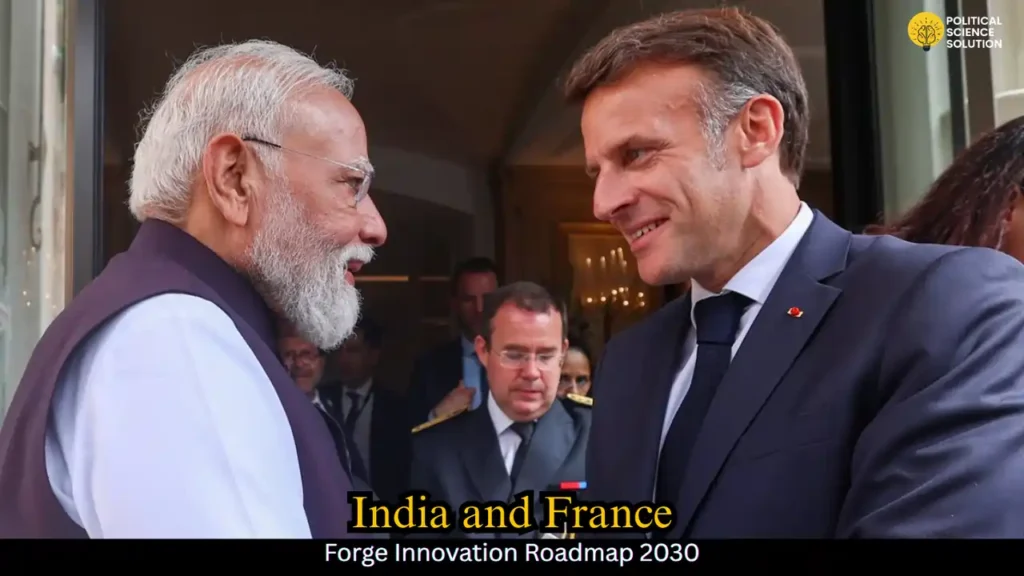
Four Strategic Pillars Driving the Innovation Roadmap 2030
The Innovation Roadmap 2030 rests on four foundational pillars designed to accelerate bilateral cooperation across critical domains:
1. Trusted AI Partnership
Rooted in the India–France Declaration on Artificial Intelligence from 2025, this pillar emphasizes the development of safe, secure, and trustworthy AI systems grounded in democratic values and human rights. Key focus areas include:
- Cooperation on interoperable, risk-based AI governance frameworks for frontier and generative AI technologies.
- Joint initiatives for online child safety, including privacy-preserving age assurance systems, safety-by-design mechanisms, and outcome-based safety standards.
- Privacy-preserving data sharing frameworks, drawing on India’s Data Empowerment and Protection Architecture (DEPA) and France’s expertise in trusted data spaces and health data platforms.
2. Enhanced People-to-People Cooperation via Academic Mobility
In line with the Horizon 2047 framework, both countries are committed to boosting student, researcher, and professional mobility. Highlights include:
- Expanding the Mutual Recognition of Qualifications (MRQ) agreement—France was the first country to sign such a pact with India in 2018—to cover more disciplines, regulated professions, and emerging tech sectors.
- Supporting France’s target of hosting 30,000 Indian students by 2030.
- New collaborations between Indian Institutes of Technology (IITs), the Indian Institute of Science (IISc), and leading French universities in student exchanges, dual-degree programs, doctoral research, entrepreneurship, sustainability, climate technologies, aerospace, AI, digital platforms, and advanced computing.
3. Technological Sovereignty and Innovation-Led Growth through Industry-Academia Linkages
This pillar strengthens collaboration among governments, industries, startups, universities, and research institutions. Major initiatives include:
- Enhanced role for CEFIPRA (Indo-French Centre for the Promotion of Advanced Research) in scientific cooperation and technology co-development.
- The India-France Innovation Network (IFIN), launched during the India-France Year of Innovation 2026, with plans for a joint steering committee.
- Establishment of the Franco-Indian Campus for Aeronautics Training and Careers in Kanpur, in partnership with India’s Ministry of Skill Development and Entrepreneurship.
- The proposed India–France InnoXchange Bridge, offering reciprocal access to research labs, technology platforms, innovation clusters, and investors for collaborative R&D, immersion programs, and startup scaling.
- Greater engagement between small and medium enterprises (SMEs) to drive innovation and employment.
4. Building AI and Research-Based Solutions for Global Challenges in Health
Focusing on consent-based, secure data-sharing architectures, this pillar builds on the pilot project between India’s Indian Council of Medical Research (ICMR) and France’s Health Data Hub (HDH). It aims to advance AI-enabled healthcare solutions, biomedical research, and public health innovation while safeguarding individual rights and complying with national laws. The Franco-Indian Campus in Life Sciences for Health will serve as a key platform.
Key Outcomes and Momentum from the Bilateral Summit in Nice
During bilateral talks in Nice on June 14, 2026, PM Modi and President Emmanuel Macron jointly inaugurated Bharat Innovates 2026, a major platform showcasing India’s deep-tech innovators and startups to global industry leaders. The leaders also elevated ties to a Special Global Strategic Partnership earlier in 2026.
Additional significant outcomes include:
- Trade and Economic Security: Agreement to establish a High-Level Mechanism to double bilateral trade within five years. Launch of a Dialogue on Economic Security to enhance supply chain resilience, particularly in critical minerals. Call for fast adoption of the India-EU Free Trade Agreement (FTA) signed earlier in 2026.
- Education: Invitation to French universities to establish campuses in India under the New Education Policy.
- Digital Payments: Expansion of Unified Payments Interface (UPI) usage in France.
- Startups: Incubation of 10 additional Indian startups at Station F, France’s premier startup campus.
- Skilling and Aerospace: MoU for a National Centre of Excellence for Skilling in Aeronautics and Allied Sectors at NSTI, Kanpur.
- Digital Sciences: Establishment of a Centre of Digital Sciences between India’s Department of Science and Technology (DST) and France’s INRIA.
- Academic Chairs: ICCR India Chair on “AI, Innovation and Culture” at Université Paris-Saclay.
- Health Research: Letter of Intent between ICMR and France’s Health Data Hub.
- Railways and High-Speed Rail: Declaration of Intent on development in India.
- Classified Information: General Security Agreement on exchange and protection.
- Space Cooperation: Letter of Intent between ISRO and CNES on microgravity research and human space exploration. Both nations will host major international space events in September, including the Bengaluru Space Expo and the International Space Summit in Paris, focusing on Earth observation and future missions.
- Signing of 19 agreements between innovation ecosystem entities.
Foreign Secretary Vikram Misri noted ongoing discussions with French power giant EDF for the long-pending Jaitapur nuclear power plant (six reactor units) and opportunities for French nuclear companies in India’s sector, including small modular reactors, under the SHANTI Act framework.
Why This Partnership Matters for Global Leadership
The India-France Innovation Roadmap 2030 represents a strategic convergence driven by technology, economic security, and shared democratic values. Both nations recognize innovation as a driver of economic resilience, sustainable development, strategic autonomy, and technological sovereignty. By pooling strengths in AI governance, academic mobility, aerospace training, health data innovation, space exploration, and startup ecosystems, India and France aim to unlock mutual potential while contributing solutions to worldwide challenges such as climate change, public health, and digital safety.
This partnership extends beyond traditional defense and diplomatic ties into future-oriented sectors. It creates tangible opportunities for businesses, researchers, students, and startups while reinforcing resilient supply chains in critical areas. The focus on privacy-preserving frameworks, child online safety, and consent-based data sharing sets a responsible benchmark for global tech collaboration.
PM Modi’s Europe visit, which continued from Nice to Vienna and Bratislava, underscores India’s proactive engagement in strengthening multilateral and bilateral innovation alliances.
As the world navigates rapid technological disruption, the India-France model offers a blueprint for trusted, values-based partnerships that prioritize human-centric innovation. With 13 key outcomes announced and a clear 2030 roadmap, this collaboration is poised to deliver long-term dividends for both nations and the global community.
The coming years will witness accelerated implementation through joint working groups, campus establishments, innovation bridges, and high-level mechanisms. Stakeholders across academia, industry, and government are expected to benefit immensely from this deepened strategic convergence.
FAQs
1. What is the India-France Innovation Roadmap 2030 and why was it adopted?
The India-France Innovation Roadmap 2030 is a comprehensive long-term framework adopted on June 14, 2026, during Prime Minister Narendra Modi’s visit to France and bilateral talks with President Emmanuel Macron in Nice. It aims to deepen cooperation in artificial intelligence (AI), research, education, innovation, startups, healthcare, space, and emerging technologies. The roadmap builds on the Horizon 2047 framework and supports India’s Viksit Bharat 2047 vision and France’s France 2030 ambitions. It focuses on innovation as a driver of economic resilience, sustainable development, strategic autonomy, and technological sovereignty.
2. What are the four main pillars of the India-France Innovation Roadmap 2030?
The roadmap is structured around four key pillars:
- Trusted AI Partnership: Focuses on safe, secure, trustworthy AI systems, online child safety, and privacy-preserving data sharing (drawing on India’s DEPA and France’s health data platforms).
- Enhanced People-to-People Cooperation via Academic Mobility: Expands student and researcher exchanges, supports France’s goal of hosting 30,000 Indian students by 2030, and broadens the Mutual Recognition of Qualifications (MRQ) agreement.
- Technological Sovereignty and Innovation-Led Growth: Strengthens industry-academia linkages through CEFIPRA, IFIN, the Franco-Indian Campus for Aeronautics in Kanpur, and the India-France InnoXchange Bridge.
- AI and Research-Based Solutions for Global Health Challenges: Promotes consent-based data sharing via ICMR and France’s Health Data Hub collaborations.
3. What are the major outcomes and agreements from the India-France summit in Nice?
Key outcomes include the adoption of the Innovation Roadmap 2030, creation of a Joint India-France AI Working Group, establishment of a High-Level Mechanism to double bilateral trade in five years, launch of the Economic Security Dialogue, and inauguration of Bharat Innovates 2026. Other highlights are: expansion of UPI in France, incubation of 10 Indian startups at Station F, a new Centre of Excellence for Aeronautics skilling in Kanpur, a Centre of Digital Sciences (DST-INRIA), an ICCR Chair at Université Paris-Saclay, railway cooperation, space agreements (ISRO-CNES), and 19 bilateral agreements in innovation ecosystems. Discussions also covered the Jaitapur nuclear project and French university campuses in India.
4. How will the Innovation Roadmap 2030 benefit students, startups, and researchers?
Students benefit from expanded academic mobility, more dual-degree programs, broader MRQ recognition, and new campuses. Startups gain through IFIN, the InnoXchange Bridge, incubation at Station F, and SME collaboration. Researchers and institutions will access joint programs via CEFIPRA, shared labs, the Franco-Indian Campus in Life Sciences, and initiatives in AI, aerospace, health data, climate technologies, and space exploration. Overall, it creates opportunities for talent exchange, innovation funding, and cross-border projects aligned with democratic values and responsible tech development.
5. How does the India-France partnership address global challenges like AI governance and supply chain resilience?
The partnership emphasizes responsible AI governance with risk-based approaches, child safety standards, and privacy protections. It promotes supply chain resilience through the Economic Security Dialogue, especially in critical minerals, and supports sustainable development via health innovation, climate tech, and space cooperation. Both countries advocate for the early implementation of the India-EU FTA and stronger economic security measures, positioning the bilateral relationship as a model for trusted, values-driven international collaboration in technology and innovation.